































































































































“The technical knowledge and insight given to us by the Bloomreach team has been top notch. We really had the feeling that Bloomreach wanted this project to be as successful as we did here at N Brown.”
No theory. Just real campaigns, real results, and real marketers sharing what actually moved the needle. Get inspired by brands like yours — and start turning ideas into impact.
The Challenge
With a lean marketing team, an audience of diverse fandoms, and dozens of product drops every month, Sideshow needed a faster, more relevant way to launch campaigns.
The Challenge
UK’s leading online holiday package company, On The Beach offers fully customizable travel packages – mixing flights, hotels, dates, and more – giving customers complete flexibility. However, this makes personalized marketing a real challenge for On The Beach.
The Challenge
Hobbycraft‘s ecommerce journey hit a wall with their previous rule-based search solution that couldn’t handle the vibrant complexity of their 27,000+ SKU universe spanning dozens of creative verticals, resulting in:
The Challenge
TFG was aware of recent advancements in AI technology that would open up new ways to connect with customers. However, since conversational AI is still a new technology, TFG had concerns:
Despite its strong offline success, Wolseley encountered significant challenges as it worked to transform its digital product discovery experience online. Operating across the UK and Ireland with a massive catalog of 500,000 products — including 300,000 available online — Wolseley struggled to deliver accurate, segment-specific search results for its varied professional audiences in plumbing, HVAC, building services, and infrastructure, which would help the brand cater to a new generation of buyers.
Here’s what Wolseley was up against:
Global Industrial started as a small material handling company when it was birthed in 1949 and has transformed into a B2B industry-leading distributor with over 1.7 million products in 21 industrial and commercial categories.
But just as Global Industrial differentiated itself in its first 70+ years of business, the company wanted to differentiate itself in the thought leadership realm as well. It wanted to create a platform to generate and distribute educational content to customers that could empower them with the resources they needed to be successful with Global Industrial products and to better understand the marketplace at large.
Global Industrial’s challenge? A product-focused and product-led website experience as well as a homegrown website platform that offered little flexibility for expanding content storytelling. Stack that on top of an increasingly competitive digital commerce marketplace and all of these factors left little room for differentiation in an already crowded space.
Not only was MKM’s tech stack reaching its end of life, but the company was also highly aware of the issues surrounding its website — from slow load times and costly maintenance protocols to its digital experience being a subpar reflection of its stellar in-person experience. MKM recognized that the industry was changing, and within the next five to seven years, 45% of its current customer base would be retiring. Therefore, the business needed to lean into the “expectation economy,” or the idea that consumers, especially those who identify as millennials and Gen-Z, have greater expectations than ever around every purchase decision.
The wholesaler also needed to address that its website only accounted for a limited amount of its business revenue. Additionally, MKM did not want the website experience to continue to reflect poorly on them as a provider of much-needed products and services and leave a potential channel of revenue untapped. The brand was also concerned about its website being the first touchpoint in the buyer’s journey, since it may deter a prospect from visiting one of its branches.
Finally, the existing website had no way to provide cohesive reporting, customer relationship management (CRM), or personalization. All of the product data was siloed, too — meaning that there was no single source of truth. Essentially, these shortcomings left MKM in a serious bind. The company had no way to evaluate the marketing and merchandising tactics that were working, differentiate customer and buyer types from one another, or ensure customer lifetime value.
STAUFF openly admitted that it had quite a few business challenges to overcome while attempting to rev up its digital transformation initiative. The company was aware that new technology was needed, but they didn’t have an in-house development team, and in turn, had no idea where to begin the nuanced and complex transformation process. As its customers continued to expect manufacturing partners — like STAUFF — to be easy to do business with and personalize buying experiences, the B2B brand could no longer put their expectations on hold.
These customer expectations were as vast as they were varied. For instance, its maintenance, repair, and operations (MRO) customers wanted real-time order status information (e.g., tracking) and instant checkout without any barriers, while the distributors STAUFF worked closely with were seeking quick-order functionality for large quantity orders and seamless access to partner assets.
Finally, its original equipment manufacturers (OEM) customers now preferred cohesive technical consulting interfaces with rapid prototyping services. The various customer necessities combined with the company’s pain points quickly accelerated STAUFF’s need to digitally innovate efficiently and effectively.
HellermannTyton was in search of a new Content Management System (CMS), as its former system did not have the capabilities to support such an ambitious digital communication strategy. It was looking for a solution that could help support its efforts to personalize content for its loyal customers.
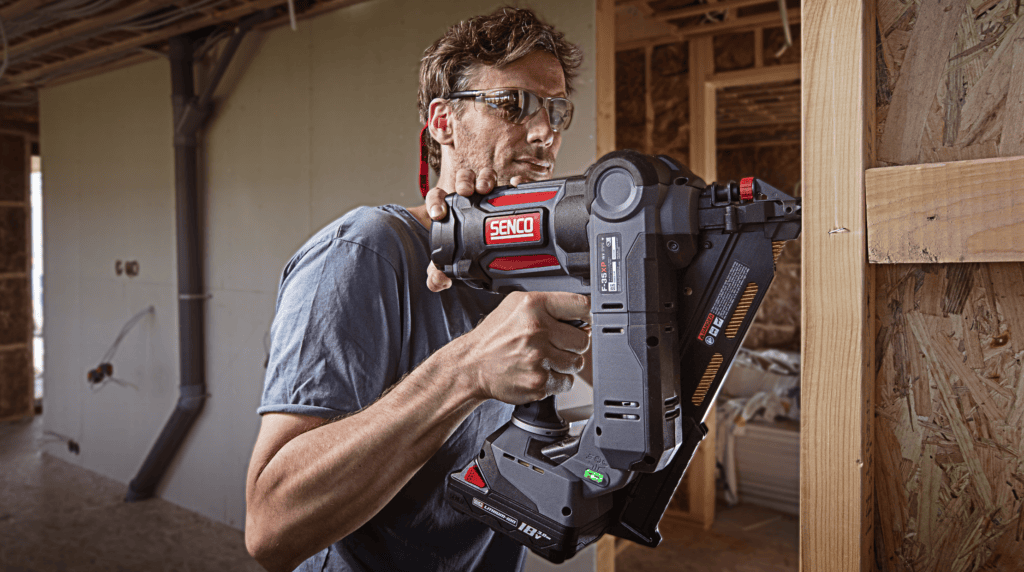
Kyocera SENCO is a wholesaler selling SENCO products worldwide. It operates in a traditional B2B market, but finds itself in a niche product market as it focuses mainly on fastening solutions.
As digital commerce soared and B2B buyers began to look online for their products, Kyocera SENCO needed to create a digital experience that would suit its buyers’ needs and drive revenue. It needed to innovate its digital presence because it no longer wanted to rely solely on the traditional B2B way of selling products through partners and dealers.
That meant investing in digital branding, increasing its online presence, and making an effort to create personalized content for customers. The company began to notice that its brand was important not only to the dealers it was selling its products directly to, but the end users that the dealers were in business with as well.
That made tapping into the partnership between SQLI Digital Experience and Bloomreach to reach more customers and promote future growth even more important.
“The technical knowledge and insight given to us by the Bloomreach team has been top notch. We really had the feeling that Bloomreach wanted this project to be as successful as we did here at N Brown.”
“The technical integration with Bloomreach was easy and seamless. Bloomreach offers enough tools and services to be that one consistent ‘brain’ behind the website operation. Bloomreach can help the customer journey be flawless across the entire web experience.”
“Having higher quality data allows you to communicate in a better way with your customers. The ultimate goal is to use the data we have collected to offer our customers the best possible experience.”
“When we first demoed Bloomreach Engagement, our tech team, data team, and marketing team were all really excited by the platform’s capabilities. It was very clear to us how easy the platform is to use and how we could leverage its features to achieve the goals of all of our stakeholders.”
Yeo Valley Organic wanted to strengthen its community-focused appeal beyond supermarket shelves while rewarding customers who choose organic products. However, its existing loyalty approach wasn’t maximizing engagement or business impact.
The brand needed a platform that could deliver its unique “Farm to Fridge” experience digitally while maintaining its core values of fun, inclusivity, and community support.
Marine retailer Defender found that it was seeing great in-store success, but now needed to find a way to expand that success online. To achieve this, Defender knew it needed to address several key obstacles with its online experience:
With a wide range of products and a customer base that spans different age groups, languages, and shopping preferences, Patrick Morin recognized that its on-site experience needed to be both accurate and intuitive to keep pace with the expectations of shoppers. The brand also had to balance operational efficiency with the ability to deliver personalized experiences at scale and better accommodate customers in the fluid home renovation market.
However, Patrick Morin’s tech setup created several roadblocks:
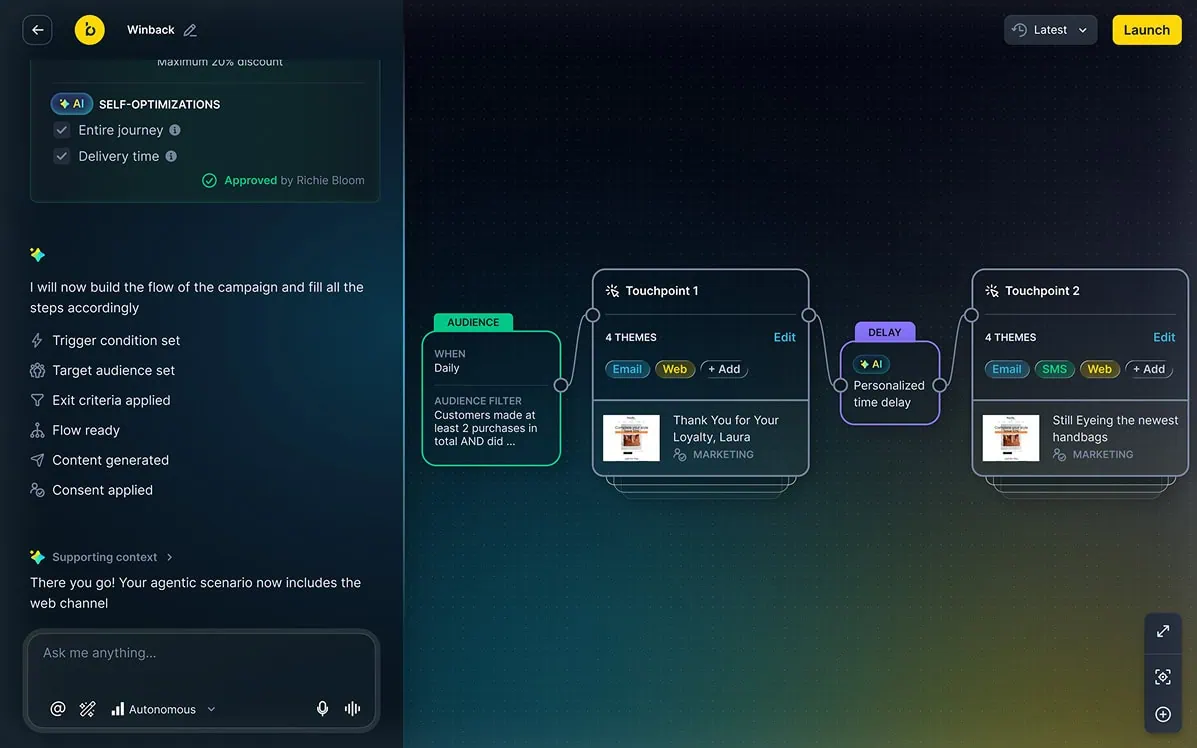
With real-time data and AI fueling every campaign, you can unlock the next level of customer experience.