


















































































































































































No theory. Just real campaigns, real results, and real marketers sharing what actually moved the needle. Get inspired by brands like yours — and start turning ideas into impact.
The Challenge
With a lean marketing team, an audience of diverse fandoms, and dozens of product drops every month, Sideshow needed a faster, more relevant way to launch campaigns.
The Challenge
UK’s leading online holiday package company, On The Beach offers fully customizable travel packages – mixing flights, hotels, dates, and more – giving customers complete flexibility. However, this makes personalized marketing a real challenge for On The Beach.
The Challenge
Hobbycraft‘s ecommerce journey hit a wall with their previous rule-based search solution that couldn’t handle the vibrant complexity of their 27,000+ SKU universe spanning dozens of creative verticals, resulting in:
The Challenge
TFG was aware of recent advancements in AI technology that would open up new ways to connect with customers. However, since conversational AI is still a new technology, TFG had concerns:
The River Island marketing team was looking for a way to fine tune its email program. Specifically, the team wanted to improve domain reputation and build trust in the brand by offering a good customer communication experience. The team wanted to accomplish these goals while not losing revenue from email.
Sending too many emails to inactive customers can annoy them and lead to high unsubscribe rates — which can negatively impact your email deliverability. At the same time, sending too few emails to loyal customers could lead to a drop in revenue. The team needed to find that sweet spot of sending the right amount of emails to the right customer.
Whisker’s challenge was a familiar one for many digital commerce companies: creating a consistent and impressionable marketing message that guides users all the way through the customer journey, from awareness to satisfied purchase.
To craft a personalized experience for its customers, Whisker needed to connect its marketing channels and access all its user behavior in one place — a single customer view — which its previous marketing solution didn’t allow for. This left Whisker’s data siloed and its marketing team unable to craft a persistent message through each customer’s journey.
With so many different customers and such a large variety of products, Notino recognized the importance of personalizing their marketing efforts. Weaving together multiple touchpoints with the insights gained from each customer’s interaction was a top priority for the company, and bringing all their valuable data together in one place was essential for their goals.
The online beauty store is committed to offering omnichannel communications to their audience fueled by a data-driven platform, which is why they consistently rely on Bloomreach’s agentic personalization platform, Loomi AI, to personalize their customer experiences.
In late 2022, Bensons for Beds expanded its brand portfolio by acquiring the IP for eve Sleep, a pioneer of luxury sleep solutions. The challenge for eve immediately after the acquisition was trying to experience similar successes that parent company Bensons for Beds was having with Bloomreach Engagement.
That meant creating a new Shopify website for eve and making tweaks to the brand and creative content to widen its appeal across a diverse customer base. More importantly, it also meant getting eve up and running with Bloomreach’s agentic personalization platform, Loomi AI, as fast as possible to begin using previously collected customer data for marketing campaigns.
What exactly would that entail? Warming up a new IP and putting that collected customer data to work so marketing automation campaigns like abandoned browse, abandoned cart, and other personalized email marketing campaigns could begin being sent — all as fast as possible so that Bensons for Beds could begin creating personalized experiences for its new database of eve Sleep customers.
Tamaris had successfully launched a digital sales strategy, but increasing purchase frequency among existing customers remained a key challenge. Without a unified view of customer behavior across channels and touchpoints, the brand couldn’t identify why customers disengaged or how to bring them back.
Fragmented customer data across disconnected systems = no clear picture of purchase patterns or engagement. Customer information lived in separate platforms: ecommerce, retail point-of-sale, email marketing, and customer service systems. This siloed architecture made it impossible to understand a customer’s complete journey or identify signals that indicated re-engagement or cross-sell opportunities.
Low repeat purchase frequency = limited customer lifetime value despite strong acquisition. While Tamaris successfully attracted new customers through digital channels, driving those customers back for a second and third purchase proved difficult. Without visibility into post-purchase behavior or the ability to segment based on engagement patterns, marketing teams sent generic campaigns that struggled to drive repeat purchases.
No framework for proactive reengagement = reactive marketing that missed critical intervention moments. The brand couldn’t easily identify when customers were at risk of disengaging or what specific actions would reengage them. By the time marketing teams recognized a customer had lapsed, it was often too late to win them back cost-effectively.
Complex multi-country rollout requirements = need for scalable solution across 13 markets. Tamaris operates across multiple European countries, each with different customer preferences, languages, and regulatory requirements. Any solution needed to work consistently across all markets while allowing for local customization — a challenge that existing fragmented systems couldn’t support.
As Hobbycraft doubled down its approach to product discovery, the well-loved UK brand recognized that shifting shopper behavior was creating both a challenge and an opportunity for its digital merchandising strategy.
With long-tail, intent-rich queries up 10%, Hobbycraft saw an opportunity to better serve these high-intent shoppers while continuing to support the casual browsers who make up the majority of the company’s web traffic.
But meeting these evolving expectations also exposed several operational challenges:
Flaschenpost.ch lost sales potential due to abandoned purchases in its web shop. Customers who were ready to buy added wines to their shopping carts but left the checkout before completing their purchases — a critical pain point for an ecommerce model that relies on convenience, inspiration, and repeat purchases.
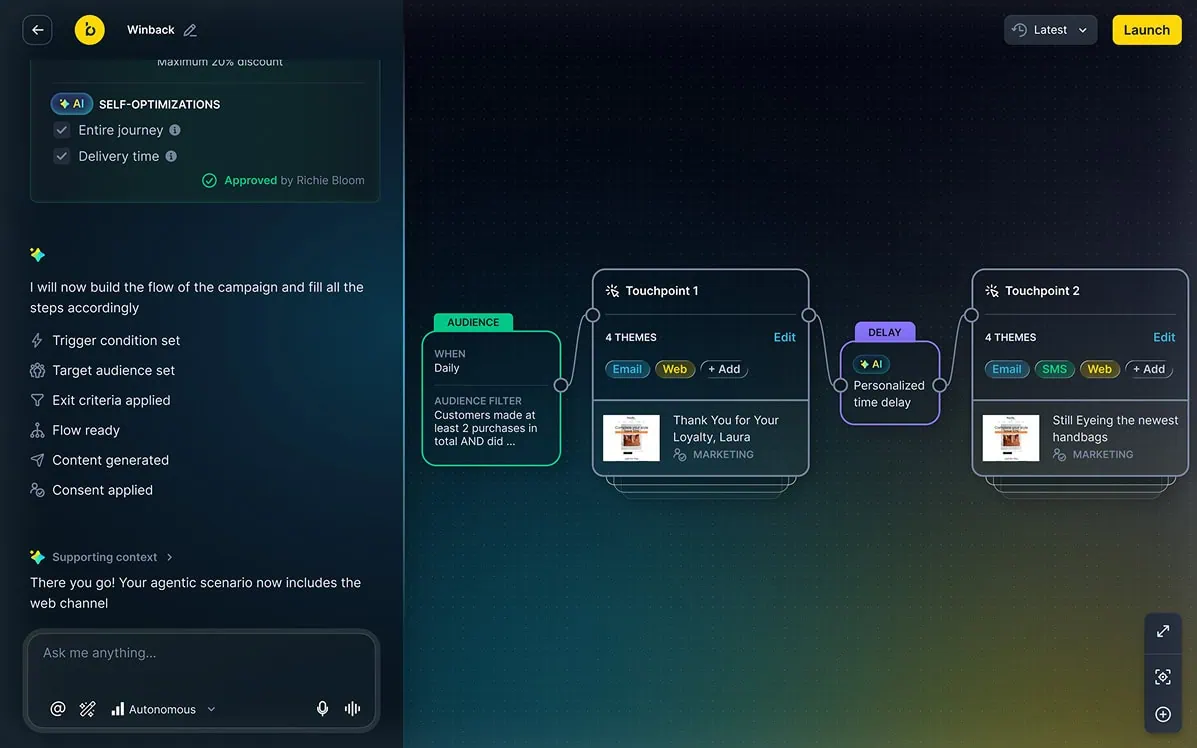
With real-time data and AI fueling every campaign, you can unlock the next level of customer experience.