

Email Marketing Platform RFP Template
82 Questions To Evaluate Vendors
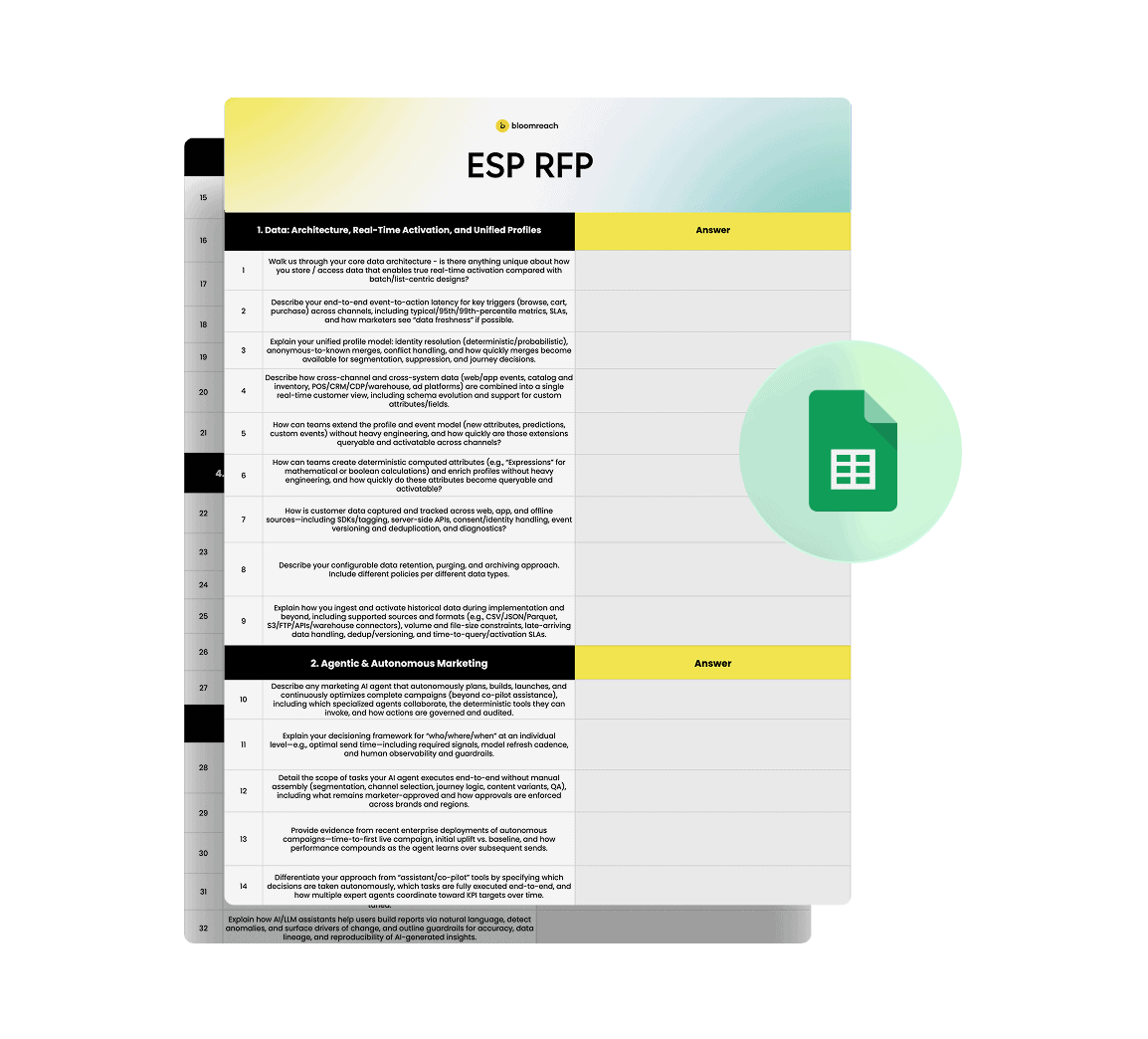
The complete evaluation framework for enterprise marketing teams selecting modern email and cross-channel platforms. This template covers real-time architecture, AI capabilities, orchestration, and deliverability at scale.
Last updated: February 2026
Download Free RFP Template
What This RFP Template Includes
This email marketing platform RFP contains 82 detailed questions across 12 capability areas, and is designed for enterprise teams evaluating platforms like Bloomreach, Salesforce Marketing Cloud, Braze, Iterable, Klaviyo, and similar solutions.
The template helps distinguish modern real-time platforms from legacy batch-processing systems by testing:
- Event-to-action latency (real-time vs. hourly batch jobs)
- Autonomous AI agents vs. co-pilot tools
- True cross-channel orchestration vs. parallel campaigns
- Deliverability infrastructure at enterprise scale (100M+ sends)
Format: Google Sheets | License: Free for commercial use
The 12 Evaluation Categories
1. Real-Time Data Architecture
Event-to-action latency, identity resolution, profile unification, schema evolution, data capture, retention policies
Tests: Can it activate on behavior in seconds vs. hours?
2. Agentic & Autonomous Marketing
AI agents that plan/execute campaigns, individual decisioning, deployment evidence, autonomous vs. co-pilot differentiation
Tests: Does the platform use true automation vs. co-pilot suggestions?
3. AI & Machine Learning
Propensity models, variant selection per recipient, product recommendations, content generation, segment discovery
Tests: Does the platform have real AI personalization vs. feature checkboxes?
4. Cross-Channel Orchestration
Journey building across email/SMS/push/WhatsApp, real-time triggers, frequency capping, arbitration, non-native channel integration
Tests: Is there unified orchestration vs. separate channel tools?
5. Analytics & Reporting
Real-time dashboards, attribution, segment activation, data refresh rates, visualization types, AI-assisted insights
Tests: Does it feature self-service insights or data team dependencies?
6. Content & Personalization
Dynamic rendering, contextual elements, brand governance, QA safeguards, personalization logic, module reusability
Tests: Is there marketer-friendly personalization at scale?
7. Testing & Optimization
A/B testing, multivariate, bandits, send-time optimization, winner operationalization, AI-driven optimization
Tests: What is the experimentation accessibility and learning velocity?
8. Deliverability & Infrastructure
MTA architecture, throughput at scale, throttling, reputation monitoring, services team, IP/domain strategy
Tests: What does inbox placement look like during 100M+ send peaks?
9. Implementation & Migration
Phased migration plans, team roles, IP warm-up, data migration, training, QA frameworks, consent enforcement
Tests: What are the realistic timelines and resource requirements of the platform?
10. Integrations Ecosystem
Marketplace connectors, data warehouse integrations, API/SDK capabilities, marketer-friendly configuration
Tests: How many prebuilt use cases are there vs. having to resort to custom integration?
11. Governance & Multi-Brand Support
Multi-brand hierarchy, role-based access, localization, content governance, approval workflows, global policies
Tests: Are there enterprise-scale permissions and compliance?
12. Privacy & Data Protection
Consent management, legal requirements, data subject requests, subprocessors, incident response, opt-in provenance
Tests: What is the GDPR/CCPA/CASL compliance depth?
How To Use This Template
Migration & Platform Selection Scenarios
If you're outgrowing entry-level ESPs and need enterprise capabilities:
Start with: Data Architecture (Q1-9) — Test if they can handle real-time activation vs. batch processing.
- Request specific event-to-action latency metrics (Q2)
- Validate identity resolution approach (Q3) — entry-level ESPs use simple email matching
Then review: AI & Machine Learning (Q15-21) — Validate advanced personalization beyond basic merge tags.
- Test autonomous AI agents (Q10-14) vs. simple automation rules
- Compare product recommendation engines (Q17)
Don't skip: Infrastructure (Q48-53) — Ensure they can scale beyond your current 10-50M sends.
- Validate throughput during peak periods (Q48-49)
- Confirm deliverability support depth (Q52-53)
Why it matters: Entry-level ESPs run on batch/list models. You need proof that the new platform processes events in real time (<5 seconds), not hourly exports.
If you're leaving legacy enterprise platforms for modern alternatives:
Critical focus: Data Architecture (Q2-3, Q9) — Compare event-to-action latency, since legacy platforms often have delays between 15 minutes and 2 hours.
- Test a unified profile model (Q3) vs. SFMC's multiple subscriber models
- Validate historical data ingestion (Q9, Q62)
Validation test: Agentic AI (Q10-14) — Distinguish autonomous AI from something like Salesforce Einstein's predictive scores, which still require manual campaign builds.
- Request deployment evidence (Q13)
- Compare decisioning frameworks (Q11)
Cost analysis: Infrastructure (Q48-53) + Implementation (Q54-59) — Legacy platforms charge per module, so you should validate the total cost of ownership.
- Factor in professional services vs. self-service capabilities
Why it matters: Legacy platforms brand "AI" but require extensive manual setup. Test for autonomous execution, not just prediction scores.
If you're managing Mailchimp + Segment + Attentive + multiple analytics tools:
Priority 1: Data Architecture (Q1, Q3-4) — How do they unify profiles without requiring an external CDP?
- Validate identity resolution approach (Q3)
- Test cross-channel data combination (Q4)
- Confirm schema evolution support (Q5)
Priority 2: Cross-Channel Orchestration (Q22-24, Q26) — Test real unified orchestration vs. API stitching between tools.
- Validate single-canvas journey building (Q22)
- Confirm global frequency caps across channels (Q24)
- Test cross-journey arbitration (Q26)
Priority 3: Analytics (Q28-30, Q33) — Validate cross-channel reporting without reverse ETL.
- Test real-time dashboard refresh (Q28)
- Confirm cross-channel stitching (Q33)
Why it matters: True unification means one platform, one profile, one set of frequency caps — not five tools with Zapier connections.
If you're reevaluating your current modern ESP:
Competitive focus: Agentic AI (Q10-14) — Most competitors offer co-pilots; test for full autonomous execution.
- Request evidence of autonomous campaign planning and execution (Q10, Q12-13)
- Differentiate from assistant tools (Q14)
Differentiation test: AI & ML (Q15-17, Q20) — Compare real-time variant selection approaches and auto-segmentation depth.
- Test per-recipient optimization (Q16)
- Validate auto-segment discovery (Q20)
- Compare propensity models (Q15)
TCO analysis: Infrastructure (Q48-53) + pricing in FAQ section — Modern ESPs vary widely on volume tier pricing jumps.
- Understand concurrent send capacity (Q48)
- Factor in deliverability services (Q53)
Why it matters: Modern platforms look similar on feature sheets. Real differences emerge in AI autonomy level, latency, and pricing inflection points.
If you run Shopify or Shopify Plus stores:
Prebuilt connector: Integrations & Ecosystem (Q63) — Understand the depth of the native Shopify integration.
- Test real-time order sync (Q63)
- Validate catalog/inventory sync (Q63)
- Confirm customer profile merging (Q3)
Ecommerce data model: Data Architecture (Q3-4) — Evaluate orders, line items, products, collections, variants, and inventory.
- Test product catalog integration (Q4)
- Validate inventory-aware personalization (Q37)
- Confirm cart abandonment triggers (Q23)
Shopify-specific features: Content & Personalization (Q35-37) — Look into product blocks, discount codes, and inventory checks.
- Test dynamic product rendering (Q36-37)
- Validate Shopify metafield support (Q4-5)
- Confirm discount code generation (Q66)
Why it matters: A generic ESP + Shopify via Zapier creates delays. A native integration should sync orders in seconds, not minutes or hours.
If you've outgrown internal tools and need enterprise capabilities:
Migration complexity: Implementation (Q54-62) — Understand the data migration and cutover approach.
- Validate support for custom data schemas (Q4-5)
- Test API/SDK flexibility for existing integrations (Q66)
- Confirm parallel run capabilities (Q54)
Feature parity: All categories — Systematically validate each capability your team built.
- Real-time triggers and webhooks (Q22-23, Q25)
- Custom computed attributes (Q6)
- Flexible segmentation (Q34)
Integration continuity: Integrations & Ecosystem (Q63-67) — Ensure that existing integrations can be maintained.
- Test REST/GraphQL API depth (Q66)
- Validate webhook support for custom systems (Q25)
- Confirm data warehouse connectivity (Q64)
Why it matters: Custom stacks often have unique capabilities you've built over years. Ensure that the platform can replicate or exceed these without regression.
Industry-Specific Use Cases
If you sell fashion, beauty and cosmetics, or food and beverage/CPG products with high SKU counts, fast-moving trends, or replenishment cycles:
Must validate: Content & Personalization (Q35-37, Q39) — How do product recommendations handle real-time inventory and trending items?
- Test contextual elements for inventory (Q37)
- Validate schema evolution for new product attributes (Q39)
- Confirm open-time rendering for real-time prices (Q37)
Critical for BFCM: Infrastructure (Q48-49, Q51) — Can they handle 50-100M sends on Black Friday with personalized product grids?
- Request peak throughput metrics (Q48)
- Test render performance for complex product layouts (Q51)
- Validate spike handling (Q49)
Revenue driver: AI & ML (Q17) — Test dynamic product recommendation logic: collaborative filtering, trending, back-in-stock.
- Confirm catalog feed integration (Q4)
- Test cold-start handling for new products (Q17)
- Validate fallback logic (Q17)
Why it matters: Fast-fashion recs go stale in days, beauty needs hyper-personalized filtering, and wrong replenishment timing = unsubscribe — all three require real-time decisioning, not batch processing.
If you sell home and furniture, electronics, or jewelry and luxury products with long research cycles and high purchase values:
Journey focus: Cross-Channel Orchestration (Q22-23, Q26) — Multi-touch nurture over weeks/months across email, SMS, and retargeting.
- Test long-running journey support (Q22)
- Validate event trigger flexibility (Q23)
- Confirm cross-journey orchestration (Q26)
Attribution needs: Analytics (Q31, Q33) — Track the full customer journey from browse to purchase across 10+ touchpoints.
- Test attribution model flexibility (Q31)
- Validate cross-channel stitching (Q33)
- Confirm lookback windows (Q31)
Personalization: Content (Q35-36) — Evaluate style-based dynamic content blocks.
- Test conditional rendering (Q35-36)
- Validate profile attribute depth (Q3-4)
- Confirm module reusability (Q38)
Why it matters: Furniture buyers research 3-6 weeks across 10+ touchpoints, tech buyers compare specs across multiple products, and over-messaging luxury customers after a $5K purchase kills lifetime value — all require sophisticated attribution and frequency management, not last-click reporting.
If you operate hotels, airlines, tours, or travel services:
Time-sensitive triggers: Cross-Channel Orchestration (Q22-23) — This includes flight changes, booking confirmations, check-in reminders, and weather alerts.
- Test real-time event ingestion (Q2, Q7)
- Validate sub-second trigger latency (Q23)
- Confirm contextual triggers (Q23)
Location-based personalization: Content & Personalization (Q37) — This includes local recommendations, weather, events, and store hours.
- Test geospatial segmentation (Q34)
- Validate contextual element timing (Q37)
- Confirm external data integration (Q37)
Itinerary management: Data Architecture (Q4, Q6) — This includes complex booking data, multi-leg trips, and companion travelers.
- Test relational data modeling (Q3-4)
- Validate computed attributes for trip summaries (Q6)
- Confirm PII handling (Q77)
Why it matters: Travel requires sub-minute trigger latency for flight changes and location-aware content. Test real-time event processing, not batch jobs.
If you operate online gaming, sportsbook, betting, or casino platforms:
Responsible gaming: Governance & Privacy (Q69-82) — Implement deposit limits, self-exclusion, cool-off periods, and play-time warnings.
- Test global policy enforcement (Q74)
- Validate consent management (Q77-78)
- Confirm suppression logic (Q24)
Real-time behavioral triggers: Cross-Channel Orchestration (Q22-23) + Data (Q2) — Useful for in-play betting, live event updates, and session-based offers.
- Test millisecond-latency triggers (Q2)
- Validate real-time segmentation (Q34)
- Confirm API performance (Q66)
Regional compliance: Governance (Q69, Q76) + Privacy (Q78) — This includes market-specific rules, age verification, and advertising restrictions.
- Test multi-region data residency (Q76)
- Validate locale-based policy rules (Q78)
- Confirm audit trails (Q70)
Why it matters: iGaming faces strict regulations and requires real-time engagement. Test compliance-first architecture and sub-second event processing.
If you operate teams, leagues, venues, or sporting events:
Event-driven campaigns: Cross-Channel Orchestration (Q22-23) — Implement game-day sequences, score updates, ticket availability, and merchandise drops.
- Test real-time event triggers (Q23)
- Validate multi-channel coordination (Q22)
- Confirm contextual timing (Q23)
Membership & ticketing: Data Architecture (Q3-4) — Data on season ticket holders, loyalty tiers, seating preferences, and renewal cycles.
- Test identity resolution across systems (Q3)
- Validate CRM integration (Q4, Q63)
- Confirm subscription management (Q77)
Spike handling: Infrastructure (Q48-49) — This includes championship announcements, playoff ticket releases, and breaking news.
- Test sudden volume spikes (Q49)
- Validate concurrent send capacity (Q48)
- Confirm throttling strategies (Q49)
Why it matters: Sports marketing is event-driven with unpredictable spikes. Test real-time triggers and infrastructure that scales instantly.
If you operate banking, insurance, investing, or fintech:
Compliance & governance: Privacy & Data Protection (Q77-82) + Governance (Q69-76) — This includes GLBA, PCI-DSS, SOC 2, and regional regulations.
- Test data subject request handling (Q79)
- Validate subprocessor vetting (Q80)
- Confirm encryption and access controls (Q70, Q80)
Lifecycle campaigns: Cross-Channel Orchestration (Q22-26) — This is for onboarding, product education, renewal, fraud alerts, and account notifications.
- Test sophisticated journey logic (Q22)
- Validate real-time triggers (Q23)
- Confirm suppression for servicing contacts (Q24)
Personalized recommendations: AI & ML (Q15-17, Q20) — Test product propensity, next-best-action, and portfolio optimization.
- Test propensity models (Q15)
- Validate real-time decisioning (Q11)
- Confirm explainability for compliance (Q18, Q21)
Why it matters: Financial services face strict compliance with severe penalties. Test governance controls, audit trails, and data protection depth.
If you provide B2C or B2B services (telecom, utilities, SaaS, professional services):
Account-based orchestration: Data Architecture (Q3-4) — Data on household/company accounts, multi-user relationships, and billing hierarchies.
- Test relational profile modeling (Q3)
- Validate cross-system data (Q4)
- Confirm role-based access (Q70)
Service lifecycle: Cross-Channel Orchestration (Q22-23) — This includes onboarding, usage milestones, renewals, churn prevention, and service notifications.
- Test long-running journeys (Q22)
- Validate diverse trigger types (Q23)
- Confirm eligibility logic (Q24)
Behavioral scoring: AI & ML (Q15, Q20) — Track engagement scores, churn risk, expansion propensity, and health indicators.
- Test propensity models (Q15)
- Validate auto-segmentation (Q20)
- Confirm computed attributes (Q6)
Why it matters: Service businesses need account-level orchestration and long-term relationship management. Test beyond transactional ecommerce use cases.
Download
the Complete
RFP Template
What’s included:
- 82 detailed questions with context
- Vendor comparison matrix with scoring rubric
- Red flags and evaluation guidance
- Use case prioritization