
Product taxonomy is the classification system that organizes your entire product catalog, and it quietly determines whether customers find what they want or leave. Most ecommerce teams don’t think seriously about it until something breaks: a site migration scrambles category structure, a feed syndication fails because attribute names don’t match retailer requirements, or site search starts returning irrelevant results for high-intent queries.
At its most basic, product taxonomy is a hierarchical system for classifying products into categories and subcategories, defining the attributes that describe them, and establishing the relationships between them. It’s the connective tissue between your catalog, your customers, and every channel you sell through. When it’s wrong, the problems compound across conversion rate, SEO, and operational efficiency all at once.
This guide covers the types of product taxonomy, their core components, real-world examples, best practices for building and maintaining them, and how AI is changing taxonomy work.
What Is Product Taxonomy?
Product taxonomy is a structure to organize everything in your product catalog in a logical way so that customers can find what they want in the fewest clicks possible.
Generally, they work as a product hierarchy that puts products into categories, and tags are used to group products into each category. Additional product data, such as attributes (e.g., color or size) are then applied to the items in each product category.
Here’s an example of a basic product taxonomy structure:
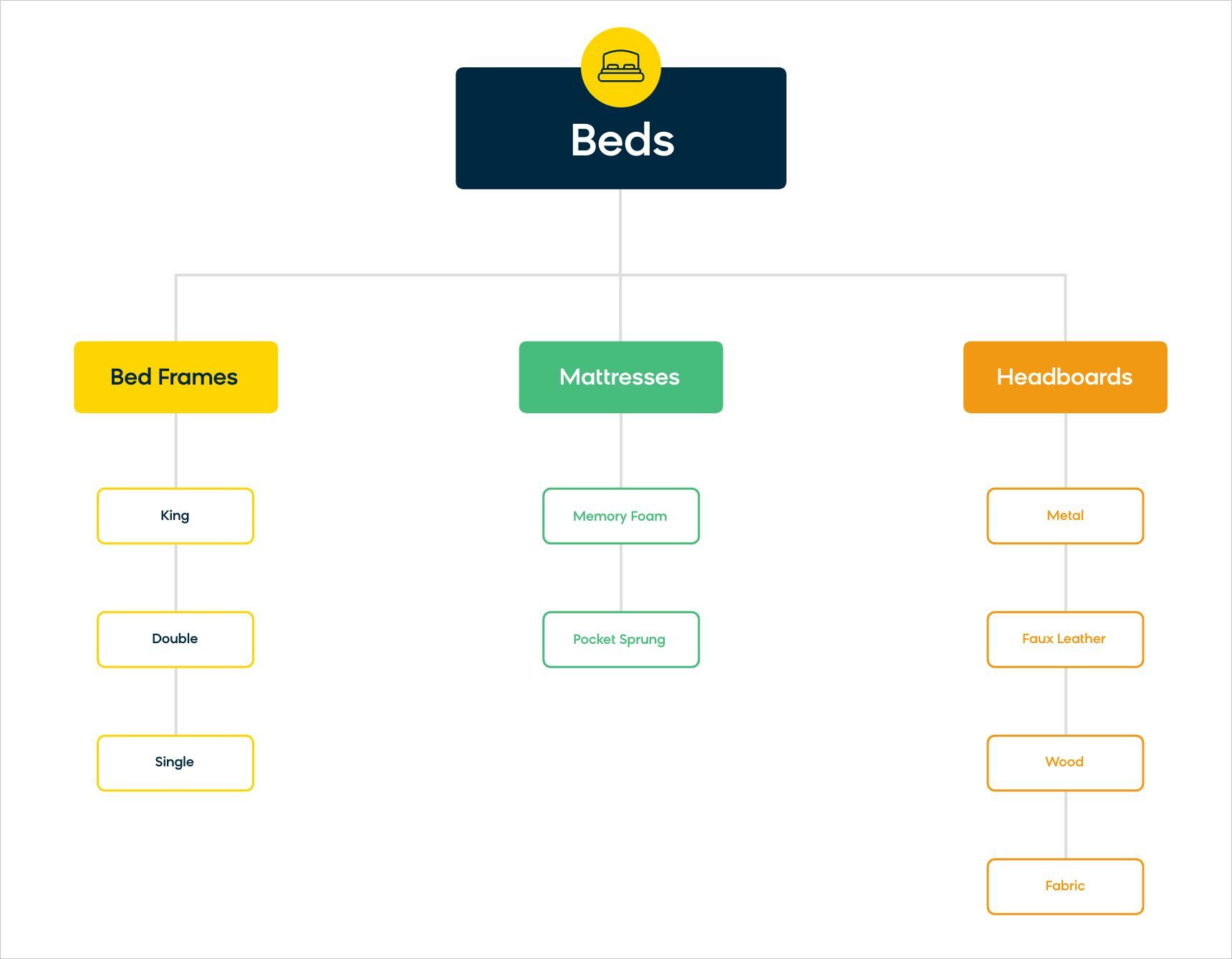
The end result is that customers can move easily through all levels to find exactly what they want.
Multiple independent taxonomies can also be overlaid for different views on the same data. For example, in a database of music, a product could be found via genre or record label.
When the right product shows up in a search, it’s much more likely that it’ll result in a purchase. Product taxonomy organizes everything in the background to make that happen.
Why Is Product Taxonomy Important?
If you optimize your ecommerce site with a well-organized product taxonomy, you’ll be able to provide a better shopping experience that your customers can intuitively navigate. It all comes down to customer behavior: Imagine a customer searching the “Fresh Food” category to find bread. They come up empty-handed, as that product is only found in the “Bakery” category.
With limited shopping time, the customer becomes frustrated and abandons the search — not an ideal result. When the proper category names aren’t in place, the results are reflected in lost sales. Over time, confidence in the brand will take a hit too.
Some of the benefits of product taxonomy include:
- Increased conversions
- More revenue
- Greater brand loyalty
- Improved SEO (and as a result, site traffic)
- Better internal organization and reporting
You might wonder why all of this can’t be handled via the search bar. The answer is: If your data and product catalog aren’t well organized with a clear hierarchy in the first place, then search won’t work. It’s the classic “garbage in, garbage out” scenario — the quality of your output (your search results) is only as good as the quality of your input (your product taxonomies).
There’s no avoiding product taxonomy. It’s the groundwork retailers must focus on to prevent users from leaving their site before finding what they want.
How Product Taxonomy Can Boost Sales
It’s clear that without the right product classification in place, website visitors will rarely compensate by continuing to try and find the product(s) they want. They just give up.
Visitors to your site are generally searchers or browsers. With browsers, products must be in the right place, but you do get a little bit of extra time to deliver on the search terms.
Searchers, however, know exactly what they are looking for. They will be more specific and expect to find exactly what they want, alongside a list of alternative selections.

Customer Experience and Conversion
Visitors to your site are generally searchers or browsers. Browsers navigate through categories, which means products must be in the right place. Searchers know exactly what they want and expect precise results alongside relevant alternatives.
An Econsultancy/Screen Pages study found site search users convert at 4.63% compared to the 2.77% site average, a 1.8x uplift. The numbers have shifted since that benchmark, but the directional finding holds: shoppers who use search convert at significantly higher rates. That uplift only materializes when taxonomy data is clean enough for the search engine to return accurate results.
A well-built taxonomy also allows your site to display related products. Rather than losing a sale when a product is unavailable, you capture that conversion by offering a relevant alternative.
Revenue and Operations
Taxonomy has a direct impact on internal decision-making. Strong reporting and analytics require clean input data. Distinct categories and correct labeling make it much easier to deliver accurate stats across a full product catalog. When it’s clear what each product is called and where it sits, reports are more reliable, and decisions about what products to feature or drop become data-driven.
The cost of poor data quality is well documented. McKinsey research on enterprise data found that employees spend an average of 30% of their working time on tasks caused by poor data quality and availability. Ecommerce teams see this play out in product data: inconsistent naming, missing attributes, and broken category mappings that require manual cleanup across every channel.
SEO Benefits
Product taxonomy directly shapes your site’s URL structure, internal linking, and crawlability. Clean category hierarchies translate into logical URLs that search engines can understand and index. Faceted navigation built on consistent attributes generates the kind of structured, predictable page patterns that perform well in organic search.
Beyond technical SEO, good taxonomy generates the structured content that both search engines and AI systems use to understand what your site sells. Pages with clear category-product relationships are more likely to appear in featured snippets and AI Overviews.
Brand Loyalty
You might wonder why all of this can’t be handled via the search bar alone. The answer: if your data and product catalog aren’t well organized with a clear hierarchy in the first place, search won’t work. It’s the classic “garbage in, garbage out” scenario. The quality of your search results is only as good as the quality of your product taxonomies.
There’s no avoiding product taxonomy. It’s the groundwork retailers must focus on to prevent users from leaving their site before finding what they want, and the foundation for the kind of consistent, reliable experience that brings them back.
A well-built taxonomy will allow your website to display related products. Rather than losing a sale if a product is not available, you get that conversion by offering something else.
Conversion rates aside, taxonomy also has a big impact on internal decision-making. Strong reporting and analytics are needed to know which products are selling and which are not.
As with any reporting system, good input is key. Distinct categories and correct labeling make it much easier to deliver accurate stats across a full product catalog. When it’s clear what each product is called and where it sits, reports are more reliable. Decisions on what products to feature or drop therefore become more data-driven and effective.
Product Taxonomy Examples
Understanding taxonomy in the abstract is one thing. Seeing how it works across different verticals makes the structural decisions more concrete.
Fashion Retail
Fashion taxonomy is complicated by the fact that the same product type (“jacket”) means very different things in different subcategories. A rain jacket and a blazer share almost no attributes (waterproof rating vs. lapel style). The taxonomy needs enough specificity that filters work correctly without creating so many subcategories that navigation becomes unwieldy.
Electronics
Electronics taxonomy has to handle rapid product cycles and deep technical specifications. The challenge is making those specs filterable for both technical buyers (who search by chipset) and casual shoppers (who search by use case like “laptop for video editing”). Attributes like processor, RAM, and screen size need to coexist with simpler labels like “good for travel” or “budget-friendly.”
Grocery and Food
Grocery taxonomy faces unique challenges around dietary restrictions and allergen labeling. A product like oat milk has one structural home (Plant-Based Milk), but tags like “dairy-free” and “vegan” allow it to surface in filtered results across the site. This is where the attribute and tag layers work together.
Product Taxonomy Best Practices
On the surface, building a taxonomy may not seem glamorous, but getting it right directly leads to increased traffic and sales. Good product taxonomy accounts for both logic and the human element.
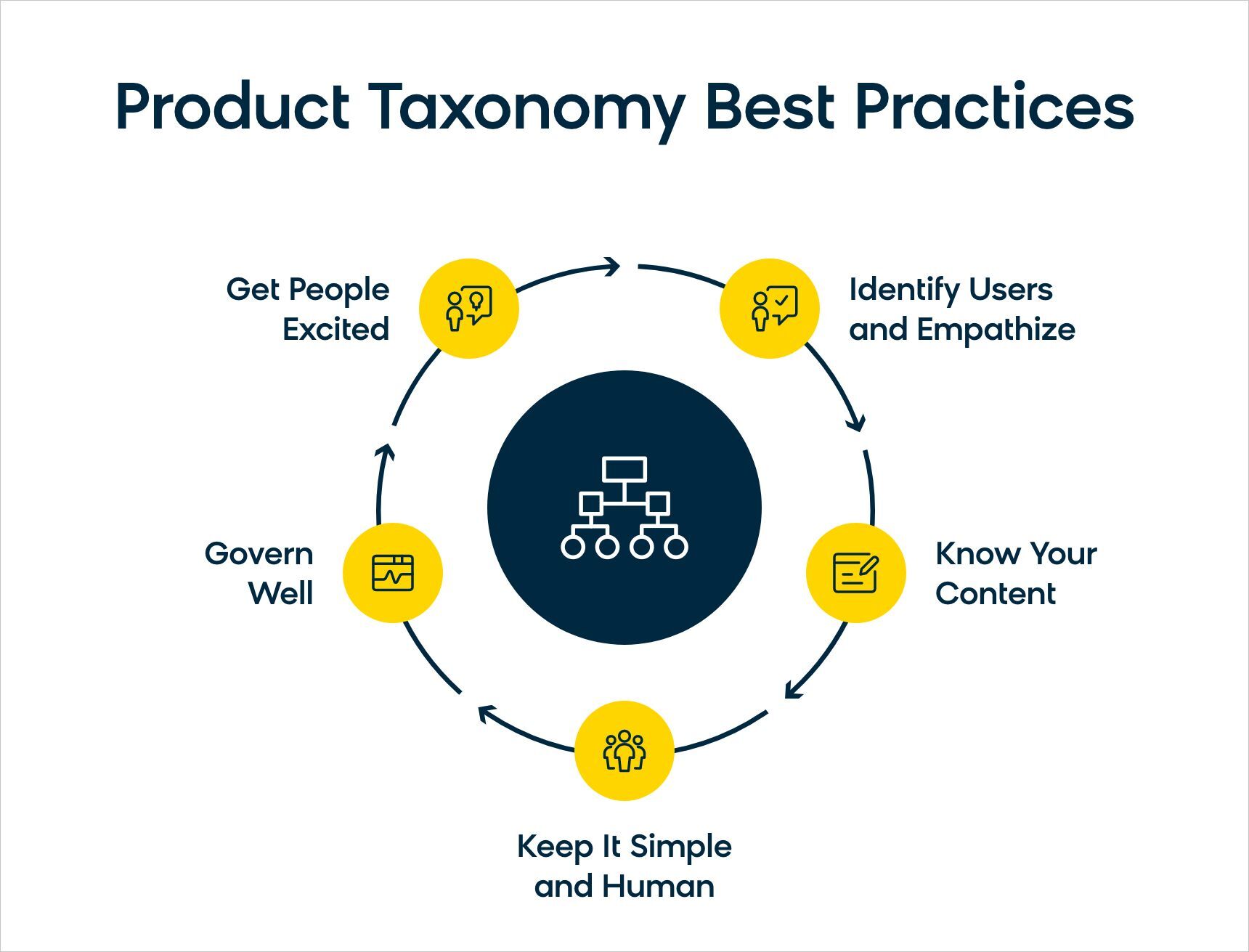
Start with Customer Intent
Taxonomies should be built for users, so this practice comes with an element of data-driven psychology. You need to understand user behavior and the language they use.
Study how customers navigate your site. Analyze data on the customer experience to see how they think and how they approach your site to find a product. You can also talk to people directly. Ask what they like and don’t like about the current setup.
One concrete starting point: pull your top 50 zero-results search queries. The terms customers searched and didn’t find are direct evidence of where your taxonomy vocabulary diverges from customer vocabulary. If it’s not working, resist the urge to blame the user. They may not always type in the right terms, but it’s not their job to figure out your site. A good taxonomy is built for the user, not the other way around.
Keep It Broad and Shallow
When it comes to category depth, go broad and shallow rather than narrow and deep. Keep hierarchies to two or three levels where possible. Users want organization, but they don’t want an endless list of subcategories to trawl through.
A complicated taxonomy won’t work. Visualize the product categories, determine where products sit within them, and lay it all out before building. If a subcategory has fewer than five products, it’s probably not worth a dedicated level.
Use Mutually Exclusive Categories
Every product should have one clear home in the navigation taxonomy. When the same product appears in multiple categories without a clear primary, it creates confusion for both users and search engines. Use tags and cross-referencing for secondary placements rather than duplicating the product in the category tree.
The exception is intentional merchandising categories like “New Arrivals” or “Best Sellers,” which are curated collections rather than structural categories.
Add Synonyms and Aliases
Customers use different language than your product team. A “sofa” is also a “couch.” A “cell phone” is a “mobile phone.” A “sneaker” is a “trainer” in the UK.
Build synonym mappings into your search taxonomy so that product findability doesn’t depend on customers guessing your internal naming conventions. This is especially critical for B2B catalogs where the same part might have a manufacturer name, a common name, and an industry-standard code.
Plan for Scalability
Build taxonomy rules that can accommodate new product lines without restructuring the entire hierarchy. Ask: if we add 1,000 new SKUs next quarter, does the current structure hold? If we expand into a new vertical, do we need to rebuild the top level?
The best approach is to define clear rules for how new categories get created, what attribute sets they inherit, and who approves changes. Without governance, taxonomies grow organically in conflicting directions as different teams add products.
Establish Governance
When you’ve built a taxonomy, you need to observe how people use it. Be prepared for people to interact with it in ways you never imagined.
This work is never done. Taxonomies constantly change, especially in retail. Regular reviews and modifications of the existing structure are necessary as part of an ongoing effort. New ideas appear quickly and become must-have terms. Adding product names, categories, and attributes never stops.
The taxonomy should be shared across business units. Customers don’t have, and don’t want, any visibility over internal company structure. Make sure everyone speaks with the same voice.
Many companies recognize the importance of clean taxonomy but aren’t in a position to hire dedicated taxonomists (people with backgrounds in library science or linguistics). For most teams, taxonomy is a side project added to a long list of other tasks. That’s where AI-assisted tools become especially valuable, reducing the manual effort required to maintain consistency as catalogs grow.
Common Product Taxonomy Challenges
Even with solid best practices, certain taxonomy problems recur across ecommerce organizations of every size.
Inconsistent Data Across Teams
When different departments maintain their own product data independently, naming conventions diverge. Marketing calls it “Athletic Footwear,” the warehouse calls it “Sport Shoes,” and the PIM system uses “Sneakers – Athletic.” These inconsistencies cascade into broken filters, inaccurate search results, and unreliable reporting.
Scaling with Growing Catalogs
A taxonomy that works for 500 products often breaks at 50,000. Categories that were once clear become catch-all buckets. Attributes that were once optional become essential for findability. The longer you wait to restructure, the more painful the migration becomes.
Cross-Channel Consistency
Your website, mobile app, marketplace listings, and Google Shopping feed all need product data, but each channel has different taxonomy requirements. Maintaining consistent product classification across channels while adapting to each platform’s specific format requirements is one of the most labor-intensive parts of catalog management.
Seasonal and Trending Products
Products that don’t fit neatly into permanent categories, like “Valentine’s Day Gifts” or a viral TikTok product, need a home in your taxonomy. The challenge is accommodating these temporary categories without cluttering the permanent navigation structure. Tags and merchandising categories solve this better than creating (and later orphaning) permanent category nodes.
AI and Product Taxonomy
AI-powered product categorization has moved from experimental to operational over the past few years. What teams used to spend weeks doing manually, such as classifying new products, mapping attributes, and maintaining synonym dictionaries, can now be automated with significant accuracy improvements.
Automatic Product Categorization
Machine learning models trained on product data automatically assign new products to the correct categories based on their title, description, images, and attributes. This is especially valuable for marketplaces and retailers onboarding products from hundreds of suppliers, where manual categorization would be a bottleneck.
We built Loomi AI, our intelligence platform for personalization, to handle exactly this kind of work. Loomi AI processes product data in context, understanding the relationships between products, categories, and customer behavior. The result is more accurate classification with far less manual effort.
Search Enrichment Through NLP
AI also enriches the search taxonomy by understanding the relationships between terms. Natural language processing enables search systems to understand that “warm winter jacket” and “insulated parka” describe the same intent, even when the product listing uses neither phrase.
This is the shift from keyword-matching to intent-matching, and it makes the search taxonomy more resilient to the infinite ways customers describe what they want.
Reducing Manual Maintenance
The most practical benefit of AI in taxonomy management is the reduction of ongoing manual work. AI systems flag inconsistencies in attribute data, suggest category placements for new products, detect duplicate listings with different names, and identify gaps where products are miscategorized based on customer behavior signals.
See how AI-powered product discovery works in practice.
Product Taxonomy and Site Search
As important as product taxonomy is, you can’t forget about site search. These two work hand in hand to drive the biggest impact on your site. A well-organized product taxonomy makes it easy for browsers to find what they’re looking for by clicking through to the right category and viewing all items within that section.
On the other hand, with the right search tool, you convert shoppers who know what they’re looking for. A tool that understands intent and automatically prioritizes the most relevant products.
By both investing in search and optimizing your product taxonomy, you create a better customer experience that improves conversions and revenue.
Explore cross-category product discovery to see how taxonomy enables customers to browse across categories without friction.
How Companies Drive Results with Product Taxonomy
HD Supply
HD Supply is a multi-billion dollar industrial distributor serving over 500,000 professional customers in the US. Managing product findability across a massive industrial catalog is exactly the kind of challenge where taxonomy meets search.
As part of its site revamp, HD Supply added the ability to “add to cart” directly from the search bar. Buyers could see the product image, part number, price, and the option to add the product to their cart. Our search algorithm works in the background, providing relevant results and boosting certain products on specific category pages.
With these changes, HD Supply saw a 16% increase in revenue from search and a 4% increase in add-to-cart rate from list and product detail pages.
The Vitamin Shoppe
The Vitamin Shoppe is a global omnichannel retailer specializing in wellness and nutrition products. With thousands of SKUs spanning vitamins, supplements, sports nutrition, and natural beauty, clean attribute taxonomy across overlapping wellness categories was the prerequisite for effective category merchandising.
The Vitamin Shoppe adopted our autonomous search and merchandising suite to transform category browsing. Instead of relying on manual fixes, AI-driven product surfacing now determines what appears on category pages, matching products to what customers are actually looking for.
The results: an 11% increase in add-to-cart rate on category pages, a 5.69% increase in search RPV, and a 2% RPV increase for shoppers starting on category pages.
SmartPak
SmartPak, a leading equine supplement retailer, faced a challenge familiar to any fast-growing catalog: rapid product expansion across supplements, tack, apparel, and stable supplies meant faceted navigation quality depended entirely on taxonomy consistency. Customers needed to find the right product quickly across a specialized catalog where attribute accuracy (dosage, horse size, ingredient type) directly affects purchase confidence.
SmartPak adopted Loomi AI to improve search relevance and category merchandising. The AI-driven system prioritized the right facets for each category, optimized product ranking for seasonality, and maintained clean taxonomy structure as the catalog grew.
The results: 15% increase in search revenue, 5.2% increase in search conversion rates, and $1.9 million in revenue impact over eight months, demonstrating that clean taxonomy paired with AI-driven discovery delivers measurable returns even in niche verticals.
Standard Taxonomies: Build vs. Buy
Every ecommerce team eventually faces the same decision: adopt an industry-standard taxonomy or build a custom one that reflects how your business actually works.
Google Product Taxonomy
Google’s product taxonomy is the most widely used standard, with 6,000+ categories. It’s required for Google Shopping and Merchant Center feeds. In January 2026, Google added four new top-level categories (Smart Home & IoT, Electric Vehicles, Sustainable Products, AI & Robotics) and expanded the Electronics and Health categories, with a compliance deadline of July 31, 2026.
For most retailers, Google’s taxonomy is the baseline for syndication. But it’s rarely sufficient as a primary navigation taxonomy because it’s designed for standardization across millions of merchants, not for optimizing a specific shopping experience.
Shopify Standard Product Taxonomy
Shopify’s standard product taxonomy is newer and actively evolving (latest release: v2026-02). It’s an open-source, community-driven standard designed specifically for commerce. If you sell on Shopify or integrate with Shopify-powered tools, aligning with their taxonomy simplifies data exchange.
When to Customize
Most businesses end up with a hybrid approach: they map their internal taxonomy to Google’s standard for syndication purposes while maintaining a custom navigation taxonomy for their own site. The key questions to ask:
- How unique is your catalog? If you sell standard consumer goods, a standard taxonomy gets you 80% of the way. If you sell specialized B2B parts or niche products, custom is unavoidable.
- How many channels do you sell through? More channels means more mapping work. A clean internal taxonomy with documented mappings to each channel’s standard saves time.
- How fast does your catalog change? High-churn catalogs (fashion, electronics) need flexible custom taxonomies. Stable catalogs (industrial supplies) can lean more heavily on standards.
Our approach handles both sides of this tension: our search and categories solutions map to Google’s taxonomy for feed syndication while supporting custom navigation taxonomy for the storefront, so you get standardized data exchange without sacrificing the browsing experience.
Make Your Product Taxonomy Drive Results with Bloomreach
Great product categorization plays a critical role in how browsable your site is, but it’s only one side of the equation. With the right product discovery solution in place, you can make search quality issues a thing of the past and enhance your customers’ shopping experience.
Loomi AI draws on billions of commerce interactions across 1,400+ brands to power our search and categories solutions, delivering results from day one. Whether you need smarter site search, AI-powered category ranking, or personalized product recommendations, we help brands turn catalog complexity into a competitive advantage.
See how Bloomreach search drives faster ROI →
Frequently Asked Questions
What is an example of a product taxonomy?
A product taxonomy is a hierarchical structure like Electronics → Computers → Laptops → Gaming Laptops. Each level narrows the product set. The attributes at each level (brand, processor, screen size) power the filters customers use to find the exact product they want. See the examples section above for detailed hierarchies across fashion, electronics, and grocery.
Why is product taxonomy important?
Product taxonomy determines how easily customers find products on your site, which directly impacts conversion rates and revenue. Baymard Institute research shows 88% of ecommerce sites have mediocre-to-poor category taxonomy UX. Clean taxonomy also powers site search accuracy (search users convert at significantly higher rates than browsers), SEO performance, internal reporting, and the efficiency of feed syndication to channels like Google Shopping.
What are the 4 types of taxonomy?
The four most widely cited types are navigation taxonomy (customer-facing categories), attribute taxonomy (the data model defining product properties), reporting taxonomy (internal analytics groupings), and syndication taxonomy (marketplace and feed mappings). Many ecommerce businesses also use a fifth type, search taxonomy, which handles synonym mappings and intent routing for on-site search.