
How personalized can a customer experience really be?
This question has always troubled businesses, and for years, the answer depended on the number of preset rules, back-end configurations, and manual tweaks you had in place.
It took a lot of time, energy, and hands-on execution to get close to a personalized experience. But agentic personalization has changed the game.
Using agentic AI, brands can now personalize every step of the customer journey, creating experiences that evolve with each new interaction, without adding extra burden on your team.
Here’s how, and where your team stays in charge.
Defining Agentic Personalization
Agentic personalization is a strategy that utilizes AI agents to deliver tailored customer experiences on a large scale.
This approach is powered by agentic AI, a form of artificial intelligence that can optimize customer touchpoints on its own, across the entire customer journey.
To see what this means in practice, let’s look at what agentic AI is, how it differs from traditional AI, and why it changes what customer experiences can be.
What Is Agentic AI?
Agentic AI describes artificial intelligence systems designed to make autonomous decisions aligned with specific goals.
Traditional AI tools need an explicit prompt to produce a result. Agentic AI uses machine learning, natural language processing, and large language models to read a situation, work out a response, and act on it without manual intervention.
Simply put, agentic AI doesn’t just respond to user inputs. It proactively works to achieve objectives, incorporating context and adapting to new information to make informed decisions.
This level of autonomy is possible through the use of AI agents. Working within agentic AI systems, AI agents independently handle tasks by assessing data and making real-time adjustments to optimize outcomes.
And with the right agents working together in an agentic AI system, businesses can use these tools to create personalized experiences that set a new standard for commerce.
Agentic AI vs. Traditional AI
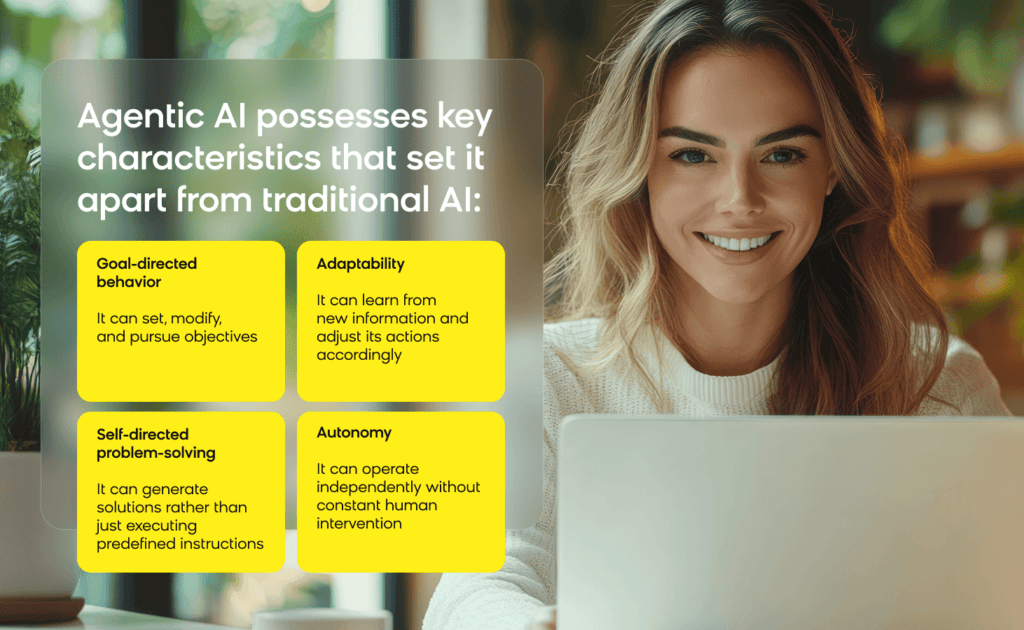
Agentic AI possesses key characteristics that set it apart from traditional AI:
- Goal-directed behavior – It can set, modify, and pursue objectives
- Adaptability – It can learn from new information and adjust its actions accordingly
- Self-directed problem-solving – It can generate solutions rather than just executing predefined instructions
- Autonomy – It can operate independently without constant human intervention
Traditional AI models wait for user commands. Agentic AI makes decisions and carries out complex tasks with minimal human intervention.
By bridging the gap between rule-based personalization and true intelligence, agentic AI can be used to personalize experiences at a speed and scale that rules never reached.
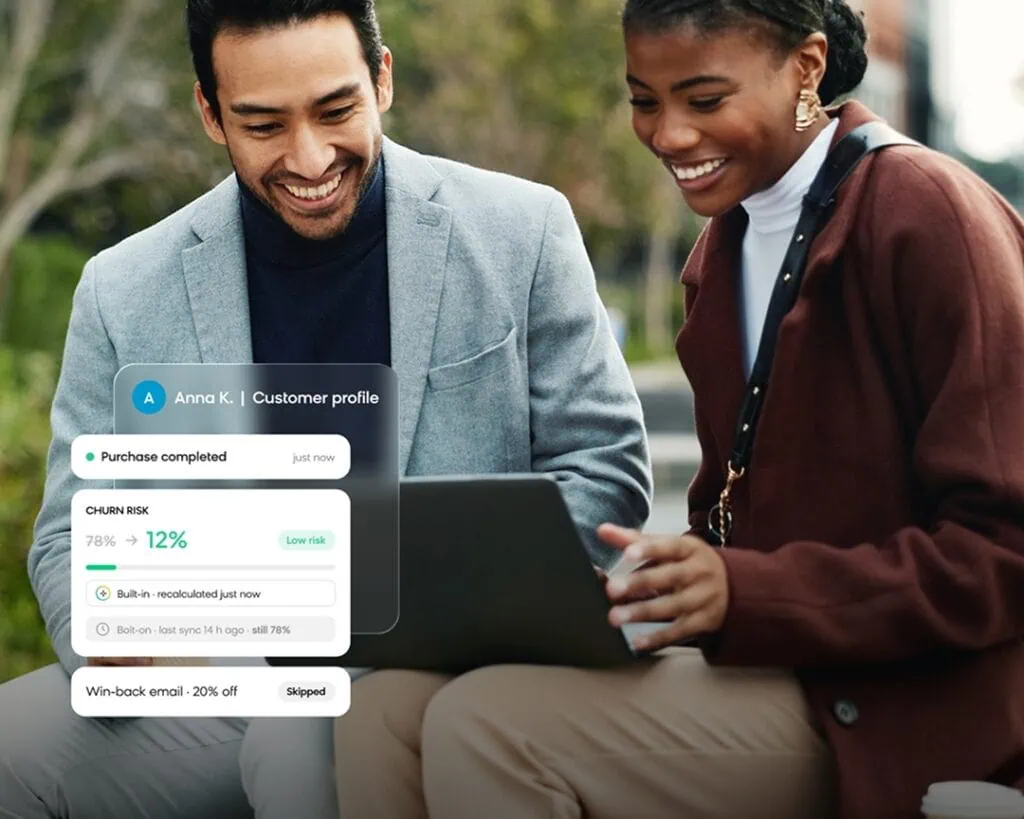
Agentic AI can act as an always-on customer relationship strategist, constantly working to achieve your goals. It analyzes millions of data points at any given moment, scanning for relevant opportunities to engage customers, refine campaigns, and optimize journeys.
That might mean identifying the perfect moment to send a promotional offer, adapting on-site recommendations as shopper preferences change, or adjusting ad spend to maximize ROI. In each case, agentic AI spots the opportunity and acts on it, without you prompting your way through every step.
Agentic Personalization vs. Rules, Segments, and A/B Tests
Agentic personalization is easiest to understand next to the three tools most teams already run. A rule is a promise you write once and the system keeps every time: this audience always gets this offer, out-of-stock items never show. A rule can’t tell which of two eligible offers this particular customer would prefer. A segment is a group strategy: everyone who fits the definition gets the same treatment, so thousands of people who share one attribute receive the same message. An A/B test finds the one variant that wins on average and then shows it to everyone.
Agentic personalization sits on top of all three rather than replacing them. It makes a separate choice for each customer from the options you have approved, and it learns from what each choice produces. The next section covers where those choices stop and your team’s control begins. If 70% of your customers respond to a discount and 30% respond to free shipping, an A/B test declares the discount the winner and sends it to the 30% who would have converted on free shipping. A per-customer decision serves each group the variant that fits, and it keeps learning after the test would have ended.
The Benefits of Agentic Personalization
Agentic personalization changes how brands engage with customers and what personalization can achieve, for the business and its audience alike.
Enhanced Customer Experiences
Agentic AI can understand and solve problems on its own, which changes how customer relationships are managed.
Instead of a reactionary customer experience (which can be a challenge to maintain even with traditional marketing methods), agentic AI can build a proactive journey for each customer. It can predict their individual needs, tailor touchpoints without manual input, and streamline customer journeys in real time.
Deeper Personalization at Scale
Creating personalized experiences for all of your customers can be a daunting challenge. You need to write the rules, put the right triggers in place, and map out what you hope is the ideal customer journey.
With agentic personalization, brands can analyze vast amounts of data and build tailored experiences at scale without heavy manual input. AI agents work out the right message, channel, and timing for each customer from that customer’s own behavior, so prewritten journeys and workflows become a thing of the past.
Every customer interaction shapes the next one, which means every customer, no matter the size of the audience, gets a relevant, personalized experience.
Real-Time Decision-Making
The ability to make decisions in real time, autonomously, is what sets agentic AI apart from traditional AI systems.
Agentic AI can continuously process live customer data, like browsing behavior, clicks, and purchasing patterns, and use it to shape every interaction with your customers. Individual context can be woven into your campaigns, your search bar, and your on-site browsing experience. It can all be personalized with up-to-the-minute insights.
Increased Revenue and Retention
This level of personalization doesn’t just enhance the customer experience. Agentic AI is built to move a business’s bottom line, supporting revenue growth and stronger customer loyalty, and the case studies below put numbers on it.
Deploy agentic AI that understands customer context and is tied to your business goals, and every decision it makes lines up with your revenue targets and your customer relationship strategy.
You get a tool that keeps looking for growth opportunities and is allowed to act on them.
Where Autonomy Stops: The Boundaries That Make Agentic Personalization Work
Every guide on this topic sells autonomy. The question that decides whether a team actually deploys it is the opposite one: where does the autonomy stop, and who holds the line? Most answers stop at a sentence about human oversight. The workable answer has four layers, and each one is a concrete mechanism rather than a principle.
Hard rules protect the non-negotiables. Consent, eligibility, regulated claims, stock status, and promotional priorities are handled by rules, and rules win every time. With Bloomreach, rules-based AI is a first-class layer alongside machine learning and generative AI for exactly this reason. An LLM can only guess whether a customer should receive an email. A rule knows which customers didn’t consent and won’t send it. The agent works inside those rules rather than around them, and it only knows your internal business rules if you state them. If you never discount more than 20%, or never send on weekends, that goes in the brief.
Segments stay as explainable group strategy. Agentic personalization doesn’t retire segmentation, it feeds it. Autosegments, for example, only runs on the customer properties and metrics your team chooses, then finds the combinations worth targeting. Every segment it proposes is a definition you can read, edit, and reuse in any campaign or report. The group baseline stays legible; the AI refines within it.
The AI chooses per person, from options you approved. Contextual personalization picks the best variant for each customer, but the variants are yours (up to 10 per campaign). The goal it optimizes for is one you defined, such as a purchase, a click, or a sign-up. The value it weights each variant by is the business worth you assigned. It evaluates each customer’s device, location, time of day, browsing, and purchase history, selects a variant, records whether the goal was met, and retrains in the background. It also deliberately makes a small share of decisions at random, so it keeps testing its own conclusions rather than locking in early. That is the difference between a system that generates whatever it likes and one that assembles from approved building blocks.
Humans keep approval and override. Bloomreach’s marketing agent builds the complete campaign, but you review, edit, and approve every node before it launches, and it tells you when a request is out of scope rather than improvising. After launch, its optimization is bounded too: for abandoned cart and browse campaigns it tunes the wait time per customer, and it does not touch your copy, audience, or offer. Campaign strategy stays yours; the agent improves execution inside it.
Read together, those four layers answer the objection that comes up first in almost every evaluation. “Autonomous” doesn’t mean unsupervised. It means the system makes the thousands of small per-customer decisions your team could never make by hand, inside boundaries your team set, and shows its work.
Applications of Agentic Personalization
Proactive, autonomous AI opens up new personalization opportunities. Here are three ways that brands can apply agentic personalization today:
Autonomous Search
Imagine a search bar that understands customers as well as a seasoned sales associate. That’s what autonomous search brings to the table.
With the power of agentic AI, your search functionality can be so much more than a navigational tool. It can identify the intent behind every query and tailor results to each shopper. The search bar becomes an interactive experience rather than a transactional one.

An autonomous search bar understands your customer’s past behavior and takes these insights into account as it generates results. It can respond to nuanced questions and conversational searches like “What are the best running shoes for marathons?” or “Show me eco-friendly furniture options.”
It can even make suggestions, learn from real-time input, and adapt the search experience to give your customers exactly what they’re looking for.
In essence, your search bar can think for itself, without extensive rules, manual rankings, or constant back-end configuration. Agentic AI keeps fine-tuning the search experience to serve your audience.
How Sur La Table Caters to Individual Customers With Autonomous Search
These applications of AI-powered search are already live. Forward-thinking businesses like Sur La Table are harnessing autonomous search today to personalize their search experience.
The well-known kitchenware retailer replaced rigid keyword rules with Bloomreach’s search solution, our intent-aware search and merchandising. It saw immediate results, including an 11.5% boost in category average order value (AOV) and a 6.6% increase in search add-to-cart rates.
Autonomous Marketing
Agentic AI is ushering in a new era of autonomous marketing, one where AI agents proactively create dynamic, customer-first, and deeply personalized campaigns.
Instead of waiting for prompts to help with key marketing tasks (building customer segments, analyzing campaign performance, or choosing the ideal channel for a customer), AI agents do the job on their own. They optimize your customer experience in real time and more efficiently than before.
That is the difference between traditional marketing automation and autonomous marketing. The first relies on predefined workflows and manual setup to build a customer experience. The second shapes and adapts customer journeys in real time.

With agentic AI, campaigns grow alongside your customer relationships. The agents learn from every interaction and adjust on the fly, so engagement stays relevant and timely.
The clearest example of this today is a marketing agent that takes a campaign brief in plain language and builds the whole thing. Bloomreach’s marketing agent assembles the audience, the triggers, the timing, the decision logic, the control group, and the email content from a single prompt. It draws on a knowledge base of high-performing campaigns that have been analyzed and labeled component by component. Before it generates anything, it checks your data mapping and catalog to confirm the campaign you asked for is actually supported by the data you have.
How Revolution Beauty Multiplied Campaign Output With Autonomous Marketing
Revolution Beauty, the UK beauty group behind 13 brands, had a constantly changing product lineup and a team that kept having to choose between speed, testing, and creativity. The team now describes the campaigns it wants to our marketing agent and lets it build them, which in its own account took campaign builds from weeks to minutes. The new autonomous campaigns generated 5x the revenue per email of the team’s existing sends and more than 5% of total email revenue.
How HMV Optimized Customer Segments With Autonomous Marketing
Using autosegments, the music and entertainment retailer HMV created hundreds of high-value customer segments in real time and used them to optimize Google Ad campaigns. Before AI, that task would have taken far longer.
This produced fantastic results for the brand: a 14% lift in campaign revenue, plus a 34% increase in impressions and a 425% surge in landing page views week over week.

Conversational Shopping
AI-powered conversational shopping agents are the most widely known application of agentic AI, and for good reason. These systems open up a new dimension of online customer engagement.
Acting as virtual shopping assistants, conversational AI agents offer real-time, personalized help as customers shop.

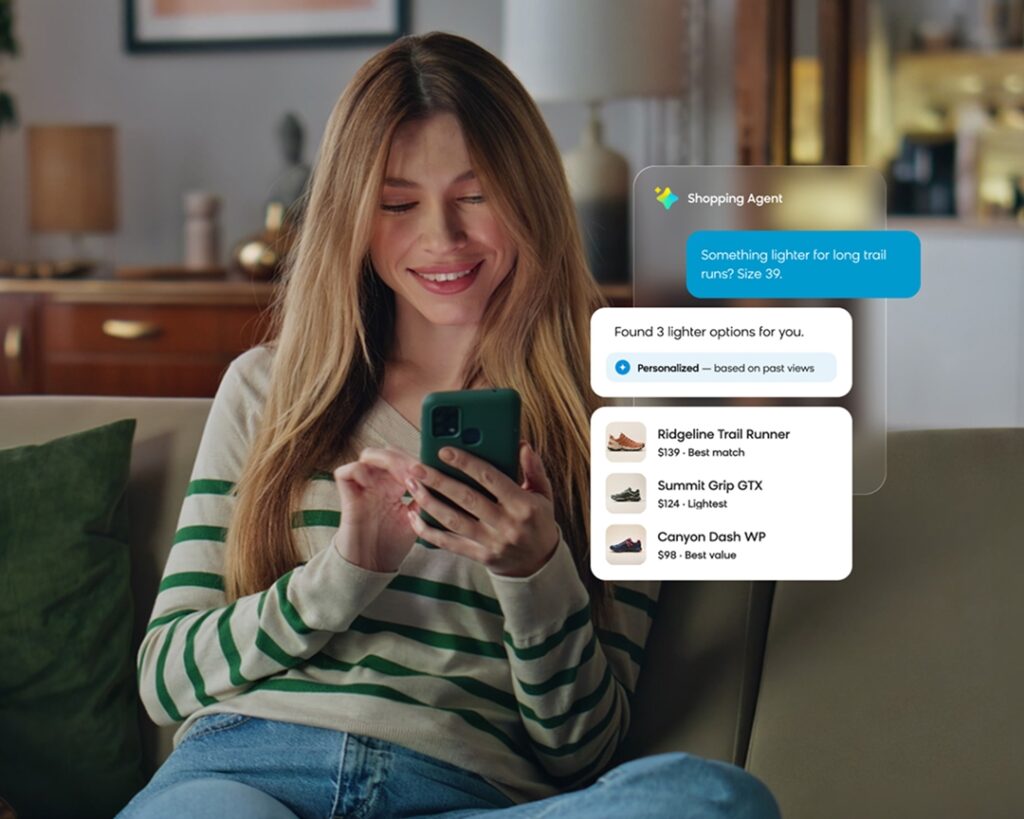
While they might seem like traditional chatbots at first glance, they go well beyond what traditional chatbots could do. Conversational AI agents can answer nuanced questions, offer tailored recommendations, and proactively step in when customers need assistance. And with the right shopping agent, you can go beyond the chat window. The conversation can sit directly within product listing pages (PLPs), the cart, the search bar, and more.
What makes these AI agents remarkable is their ability to bring context into every conversation. They personalize interactions, offering expert advice that aligns with a customer’s preferences and past behaviors.
Plus, these agents can recognize when and where a conversation will have the most impact. For instance, they can welcome back a returning visitor and remind them about items left in their cart. Or they can step in when a shopper is clicking back and forth between two products and help them decide.
This opens up new ways to engage online shoppers and changes how businesses personalize each interaction.
Working on their own, these agents turn touchpoints that were taken for granted into standout moments. And businesses that are adopting conversational shopping strategies are quickly seeing how lucrative this transformation can be.
How TFG Boosted Conversions With Conversational Shopping
The specialty retail group TFG (The Foschini Group) deployed Bloomreach’s shopping agent, our conversational AI agent, on Bash, its ecommerce platform. The results came during the busy Black Friday period.
The test ran as an A/B test over Black Friday weekend. The agent reached out only to shoppers who had engaged with at least three product pages, and that group was measured against a control group that never saw it. Shoppers who got the agent converted at a 35.2% higher rate, generated 39.8% more revenue per visit, and exited 28.1% less often.
Agentic Personalization Is Possible With Bloomreach
Agentic AI offers real opportunities, and the businesses that use it to deliver personalized, real-time experiences gain a competitive edge.
If you’re ready to put agentic AI to work, look no further than Loomi, our AI for customer engagement. It brings customer data, predictive models, and real-time activation together to personalize every step of the customer journey.
Request a demo to learn Bloomreach customers are using Loomi to achieve all of their agentic personalization goals.
Frequently Asked Questions
How does agentic personalization decide what each customer sees?
It evaluates the individual customer’s context: device, location, time of day, browsing behavior, and purchase history. It then selects the option most likely to achieve the goal you set, records whether that goal was met, and uses the outcome to improve the next decision. The options it chooses from are the variants, offers, and products your team approved, and hard rules such as consent and eligibility are applied before any choice is made.
Is agentic personalization just A/B testing with more power?
No. An A/B test finds the single variant that performs best on average and shows it to everyone. Agentic personalization finds the best variant for each individual customer, so the minority who would have responded to a different message still get it. It also keeps learning after launch instead of stopping when a test reaches significance.
Does agentic personalization mean the AI acts without approval?
Not in a well-designed system. Bloomreach’s marketing agent, for example, builds the complete campaign from a prompt, but every node is reviewed and approved by your team before launch. Requests outside its scope are declared rather than attempted, and post-launch optimization is limited to timing within the campaign you designed.
What data do we need before agentic personalization is useful?
Less than most teams assume, and the system tells you what is missing. Loomi marketing agent checks your data mapping and catalog before it builds a campaign and warns you if something the campaign needs is absent. The working minimum is unified customer profiles with behavioral events (views, carts, purchases), a product catalog, and a defined goal for each campaign. Unifying profiles is usually the hard part, and the system improves as that data matures. Per-customer optimization gets better as more customers complete the campaign, so always-on flows such as abandoned cart learn faster than one-off sends.
Does agentic personalization keep learning after launch, or is it built once?
Both happen, in different places. Campaign structure is built once and approved. Per-customer decisions, such as which variant to serve or how long to wait before a follow-up, keep learning from every outcome for as long as the campaign runs. That is why the approach suits ongoing lifecycle campaigns more than single sends.