
AI is rapidly changing ecommerce. The technology is unlocking new levels of personalization, efficiency, and revenue — and organizations are adopting it fast. For brands that want to keep up with rising consumer expectations, AI is no longer optional.
But AI isn’t just transforming customer experiences — it’s also changing the questions ecommerce teams ask about it. A year ago, the question was “does this actually work?” Now it’s “how can I best use it?”, “where can it help me think creatively, and where can it automate the tedious work?”, and “how do I prove AI’s uplift to my CFO?”
This blog aims to answer all your questions, starting with a clear definition of what AI really means for commerce. AI in ecommerce is the use of machine learning, natural language processing, and — increasingly — autonomous agents to personalize what shoppers see and understand what they mean when they search. It also reshapes the way businesses work, automating the merchandising and marketing operations that teams used to do by hand.
In short, it can impact every aspect of your business. Here are seven ways AI is revolutionizing ecommerce right now.
Key takeaways:
- AI in ecommerce has consolidated around seven proven use cases: personalized recommendations, intelligent search, conversational shopping agents, customer predictions, visual search, demand forecasting, and agentic marketing
- The center of gravity moved from assistive AI (suggesting what to do) to agentic AI (doing tasks autonomously, with human approval)
- The biggest blockers for AI-driven success are fragmented data, trust in unsupervised automation, and proving incremental lift — not the technology itself
The 7 AI Use Cases Winning in Ecommerce Right Now
1. Personalized Product Recommendations
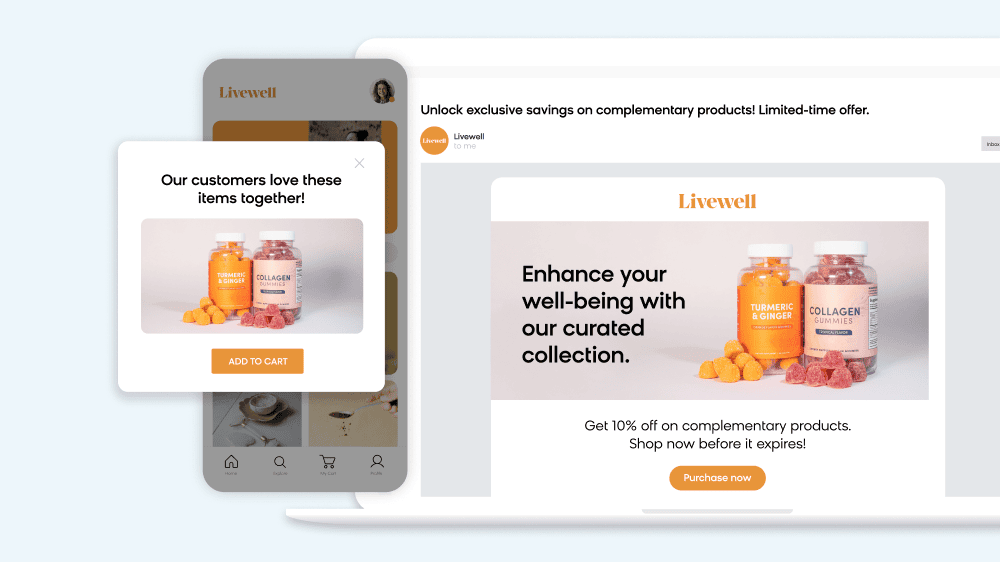
A common misconception about recommendation engines is that they just show people what they already bought or browsed. That was true of early collaborative filtering, but AI-powered recommendations work differently — AI predicts what a shopper is likely to want next, including products they’ve never viewed, while suppressing what they already own.
This leap forward offers huge potential for ecommerce teams, allowing them to recommend products that speak to a customer’s real-time shopping intent. Loomi’s experience-driven recommendations build a real-time affinity profile for each visitor: every search, click, and add-to-cart updates that individual’s preferences for specific colors, brands, sizes, categories, and price ranges. The widget then re-ranks against the refreshed profile on the next interaction. A sequence-aware layer goes further by weighing the order of interactions — a shopper who viewed a crib and then a mattress is in a different place than one who did the reverse.
In practice, this is most often seen on websites where retailers highlight sections like “inspired by your shopping trends,” suggest related add-on items in a cart, or surface location-relevant content based on where the customer is.
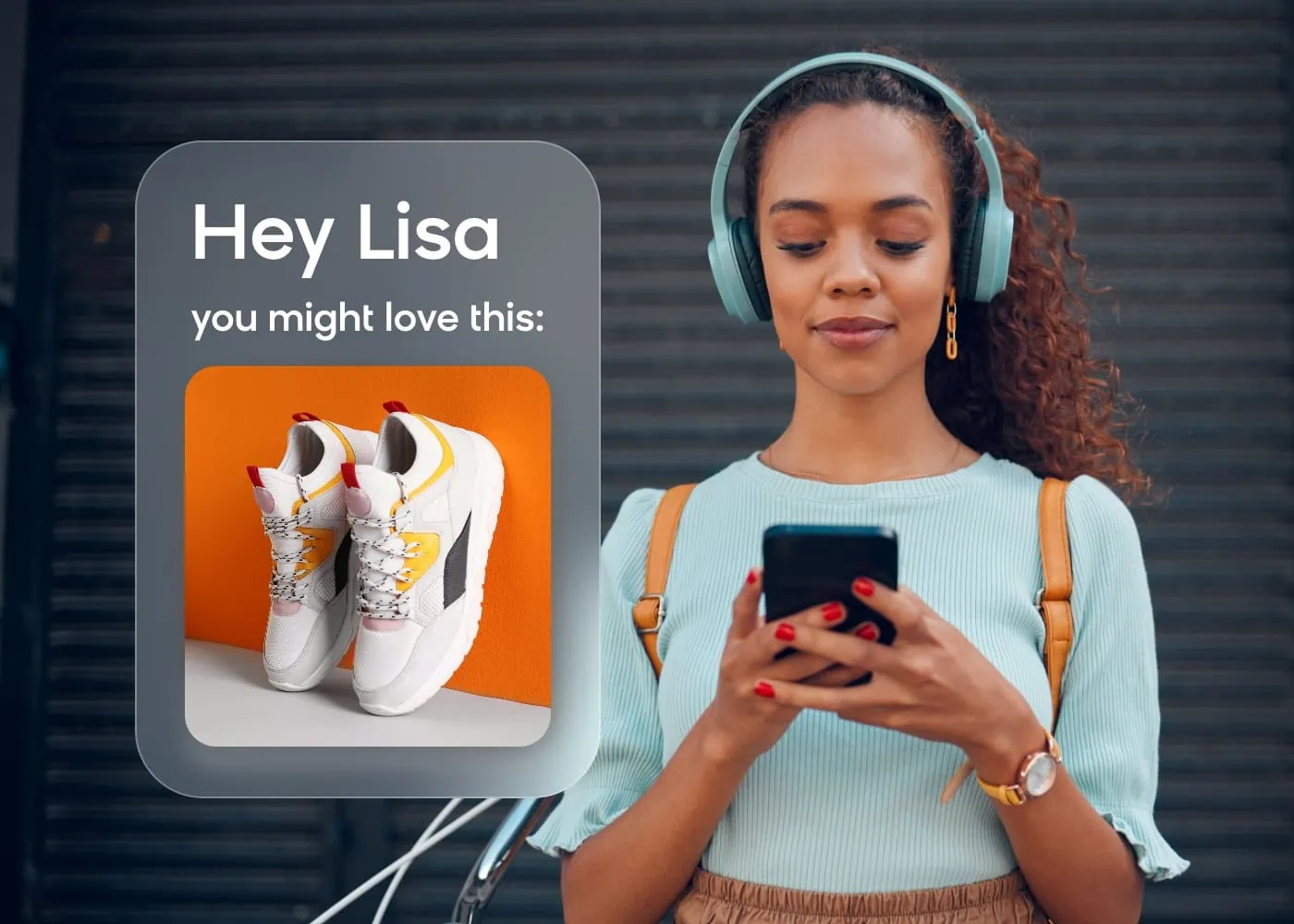
This helps shoppers find what they want faster, and retailers earn the cross-sell. When Yves Rocher switched from generic top-seller carousels to real-time personalized recommendations, shoppers clicked recommended items 17.5x more within a minute of display, and the purchase rate of recommended products rose 11x. And because the profile-building happens automatically, it’s as available to a three-person marketing team as to a retail giant with a data science bench.
2. Intelligent Search and Discovery
Site search is where AI pays off most visibly, because keyword-matching search results can fail in ways every shopper has felt. AI-powered ecommerce search reads what the shopper means rather than matching the letters they typed. If a shopper searches for “hats,” and the AI can determine they are in a cold climate, it can return results for winter beanies rather than summer baseball caps.
Because AI is constantly studying behavior, it learns individual preferences and returns more relevant results over time. A search for “best wedding dresses” would surface the shopper’s favorite brands, appropriate for the occasion they’re shopping for.

This is also the use case with the deepest evidence base. In Bloomreach’s published aggregate across dozens of A/B tests on customer sites, Loomi search delivered 25% more revenue per visitor and a 15% higher conversion rate than the previous AI search tools those retailers were running — in part by surfacing 29% more products through natural language understanding. Bensons for Beds rebuilt its product discovery experience on personalized search and grew ecommerce sales 41% year over year.
Better discovery also chips away at one of ecommerce’s most stubborn metrics: cart abandonment, which still averages 70.22% globally. When shoppers find the right product faster, they’re far more likely to finish buying it.
3. Conversational Shopping Agents (Not Chatbots)
Many ecommerce teams still think that conversational shopping agents are just chatbots, meant to help with customer service and support tickets. But a shopping agent does something fundamentally different. It serves as a dynamic, reactive salesperson for your brand — recommending products, comparing options, and guiding purchase decisions in real time.
The difference is architectural. A support chatbot answers from a FAQ corpus. A conversational shopping agent runs on the same product discovery engine as your search bar and obeys the same merchandising rules you’ve set there. It can open a mini product page — with price, sizes, and images — inside the conversation itself, so the shopper never leaves the thread. And it deploys wherever the purchase decision is actually happening: product pages, category pages, and checkout.

The natural language processing underneath handles context a scripted bot never could. By analyzing customer reviews, the agent can understand that a garment runs large and recommend sizing down before the shopper adds it to their cart. With a customer’s previous purchases and preferences informing responses, shopping agents become a true shopping companion, creating personalized, end-to-end journeys.
This elevated experience isn’t just possible — customers now seek it out. Shoppers increasingly expect a single agent to handle discovery, service questions, and order status in one conversational thread — not three separate aspects of your website. That consolidation is what conversational commerce looks like in practice now.
4. Customer Predictions: Purchase, Churn, and Send Timing
Prediction is where AI quietly compounds — it helps brands build the next step in a customer’s journey before anything visible happens.
There’s layers to AI’s predictive capabilities, and each offers valuable strategies. Purchase-probability models score every profile so campaigns target the shoppers most likely to convert. Churn models flag customers at risk of lapsing before they go silent. And send-time prediction learns when each individual actually opens messages, scheduling delivery per person, per channel — not at “Tuesday 10am” for the whole list.
There’s a less obvious layer here, too: AI-powered segment discovery. Instead of a marketer manually building segments based on intuition, AI surfaces high-value customer groups from combinations of properties and behaviors buried in the data — groups a team would never think to build by hand. A segment like “customers who browsed three times in the last week, added to cart once, but haven’t purchased in 60 days” can outperform any hand-built list, and the AI finds these audiences in a fraction of the time.
For the small teams running most ecommerce marketing — often one to five people covering email, SMS, and site personalization — this is the difference between segmentation existing in theory and actually shipping.
5. Visual Search and Multimodal Discovery
Sometimes the shopper’s best query isn’t words. Visual search lets a customer upload a photo and get back visually similar, shoppable products, which matters most in categories where style is hard to describe: fashion, furniture, home decor.
Loomi’s visual search widget does exactly this, returning similar items from your catalog against an uploaded image. It bridges the gap between “I know it when I see it” and a text search bar.
Voice and natural-language input round out the multimodal picture, and they’re converging with the conversational agents in use case 3. What shoppers increasingly want is to talk to the search bar — typing or saying “lightweight shirt for a summer wedding” and getting back a curated shortlist rather than a keyword dump. That capability went from novelty to expectation in under two years.
One honest note: the measurement story for visual search is younger than for core search or recommendations. Treat it as a fast follow rather than the first AI project you invest in.
6. Demand Forecasting and Operations
Behind the storefront, the same AI machinery runs the supply side. Retailers use machine learning to forecast demand for inventory management, predict seasonal spikes like Black Friday, and optimize warehouse and delivery operations.

Demand models also feed pricing decisions — automated markdown optimization to clear slow inventory without giving away margin, and demand-responsive pricing on trending items. That’s the pragmatic version of dynamic pricing, and it’s where most retailers should start. Per-shopper personalized pricing remains rare outside loyalty-gated offers, and vendor demos of it deserve your most skeptical eye.
The same pattern-detection guards the checkout, too. Transaction-anomaly models flag likely fraud in real time without adding friction for legitimate buyers. It rarely makes the AI highlight reel, but fraud detection is one of the longest-running production uses of machine learning in ecommerce.
7. Agentic AI: Marketing That Builds Itself (With Your Approval)
The biggest shift since we first published this article is agentic AI — systems that act on a goal instead of waiting for instructions. Where the predictive layer in use case 4 decides who to reach and when, an agent takes the output and does the reaching. Give it an objective and it works out the steps, drafts the assets, and optimizes as it learns.
Here’s what that looks like in practice today: a marketer writes a plain-language brief, and an AI agent builds the email campaign from it, with brand controls applied and an approval workflow built in. Nothing sends until a human signs off.
That last point is one that many ecommerce teams focus on. The concern that comes up most often around agentic AI is trust — nobody wants a system running unsupervised against their brand. But the reality is, these are tools that support teams and their tasks. The AI builds, and you approve. How much you delegate can grow as the system earns it.
Agentic personalization applies the same principle to the shopping experience — personalizing search results, product recommendations, and campaigns in real time using every click, search, purchase, and return.
What Actually Blocks AI Adoption (It’s Not the Technology)
The implementation challenges retailers hit in 2026 are rarely about model quality. Three patterns dominate:
Fragmented data. The most common setup is still the Frankenstein stack — separate tools for email, search, recommendations, and testing, each with its own data silo. The customer clicks a personalized email and lands on a generic homepage. No AI layered on top of disconnected data will fix that. Unifying customer data has to come first, whether through a CDP, a warehouse with an activation layer, or a platform-native data engine.
Trust and control. Merchandisers who can’t see or tune the model will route around it with manual overrides, which cancels the AI’s value entirely. Look for systems that expose their logic and keep humans in the approval loop, rather than black boxes that ask for faith.
Proving incrementality. AI-attributed revenue convinces nobody in finance. The teams that get budget renewals run controlled A/B tests that isolate the AI’s lift over your baseline, then report that lift on its own. If a vendor can’t support a holdout test, that tells you something.
Privacy and compliance still matter, and GDPR, CCPA, and the emerging wave of AI regulation all apply. But these are solvable with transparent consent and data residency. The three blockers above are what actually stall projects.
Where AI in Ecommerce Goes Next: Agents Talking to Agents
Our prediction for the next 18 months: the competitive question shifts from whose AI is smartest to whose agents can talk to each other.
The evidence is already in the vocabulary. “Chatbot” has largely disappeared in favor of “agent.” Model Context Protocol (MCP) is the emerging standard that lets AI agents from different vendors share data and call each other’s tools — and it went from a term nobody had heard to something technical evaluators raise unprompted, the way API access became a procurement checkbox five years ago. Enterprise teams are building their own internal AI and want commerce intelligence to plug into it as a data layer. The goal is one brain, with multiple UIs.
This theory is already starting to take shape. As shoppers adopt AI assistants that browse and buy on their behalf, and retailers deploy agents of their own, commerce increasingly happens between machines. The retailers that win that transition will be the ones whose product data, merchandising rules, and customer intelligence are exposed in ways an external agent can consume. Making your catalog legible to other people’s AI is becoming as important as making your website legible to Google.
Getting Started With AI in Ecommerce
Embracing AI in a meaningful way doesn’t require seven simultaneous projects. The best approach is to pick the use case closest to your direct revenue goals, run it against a holdout, and let the measured lift fund the next step.
To do that well, you need a platform that unifies your customer and product data in one place — like Loomi, Bloomreach’s agentic personalization platform built for commerce. Loomi provides the real-time data architecture and AI-driven capabilities you need to stay one step ahead of the competition, from AI-driven search and autonomous marketing to conversational shopping.
Frequently Asked Questions About AI in Ecommerce
How does AI personalization work for first-time or anonymous visitors?
AI can personalize first-time and anonymous visitor experiences, because not every AI feature needs behavioral history. Semantic search and catalog-based recommendations work from day one using product data alone. Behavioral personalization then builds within the session itself: a real-time affinity profile starts forming from the first click, so even an anonymous visitor sees increasingly relevant results before they’ve logged in or bought anything.
Does an AI shopping agent add revenue, or just cannibalize site search?
This is the sharpest version of the measurement question, and one finance teams are increasingly asking as agents move from pilots to paid contracts. The honest answer: both can be true. Some agent conversions would have happened through the search bar anyway. The test that settles it is an A/B split — one group sees the agent, one doesn’t. Then compare total revenue per visitor across the whole session. That captures both the agent’s direct conversions and any lift it creates downstream.
Do AI shopping agents replace human merchandisers?
No, they change the job. In practice, merchandisers stop hand-curating individual category pages and product slots and instead set the strategy the AI executes: business rules, brand priorities, margin constraints, and the exceptions that matter. The AI handles the long tail no team could curate manually; the merchandiser handles judgment.
What are the risks of using AI in ecommerce?
The operational risks matter more than the theoretical ones. The failure mode that actually shows up isn’t a rogue AI; it’s an agent recommending an out-of-stock size, surfacing a product from the wrong category, or an off-brand tone, discovered by a customer before the team. The mitigations are unglamorous: guardrails that constrain what the AI can recommend, brand and tone controls enforced at the platform level, approval workflows for anything customer-facing, and a review loop so someone looks at what the AI did last week. Ask every vendor to show you the monitoring screen before they show you the demo.
What’s a realistic ROI timeline for AI in ecommerce?
Search and recommendations typically show measurable lift within the first quarter, because they act on every session immediately. Predictive and lifecycle use cases (churn models, send-time optimization) need a few campaign cycles to prove themselves. Agentic marketing pays back fastest in time saved. Campaign builds routinely take one to four weeks end to end (data requests, CSV uploads, approvals); collapsing that cycle is the agent’s first measurable win, with revenue impact following as the team ships more.