
Marketing teams know what they want to say, but the bottleneck is often in building it.
You have the campaign idea, the audience, and the offer — but wiring up the consent logic, the channel routing, the voucher assignment, and the send timing? That takes hours of manual setup. And by the time the campaign is live, the window for impact has already started to close.
There’s a better way.
Campaign Complexity Is Eating Your Calendar
Every marketer has felt it: You want to run a simple back-in-stock notification across email and SMS, but “simple” quickly becomes anything but.
The Orchestration Tax
SMS and email have different consent rules, different opt-in lists, and different content constraints. Running them together in a single flow means building conditional branches for consent, routing customers who are reachable on only one channel, and making sure no one falls through the cracks. Most teams avoid the complexity entirely and run SMS as standalone blasts — disconnected from the lifecycle programs where it would actually perform best.
The same tax applies to personalization. You want every new subscriber to get a unique discount code, not a shared coupon plastered across the internet. But assigning codes at send time, only to reachable customers, without wasting inventory? That requires manual list management and careful orchestration, which is difficult to scale.
Why Manual Setup Fails at Speed
Here’s the reality: the campaigns that drive the most revenue are the ones that go live at the right moment. There’s no point in announcing a flash sale if it’s three hours late, or sending a back-in-stock alert after the item has already sold out again.
Every hour spent on campaign plumbing is an hour not spent on strategy. And the more channels, triggers, and personalization layers you add, the wider the gap between “idea” and “live” becomes.
The real problem isn’t that marketers lack ambition — it’s that the tools make ambition expensive. Multi-channel orchestration, dynamic personalization, and flexible send timing are all possible, but they’re just not practical to build by hand, campaign after campaign.
Loomi Marketing Agent Builds What You Describe
Loomi marketing agent is our AI agent designed specifically to help you build campaigns.
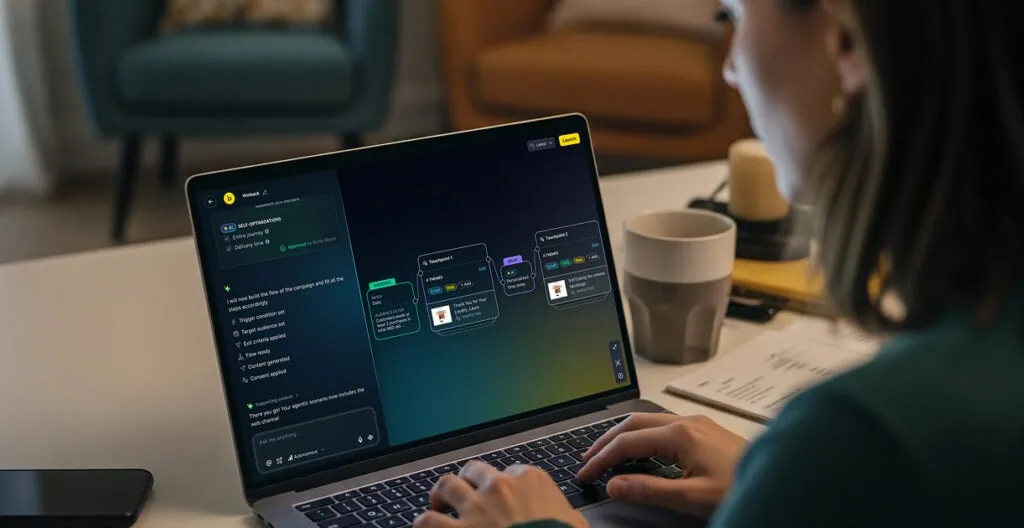
You describe the campaign you want in plain language, and the agent handles the orchestration — audience selection, channel routing, consent logic, personalization, and timing — turning what used to take hours of manual setup into a single conversation.
How Loomi Marketing Agent Works
Using the Loomi marketing agent is a straightforward process:
1. Describe your campaign: Tell the agent what you want to achieve, who you want to reach, and what you want to say
2. Let the agent build: Loomi determines the channel mix, applies consent rules, assigns personalization, and sets the send timing
3. Review the result: The agent presents a fully built campaign — audience, content, channels, and schedule — ready for your approval
4. Launch instantly: Approve and send, or refine in conversation until it’s exactly right
Loomi marketing agent doesn’t just save time — it removes the orchestration tax entirely. It lets you run the campaigns you’ve been avoiding because the setup was too complex to justify.

What’s New: Three Updates That Push the Agent Forward
This month brings a set of updates that expand what the Loomi marketing agent can build and how it can deliver. They open up new campaign types, new personalization, and new send patterns — all from a single request.
Update #1: SMS Working Alongside Email
Loomi marketing agent now builds campaigns across email and SMS together, in a single flow.
When you describe a campaign, the agent determines the channel mix and applies the consent rules for each channel automatically. It handles which customers enter the program, which customers receive which channel based on their consent, and how customers who are reachable on only one of the two channels are treated within the flow.
Building omnichannel email and SMS flows previously required setting up consent and channel routing by hand — which is one reason many teams run SMS as standalone blasts. The agent now manages that orchestration, so one request produces one coordinated send across both channels.
A retailer can run an agentic marketing campaign where communication goes out by SMS to customers who have opted in on mobile and by email to everyone else. The agent routes each customer to the right channel based on consent — no manual branching required.
Update #2: Vouchers Pulled Straight From Your Catalog
The agent can now include unique voucher codes drawn directly from your own catalog.
Marketers upload a catalog of voucher codes into Loomi. When you request an email campaign that includes a voucher, the agent locates the relevant voucher in your project data and adds it to the campaign. It uses the data already in your project — no new properties or events to create.
The codes are unique and persistent for each customer, rather than a single shared code sent to everyone. The agent assigns each code at the moment of send, so codes are only allocated to customers who can actually be reached. This means no wasted inventory and no manual list management.
Update #3: New Send Triggers for How You Actually Work
The agent now supports three send modes: immediate, scheduled, and recurring.
- Send now: This creates a one-time immediate send. When you describe an urgent campaign — like announcing that a sale starts today — the agent recognizes it as a one-time send and sets the mode accordingly.
- On date: This schedules a send for a specific date and time. The agent reads the date and time from your request, applies the project timezone, and supports rescheduling within the conversation — a follow-up like “actually make it 10 a.m.” is enough to change it.
- Repeat: This handles recurring sends, such as a weekly newsletter.
With all three in place, the agent covers one-time, scheduled, and recurring send patterns — which means more of what you run day-to-day can move through the agent from first request to final send.
A marketer can now announce a same-day flash sale with a single “send now request” in the morning, then schedule the follow-up reminder for the next day with “on date” — all in the same conversation.
What Makes Loomi Marketing Agent Different
Loomi marketing agent is the only solution in the marketing automation space where a marketer can describe a campaign in plain language and receive a fully orchestrated, multi-channel program — including audience, content, consent logic, personalization, and timing — built automatically.
Competitors offer chatbot-style assistants that help write subject lines or suggest segments while Loomi marketing agent builds the entire campaign.
Built on Real-Time First-Party Data
Loomi marketing agent works because it’s built on our first-party data foundation.
- Real-time data ingestion captures every customer interaction as it happens
- Profile unification creates a complete customer view across channels and devices
- Consent management ensures every send respects opt-in status per channel
- Voucher catalogs, customer properties, and behavioral data feed the agent continuously
The agent doesn’t operate on a snapshot — it builds campaigns against your live customer data.
Conversational Refinement
Loomi marketing agent isn’t a one-shot generator. It works within a conversation.
You can adjust the audience, change the send time, swap the channel mix, or refine the copy — all without starting over.
“Actually, make it 10 a.m.” is a valid instruction. So is “add SMS for customers who opted in.” The agent treats each refinement as an update to the existing campaign, not a new request.
From Idea to Live in One Conversation
The gap between “I want to run this campaign” and “this campaign is live” has always been filled with manual work — figuring out branching consents, routing channels, assigning vouchers, scheduling sends. etc. Loomi marketing agent closes that gap.
With SMS and email orchestration, unique voucher personalization, and flexible send triggers, the agent now handles campaign types that most teams either build slowly or avoid entirely.
But perhaps most importantly, these updates change what’s practical. It’s not that multi-channel orchestration or unique voucher assignment were impossible before — it’s that they weren’t worth the setup time for every campaign. When the agent handles the complexity, then campaigns that used to be reserved for tentpole moments become everyday plays.
This is the promise of an agentic approach to marketing: not just faster execution, but a fundamentally different relationship between ambition and effort. Schedule a demo today to see Loomi marketing agent in action and learn how it can impact your business.