Emarsys spent two decades becoming one of the most recognizable names in retail marketing automation. In February 2026, SAP retired the name: SAP Emarsys Customer Engagement is now SAP Engagement Cloud, split into two editions with two different futures. If you’re running Emarsys today, or evaluating it against other solutions, the rename is a natural moment to check whether the solution’s direction still matches yours.
Key Takeaways
Key Takeaways
-
SAP renamed SAP Emarsys to SAP Engagement Cloud in February 2026. The existing product lives on as the “Emarsys Edition”; a new “Enterprise Edition” adds administration, governance, and content and data-control capabilities for organizations running multiple brands, regions, and teams.
-
The strongest Emarsys alternatives in 2026 are Bloomreach, Klaviyo, Insider One, Braze, Iterable, Salesforce Marketing Cloud, Adobe Experience Cloud, and Dotdigital.
-
An evaluation criterion that’s easy to overlook: how much behavioral history a solution can actually segment and activate on. It can separate these tools more sharply than channel lists or pricing models do.
Emarsys Is Now SAP Engagement Cloud — Here’s What Actually Changed
SAP announced the rename in February 2026, positioning engagement as “a core enterprise capability” across the SAP portfolio. Two editions now exist:
- SAP Engagement Cloud, Emarsys Edition is the existing Emarsys product, unchanged. Current customers keep the platform they know.
- SAP Engagement Cloud, Enterprise Edition is new. SAP describes it as adding advanced administration, governance, and content and data-control capabilities for organizations operating across multiple brands, regions, and teams. TechTarget’s coverage summarizes it as additional admin and governance tooling.
Based on SAP’s announcement, SAP is positioning engagement as an enterprise capability wired into the rest of the SAP stack. The example SAP gives is a global consumer goods group managing engagement roles, permissions, and data centrally while local teams execute, with engagement adapting when inventory levels, fulfillment delays, or service disruptions occur, rather than being coordinated by hand across disconnected systems. If you’re already deep in the SAP portfolio, that direction may work in your favor: SAP describes connecting operational data to customer messaging as a focus of the Enterprise Edition.
SAP is clear about what this means for existing customers: the capabilities of the SAP Emarsys solution remain available within SAP Engagement Cloud, and customers can adopt new ones incrementally, with further innovations coming through SAP’s innovation roadmap. Any repackaging is still a reasonable moment for renewal diligence, and the questions are the ordinary ones you’d ask any vendor after a structural change: Which edition are we on? What’s included in it? And what’s on the roadmap for it over our contract term?
Why Brands Look for Emarsys Alternatives
Brands weighing a potential switch away from Emarsys often have some specific pain points, including:
Reporting ends in a spreadsheet. Some teams find that Emarsys’s predefined dashboards don’t cover every metric they need, so they export data and rebuild their analysis in spreadsheets to cross-reference the metrics they actually need. The platform captures the data, but getting answers out of it can take extra work.
Behavioral history window. Emarsys’s own documentation describes web behavior segments built on last-session categories, top categories from the past week, and categories ever purchased, which is a narrower window than an event-level history. Teams that want to segment on patterns over time (e.g., “who viewed this category three times in January?”) should confirm how much behavioral history is available for segmentation.
Omnichannel friction. Emarsys began as an email platform (the Emarsys name was based on “email marketing system”) and added more channels over time. Depending on the channels involved, creating omnichannel customer journeys may require additional tools or integrations, which can add complexity and cost.
Loyalty is an add-on. SAP Emarsys Loyalty is a platform add-on with its own prerequisites (it requires a working Smart Insight integration, which SAP lists as a paid feature). Teams budgeting a switch should account for it in both directions: the loyalty module is a separate line item on Emarsys, and any replacement platform needs to cover that functionality too.
There’s plenty Emarsys still does well. The loyalty module is well regarded, the email engine is a dependable workhorse, and for companies deep in SAP’s ecosystem, procurement and integration are simpler. However, for marketers who switch, the data model and operating assumptions may no longer fit how they want to market, which is exactly what the next section helps you evaluate.
How To Evaluate an Emarsys Alternative
To find the best Emarsys alternatives for your needs, you’ll want to assess the solutions based on these six criteria:
1. The Depth of Behavioral Data
Behavioral data is one of the most crucial elements of a great solution since it’s what will determine how effectively you can drive customer engagement.
The question to put to every vendor: Can I build a segment on the full timeline of what a customer has done, or only on their most recent data point? “Customers whose average order value dropped this quarter” and “customers who viewed a category three times in the last month but never purchased” are timeline data points. If the tool can’t answer them, neither can your campaigns.
2. Identity Coverage
Retail brands lose customers at the identity layer before losing them anywhere else. A shopper who gives your store associate a phone number but no email, an anonymous browser with three sessions of behavior, a loyalty-card holder whose email bounced: each is a customer some platforms can’t hold a profile for. Ask what identifiers a profile requires, whether anonymous behavior is kept and merged once the customer identifies themselves, and whether a phone number alone is enough to start marketing.
3. Channel Consolidation With Frequency Control
Adding channels multiplies message pressure. When marketers are already frequently emailing customers, they’re often wary of what would happen after they try adding SMS or WhatsApp to the mix. While having the right channels in the solution is important, what matters even more are the frequency rules attached to them. Look for one policy governing email, SMS, and push together, with limits that adapt to engagement, so your most active subscribers can hear from you more, and your quiet ones aren’t driven to unsubscribe. That’s the difference between an omnichannel engagement strategy and four channels firing independently.
4. Marketer Self-Service
If a solution isn’t user-friendly, then that’s another roadblock to your teams launching campaigns. While a large team can manage a platform that’s more opaque, you’ll want to put it to the test. Have your marketers, not the vendor’s solutions engineer, build a segment, an automation, and a report live in the demo. Count the steps and count the times someone says, “You’ll need to ask your developer for that.”
5. Migration Path and Contract Timing
A switch in platform is always a big step, and you’ll want to ensure there’s no interruption to your campaigns. Make sure the platform has a plan in place to help you run the new solution in parallel before the old contract expires. You’ll want to warm up send domains while Emarsys handles business as usual, then cut over channel by channel. Start the evaluation six months out so that you have plenty of time to transition.
6. Total Cost of the Whole Stack
Compare stacks, not licenses. An Emarsys setup might bundle loyalty (as a paid add-on), while a replacement needs a separate loyalty tool. Or, the replacement might consolidate the CDP, analytics, and web personalization tools you currently pay for separately. Price the full stack you’d run, including the contracts you’d retire.
The 8 Top Emarsys Alternatives in 2026
Bloomreach publishes this article and is included in the list below. Product assessments draw on vendor documentation and publicly available information about each solution’s capabilities.
1. Bloomreach: Best for Real-Time Personalization on a Full Behavioral Profile
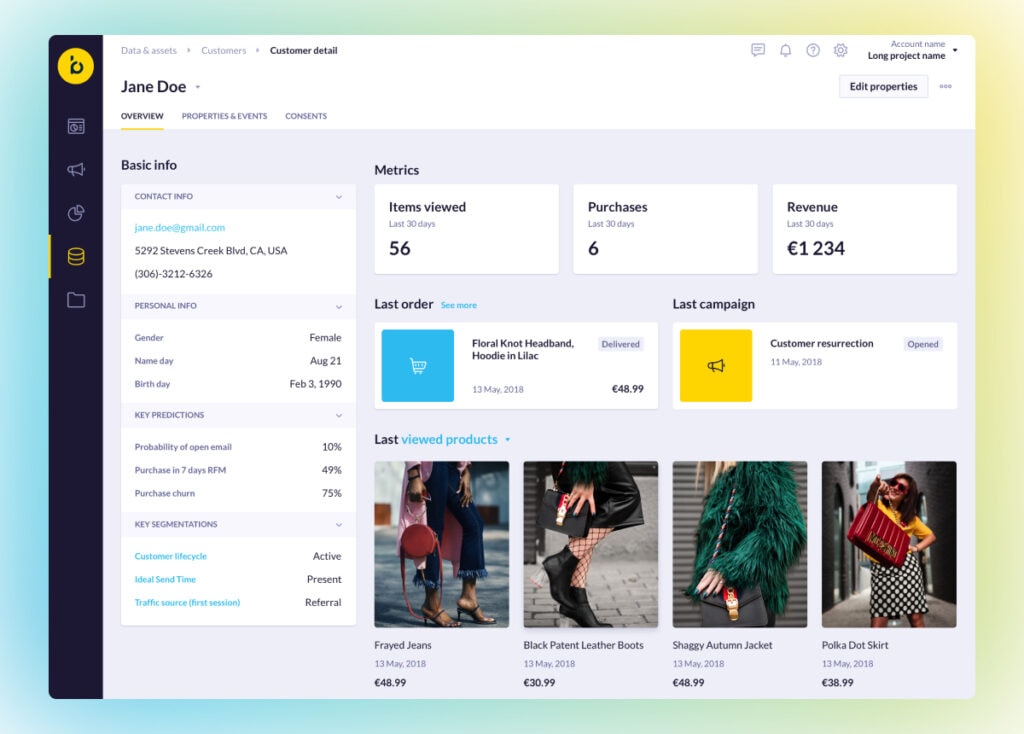
Bloomreach is an AI company for personalized customer engagement. Its intelligence layer, Loomi, is embedded across every Bloomreach app and agent, personalizing customer engagement in real time. Loomi provides a single customer view for each customer that holds their full event history, with segmentations, aggregates, and predictions calculated from this data. Where a recent-activity field tells you the last thing a customer did, the event timeline holds everything they’ve done. A profile can carry multiple hard identifiers, so an email address, a customer ID, and a loyalty card number can all anchor the same person, and anonymous browsing merges into the profile once the customer identifies themselves. In-store customers who only leave a phone number still get a profile.
Key capabilities:
- Full-history behavioral segmentation: timeline questions (“viewed the category three times, never purchased”) are standard segment logic
- Email, SMS, WhatsApp, RCS, web, mobile app, ad audiences, and more orchestrated from one profile
- One frequency policy across email, SMS, and push, with engagement-based limits per segment
- AI-powered ecommerce search and product discovery powered from the same data
- 100+ native integrations, including Shopify, Magento, BigCommerce, Snowflake, and Databricks
- An autonomous marketing agent for building campaigns from a plain-language objective
Best for: Mid-market to enterprise brands, in retail and beyond, that want personalization running on a complete behavioral profile rather than a snapshot of recent activity.
2. Klaviyo: Best for Self-Serve Email and SMS
Klaviyo is the default choice for ecommerce teams that want to run their own email and SMS without an implementation project. Native Shopify, BigCommerce, and WooCommerce integrations, prebuilt flows for the standard lifecycle moments (welcome, abandoned cart, post-purchase), and straightforward self-serve onboarding make it fast to stand up.
Best for: SMB to mid-market ecommerce brands that want a do-it-yourself platform their existing team can operate day one.
3. Insider One: Best for Mobile and Web Personalization
Insider One focuses on personalizing owned experiences, particularly web and mobile app, alongside its messaging channels. Journey orchestration ties the channels together, and its template library for on-site experiences (banners, recommendations, gamified capture) is extensive.
Best for: Mid-market to enterprise B2C teams that need strong mobile and web personalization alongside messaging.
4. Braze: Best for Consumer Apps and Mobile-First Brands
Braze specializes in real-time engagement for app-centric businesses: push notifications, in-app messaging, and event-triggered campaigns at high volume, orchestrated through its Canvas journey builder. Brands whose customer relationship lives primarily in an app get the deepest value. We’ve written a full guide to Braze competitors and alternatives if that’s the comparison you’re weighing.
Best for: Consumer apps, fintech, and mobile-first brands with dedicated marketing operations teams.
5. Iterable: Best for Enterprise Cross-Channel Orchestration
Enterprise teams that want orchestration depth with strong API access tend to shortlist Iterable. The platform offers cross-channel campaigns (email, SMS, push, in-app) built in a visual journey builder, on a data model that adapts well to custom schemas.
Best for: Large enterprises with marketing operations teams building complex cross-channel programs.
6. Salesforce Marketing Cloud: Best for Enterprises Standardized on Salesforce
Salesforce Marketing Cloud makes sense when the rest of the business already runs on Salesforce CRM: Journey Builder, Einstein AI features, and the broader Salesforce ecosystem connect marketing to sales and service data. Like Emarsys within SAP, it’s a platform whose strongest case is ecosystem fit. Our guide to Salesforce Marketing Cloud alternatives covers this comparison in depth.
Best for: Enterprises with existing Salesforce CRM investments and the teams to operate an enterprise suite.
7. Adobe Experience Cloud: Best for the Adobe Ecosystem
Adobe Experience Cloud (with Adobe Campaign and the Adobe Experience Platform) suits large enterprises already invested in Adobe’s analytics and content tools. Cross-channel campaign management plus deep integration with Adobe Analytics and Target rewards companies that commit to the full stack.
Best for: Large enterprises already running Adobe Creative Cloud, Analytics, or Target.
8. Dotdigital: Best for Mid-Market Email Automation
Dotdigital is a platform offering email, SMS, and WhatsApp with prebuilt commerce connectors for Magento, Shopify, and BigCommerce. For European mid-market teams leaving Emarsys who mainly need dependable email automation with commerce data, it’s a pragmatic, lower-complexity option.
Best for: Mid-market commerce teams that want straightforward email and SMS automation.
Emarsys Alternatives at a Glance
| Platform | Best For | Key Strength |
|---|---|---|
| Bloomreach | Real-time personalization on a full behavioral profile | Full event history + channels + search — all powered by Loomi |
| Klaviyo | Self-serve email and SMS | Shopify integration, ease of use |
| Insider One | Mobile and web experience personalization | On-site experience templates |
| Braze | Consumer apps and mobile-first brands | Real-time mobile engagement |
| Iterable | Enterprise cross-channel orchestration | Flexible data model, APIs |
| Salesforce Marketing Cloud | Enterprises standardized on Salesforce | Salesforce CRM integration |
| Adobe Experience Cloud | Adobe ecosystem enterprises | Analytics and content integration |
| Dotdigital | Mid-market email automation | Commerce connectors, simplicity |
Why Teams Leaving Emarsys Choose Bloomreach
For brands assessing Emarsys alternatives, the biggest factors they look to are features, ease of use, and how seamless the migration process will be. Loomi is trained on 15+ years of commerce data and use cases. By combining that expertise and your data into a single customer view, you can personalize customer experiences in real time.
Plus, a Forrester Total Economic Impact study found that a composite organization based on interviewed Bloomreach customers achieved 251% ROI over three years with payback within six months, driven partly by consolidating the separate CDP, analytics, and personalization tools a marketing automation platform usually sits beside.*
Learn more about how Bloomreach can meet your needs and support your migration. Book a demo, and we’ll build the segment in front of you, on a full event history, and show what your campaigns could do with it.
*The Forrester Total Economic Impact study was commissioned by Bloomreach and independently conducted by Forrester Consulting. Actual results may vary.
All trademarks, service marks, and company names referenced in this article are the property of their respective owners. Feature information is based on publicly available data as of October 2026 and is subject to change. Bloomreach does not guarantee the accuracy of third-party feature details.
Frequently Asked Questions
Is Emarsys now SAP Engagement Cloud?
Yes. SAP renamed the SAP Emarsys solution to SAP Engagement Cloud in February 2026. The existing product continues as the Emarsys Edition; a new Enterprise Edition, available from the same date, adds advanced administration, governance, and content and data-control capabilities for organizations running multiple brands, regions, and teams. SAP says existing Emarsys capabilities remain available, and customers can adopt new ones incrementally — what changes most is the strategic frame around the product.
What are the best Emarsys alternatives?
The strongest Emarsys alternatives in 2026 are Bloomreach, Klaviyo, Insider One, Braze, Iterable, Salesforce Marketing Cloud, Adobe Experience Cloud, and Dotdigital. Your best bet is to match the solution to your specific situation. For example, Bloomreach for real-time personalization on full behavioral profiles, Klaviyo for self-serve SMB email and SMS, Braze for mobile-first brands, and Salesforce or Adobe when you’re already committed to those ecosystems.
Is Emarsys a CDP?
Emarsys includes a customer database, but SAP sells its customer data platform as a separate product. If CDP capabilities matter to your evaluation, ask any vendor, including us, to demonstrate segmentation on full behavioral history rather than recent-activity fields.
Does switching from Emarsys mean rebuilding everything from scratch?
Not necessarily. Customer data, consent records, and campaign engagement history can typically be migrated, and core lifecycle automations are typically rebuilt quickly in a modern visual builder. Planning a parallel run ahead of your renewal date helps minimize disruption at cutover.
Should I choose Emarsys or Klaviyo?
They serve different situations. Klaviyo is self-serve, fast to launch, and priced for SMB-to-mid-market ecommerce; Emarsys (now SAP Engagement Cloud) targets enterprise retail, particularly SAP-based businesses. Teams whose needs fall between the two may also want to evaluate solutions like Bloomreach.