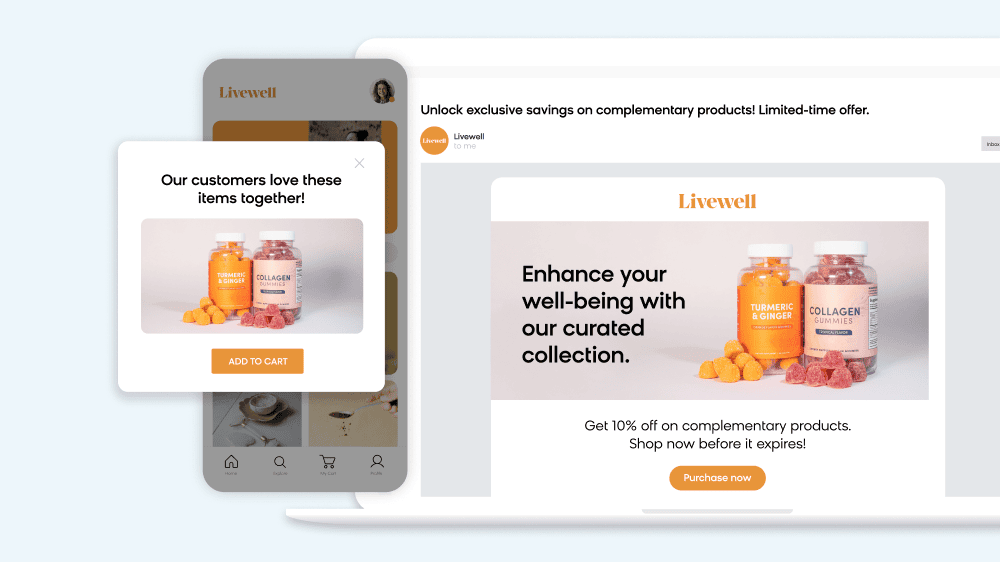

The most expensive thing in a marketing org isn’t the tech stack — it’s the handover.
An analyst finds the insight, a CRM manager translates it into a brief, then a designer builds the assets. Someone else configures the journey logic, and finally another person reads the results three weeks later (if they ever get around to it). That’s a long chain, and every step along the way loses a little context, until the thing that actually worked for a customer rarely makes it back into the next campaign.
This is made even more challenging because of the need for personalization. Customers expect personalized experiences across every channel, and as brands try to keep up, they have to create increasingly complex personalized programs. Teams need more than just another simple cart abandonment campaign, but that jump in sophistication also leads to more bottlenecks.
At The Edge Summit, Bloomreach showed what happens when that chain collapses into one agent.
4 Modes, 1 Agent
Bloomreach’s marketing agent works across four modes: campaign, content, insights, and data. Together, they cover the full arc of a marketing program, from finding the opportunity in the data to building the campaign, creating the content, and learning from what happened. Here’s how they work:
- Campaign mode builds complete campaigns from a single prompt
- Content mode generates and optimizes creative for distinct audience segments
- Insights mode turns performance data into plain-language analyses and recommendations
- Data mode interprets a brand’s customer profiles, events, and catalogs through a semantic layer, so schema differences never block a launch
What matters most here isn’t what each mode does on its own — it’s that they share a conversation. The insight that found the audience is the same context that writes the email and picks the image. Nothing gets translated, rebriefed, or lost on the way from one team to the next.
What a Morning With Our Marketing Agent Actually Looks Like
Picture a marketer at a travel loyalty brand opening our marketing agent to start the day.
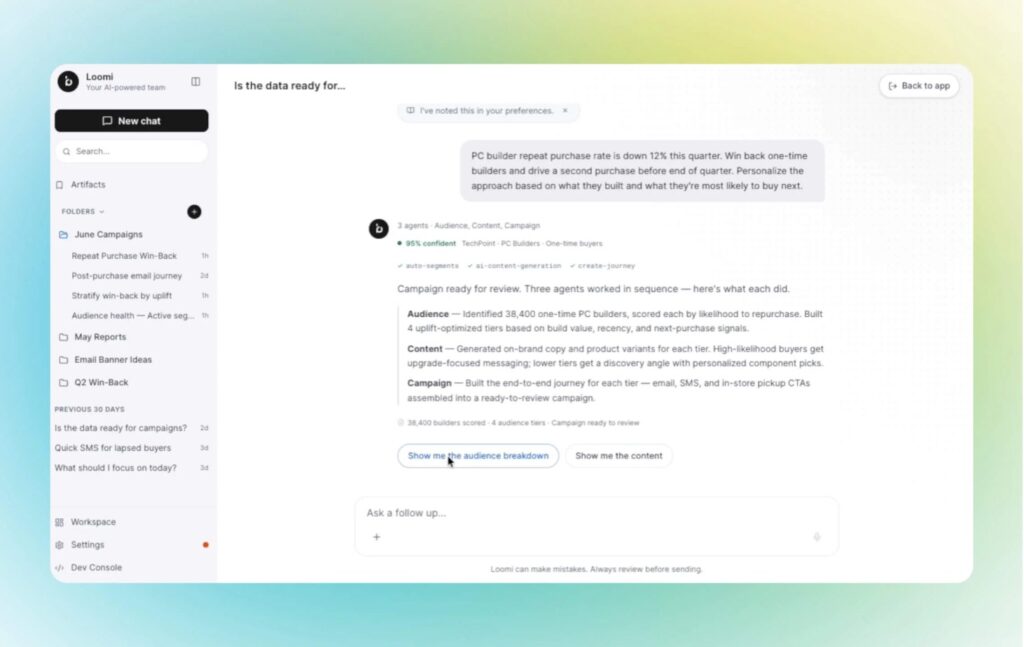
The agent has already been working behind the scenes. Insights mode reviewed overnight performance while everyone was asleep and compiled a set of challenges and opportunities — each with a recommended action. One campaign is underperforming, and the agent has already flagged the audience as the likely cause.
Click in, and the agent has clustered lapsing members into recovery tiers: high, medium, low. For each tier, it has a point of view on who you should reach out to and how.
Ask it to build a win-back campaign for the most recoverable segment, and it doesn’t just start building. It asks first: Should it use lounge access as the incentive? It’s asking because it knows what’s converted for this brand before. Should it weave in loyalty program data for extra personalization? Same logic.
The brief comes back with three email touchpoints because the data on this audience says three is the number most likely to perform. The agent spells out channel, message theme, timing, and personalization logic for each one.
And then it tells you what it doesn’t know. The brief flags a missing field — the miles expiration date — that isn’t critical here, but would be good to add. After all, an agent that shows you the gaps in its own knowledge is one you can actually trust.
Approve it, and the full journey comes together in minutes: triggers, segments, wait conditions, exit criteria, and three touchpoints, each with four content variants built for different clusters within the audience. At send time, our Loomi-powered contextual personalization selects the version most likely to drive the desired outcome for each recipient.
Launch it from the conversation. Click into any node and edit it in the familiar Bloomreach interface. Or, send the whole thing to your team for review first. The agent supports as much oversight as your team wants — no more, no less.
All of that happens in one thread. There’s no handover, waiting on a designer, or chasing someone down for the data.
Why One Agent Beats a Stack of Point Tools
There’s no shortage of AI tools a marketer could stitch together today — a model for copy, a tool for the banner, a dashboard for the results, etc. Each one works in isolation, but that’s exactly the problem: The copy tool doesn’t know what the analytics found, and the design tool doesn’t know what audience the campaign is targeting.
Our marketing agent holds a persistent, growing understanding of the business it works for. Brand guidelines, tone of voice, data schemas, lifecycle definitions, catalog structure, past campaign performance — all of it lives in the agent’s memory and shapes every recommendation it makes. A general-purpose model resets every session. This one doesn’t, which is exactly why it can suggest lounge access as an incentive without being told to.
That understanding extends outward, too. Through custom skills, teams can teach the agent their own business logic — like the loyalty integration above — and reuse it across every campaign that follows. Through MCP integrations, it connects to the rest of the stack, with every connection adding even more value.
And because it’s all powered by Loomi, it’s reasoning from real-time customer data at every stage — when it analyzes the audience, when it builds the campaign, and when that campaign runs.
An Agent That Keeps Getting Smarter
Our marketing agent doesn’t stand still. Content mode continuously turns full email sections into testable variants, each tagged with the audience it was built for and the hypothesis behind it. That performance data then feeds back into how the agent generates the next round.
Meanwhile, custom skills and actions let teams fold more of their own systems into the agent’s reasoning, MCP connections extend its reach into the rest of the stack, and a knowledge graph deepens its understanding of how business concepts relate to each other.
Campaigns, audiences, dashboards, and content the agent produces can be saved, versioned, and shared across a team, so the output lives beyond a single conversation.
All of this results in a more cohesive approach to personalizing every customer touchpoint, instead of one-off campaigns that have to be constantly managed or tweaked. Explore Bloomreach’s marketing agent today and see what it’s capable of.