
Legacy platforms helped usher in digital marketing at scale, but the requirements have shifted. Modern marketers now look for intelligent orchestration, fast deployment, and autonomous personalization across unified journeys.
As AI disrupts marketing workflows in 2026, agentic platforms (AI-native tools that learn, adapt, and act across unified journeys) are becoming essential. Salesforce Marketing Cloud’s pricing is not published publicly and varies by contact volume, modules, and multi-cloud configuration, so teams typically assess it through direct vendor engagement alongside the alternatives covered in this guide.
The nine platforms in this guide each take a different approach to closing the gap between legacy architecture and modern marketing requirements.
Why 2026 Demands a New Kind of Enterprise Marketing Platform
Traditional marketing platforms excelled when email campaigns and basic segmentation defined digital marketing success. But 2026 presents different requirements that expose the limitations of platforms built through decades of acquisitions rather than a unified architectural vision.
Modern enterprise marketers need real-time personalization across channels, unified data systems that eliminate silos, and tools that operate autonomously rather than simply automate predefined rules. The rise of AI agents and conversational commerce has accelerated demand for platforms that learn and adapt in real time, keeping pace with customer behavior as it happens rather than catching up hours or days later.
The Rise of AI-Native Enterprise Marketing Architecture
AI-native architectures are redefining enterprise marketing capabilities beyond traditional automation. These platforms continuously learn from customer interactions across all enterprise touchpoints and adjust strategies in real time, moving well past executing predefined workflows. AI-powered ecommerce tools now drive product recommendations, content personalization, and customer journey optimization simultaneously, creating cohesive experiences that adapt in real time to individual customer behavior across every touchpoint.
Enterprise organizations increasingly look for platforms that integrate cleanly with best-of-breed solutions, giving teams the flexibility to combine specialized tools across their technology stack. This flexibility becomes especially valuable for organizations managing complex technology ecosystems and diverse customer segments.
Traditional Limitations
Salesforce Marketing Cloud remains a capable platform, and any fair evaluation should start with what it genuinely does well before examining where modern requirements expose gaps. The points below describe the legacy marketing cloud category broadly, with Salesforce Marketing Cloud as the prime example.
What Still Works
- Salesforce CRM integration: For organizations already running Sales Cloud and Service Cloud, the native data flow between CRM and marketing activation is a real advantage, reducing the integration work that independent platforms require.
- Einstein AI and Journey Builder maturity: Salesforce Marketing Cloud has had years to develop its AI layer (Einstein) and its visual journey orchestration, and many enterprise teams have deep institutional knowledge of how to operate them.
- Ecosystem and partner depth: The AppExchange marketplace, the certified consultant network, and the breadth of available integrations give large organizations confidence for complex, multi-team deployments.
- Comprehensive feature coverage: The platform spans email, mobile messaging, advertising, and analytics, which appeals to enterprises seeking to consolidate vendors under unified contracts.
Critical Modern Limitations
- Patchwork architecture from acquisitions: Many traditional platforms reflect histories of acquiring separate companies rather than building unified architecture. Users frequently report frustration with inconsistent interfaces, duplicate functionality across modules, and data silos between components.
- Rule-based vs. autonomous learning: Traditional personalization relies heavily on predefined rules and segments rather than real-time machine learning. This approach conflicts with modern consumer expectations for sophisticated personalization across all touchpoints.
- Implementation complexity and speed-to-market: Traditional deployments for enterprise organizations typically require 6-12 months and extensive IT involvement. This timeline conflicts with the rapid experimentation and iteration that AI-driven marketing demands.
- Limited real-time responsiveness: Legacy batch processing architectures struggle with the real-time personalization that modern digital experiences require. This limitation becomes particularly apparent in ecommerce scenarios where recommendations must adapt instantly to user behavior.
A Strategic Framework for Evaluating Enterprise Alternatives
Selecting the right enterprise marketing platform requires moving beyond traditional feature checklists to evaluate capabilities through the lens of future marketing requirements. This framework addresses the strategic and operational realities that will define enterprise marketing success over the next three to five years.
1. Native AI & Autonomous Functionality for Enterprise Scale
Modern enterprise marketing platforms must demonstrate AI capabilities built into their core architecture, integrated by design rather than bolted on as afterthoughts. Evaluate whether the platform provides autonomous orchestration across customer touchpoints, predictive decisioning that improves over time, and real-time learning from every customer interaction across your entire enterprise customer base.
Key indicators include AI models trained on your specific data, automatic optimization of campaign elements without manual intervention, and intelligent audience creation based on behavioral patterns rather than static demographics, all at enterprise scale.
2. Unified, Real-Time Data Architecture
The platform should eliminate data silos through unified customer profiles that update in real time across all touchpoints. This means low-latency data pipelines that capture behavioral, transactional, and identity information as it occurs through continuous streaming rather than overnight batch processes, which is critical for enterprise organizations with high-volume customer interactions.
Look for single customer views that reflect actions across web, mobile, email, and offline channels; real-time event streaming capabilities; and the ability to act on data within minutes of collection across complex enterprise customer journeys.
3. Omnichannel Personalization at Enterprise Scale
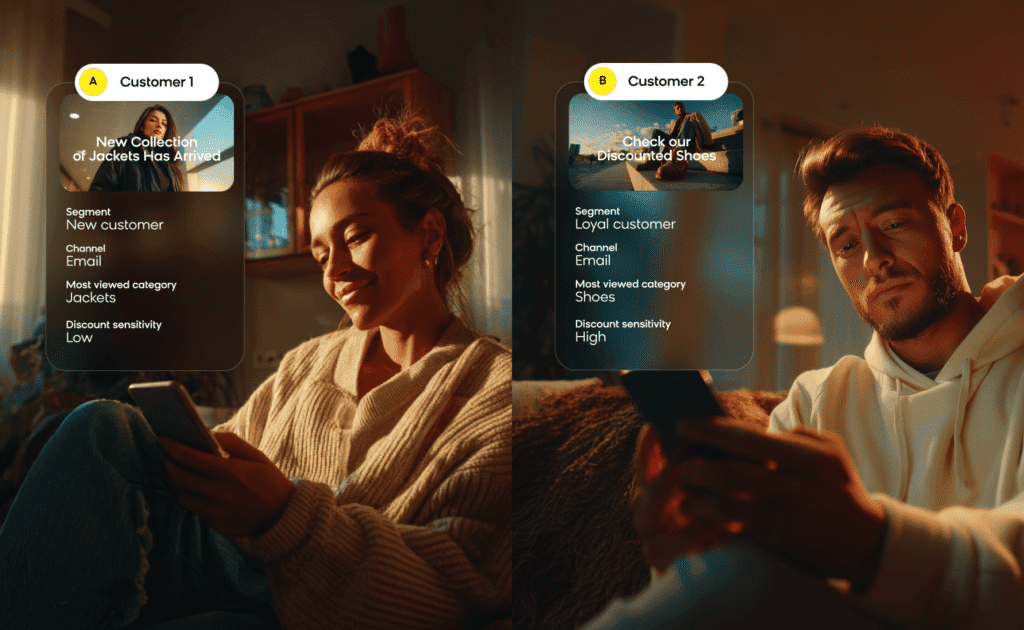
True omnichannel execution requires consistent personalization logic across email, SMS, push notifications, website content, mobile apps, and advertising channels. The platform should maintain context and continuity as customers move between touchpoints, managing the complexity of enterprise-level customer interactions.
Essential capabilities include cross-channel message orchestration, consistent product recommendations across all touchpoints, and the ability to suppress communications across channels to prevent over-messaging, all while handling enterprise-volume customer interactions.
4. Speed to Value and Market Responsiveness
Enterprise marketing teams need platforms that enable rapid experimentation and iteration despite organizational complexity. Evaluate implementation timelines, the complexity of creating new campaigns or customer journeys, and how quickly team members can become productive without extensive training (see also: building a segmentation strategy that doesn’t require technical specialists).
You also need to consider the time it takes to go from contract signing to the first campaign launch, how easy it is to build complex automated workflows, and whether your teams can operate independently without constant IT support.
5. All-Inclusive or Interoperable Architecture
The platform should inherently have all the tools you need to personalize the entire customer experience, including product discovery, marketing, conversational shopping, and more. If these features aren’t built in, then the platform should at least integrate cleanly with existing enterprise technology investments and best-of-breed solutions.
Assess API-first design, prebuilt connectors to common enterprise systems, and the platform’s approach to data sharing with other tools in your complex enterprise stack.
6. Business-First User Experience
Enterprise marketing platforms should empower marketing professionals, not require technical specialists for routine tasks. The interface should reflect how marketing teams think about customer journeys and campaign creation, even within complex enterprise environments.
Evaluate whether non-technical users can build sophisticated automations, how much of a learning curve there is for new team members, and how much time users spend navigating the platform versus creating customer value across multiple enterprise initiatives.
Organizations can apply this framework alongside comprehensive stack audits and total cost of ownership analysis to make informed platform decisions that align with both current enterprise needs and future growth requirements.
Leading Salesforce Marketing Cloud Alternatives: 2026 Enterprise
The marketing technology field offers numerous alternatives to traditional marketing clouds, each with distinct strengths and ideal use cases for enterprise organizations. Using our six-point evaluation framework, here’s how leading platforms address critical modern enterprise marketing requirements.
1. Bloomreach
Bloomreach is purpose-built for AI-driven personalization, unifying commerce, content, and customer engagement in a single platform designed for enterprise scale. Powered by Loomi, it stands out for real-time decisioning, rapid deployment, and autonomous optimization across all touchpoints. The platform fits enterprise ecommerce and retail brands that need sophisticated personalization at scale without the complexity of traditional marketing clouds.
Bloomreach’s unified architecture eliminates the common enterprise problem of managing multiple disconnected systems, while its AI-native design provides autonomous optimization that continuously improves performance without requiring constant manual intervention. The platform’s composable approach enables clean integration with existing enterprise technology investments while providing integrated capabilities across commerce, content, and customer engagement.
Key capabilities:
- Loomi: autonomous journey orchestration, real-time product recommendations, and predictive segmentation that continuously learns from customer behavior
- Unified CDP: real-time single customer view across web, mobile, email, and offline touchpoints, updated as events occur
- Ecommerce-native architecture: product discovery and marketing automation operate as a single system rather than separate tools that need to be reconciled
- Loomi Connect: out-of-the-box integrations with composable stack partners, including the ability to surface personalization in conversational channels like ChatGPT
Best for: Mid-market to enterprise ecommerce and retail brands that need product-catalog-aware personalization, omnichannel journey orchestration, and a commerce-native CDP in one platform.
Motorpoint, the UK’s largest independent retailer of nearly new and used cars, migrated directly from Salesforce Marketing Cloud to Bloomreach. Their CRM team had been spending significant time on manual campaign setup, and their previous platform’s automation logic couldn’t account for the extended, research-heavy purchase cycles typical in used car retail. After the migration, Motorpoint cut the time its CRM team spent on email production by 40% per week and saw a 50% uplift in product recommendation email performance. Real-time behavioral tracking and automated journey orchestration allowed the team to reclaim time previously consumed by manual processes and redirect it toward higher-level strategy.
Other retailers have seen similar results. Veke, Finland’s fastest-growing online furniture retailer, achieved a 58% increase in automated campaign revenue after adopting Bloomreach’s behavior-based marketing automation. A Forrester Total Economic Impact (TEI) study commissioned by Bloomreach* found that companies using its marketing automation solution can see up to a 251% ROI over three years, with payback within six months.
Bloomreach is most fully realized for commerce-focused enterprises; organizations primarily seeking B2B lead nurturing without an ecommerce component may find certain features more marketing-automation-centric than they require.
2. Adobe Experience Platform
Adobe Experience Platform is a wide-ranging suite with strong creative integration and advanced analytics capabilities built for large enterprises already invested in the Adobe ecosystem. It combines a real-time CDP, Journey Optimizer for cross-channel orchestration, Marketo Engage for B2B automation, and GenStudio for content creation into an integrated stack.
For organizations already running Adobe Creative Cloud, this integration reduces the friction of moving assets from creative production into campaign execution. Journey Optimizer handles cross-channel journey design and can pull on real-time profile data from the CDP layer, while Marketo Engage covers B2B lead nurturing with account-based marketing features that many enterprise teams rely on.
Key capabilities:
- Real-time CDP: unified customer profiles built from behavioral, transactional, and identity data across channels
- Journey Optimizer: cross-channel orchestration covering email, push, SMS, and in-app messaging with real-time decisioning
- Marketo Engage: B2B marketing automation with account-based marketing and lead management
- GenStudio: AI-assisted content creation and activation designed to accelerate creative-to-campaign workflows
Best for: Large enterprises already invested in the Adobe Creative Cloud ecosystem that need tight integration between content creation, campaign execution, and customer data.
Implementation complexity is a real factor to plan for. Adobe Experience Platform typically requires Adobe Professional Services or a certified systems integrator partner to deploy at enterprise scale, which extends timelines and total cost of ownership beyond licensing fees alone.
3. Oracle Marketing Cloud
Oracle Marketing Cloud brings together B2B and B2C marketing automation under one vendor umbrella, with a particular emphasis on deep integration with Oracle’s broader ERP and CRM infrastructure. For enterprises already running Oracle back-office systems, the data connectivity between marketing and operations can reduce the custom integration work that independent platforms require.
The platform covers the core enterprise use cases: Eloqua handles B2B marketing automation and lead management, Responsys manages B2C email and mobile programs, Oracle Unity provides a CDP layer, and Oracle’s data management platform supports audience segmentation and targeting.
Key capabilities:
- Eloqua: B2B marketing automation with sophisticated lead scoring, nurture programs, and sales alignment workflows
- Responsys: B2C email and mobile messaging with personalization and lifecycle automation
- Oracle Unity: CDP layer that unifies customer data across Oracle’s marketing, sales, and service products
- Data management platform: audience segmentation, third-party data integration, and targeting for advertising campaigns
Best for: Enterprises with existing Oracle ERP or CRM investments that want tight data unification between back-office operations and marketing execution.
Oracle’s platform breadth means teams typically invest in training before reaching full productivity, so organizations should factor onboarding timelines into their evaluation.
4. SAP Emarsys
SAP Emarsys is an AI-powered platform with a strong retail and ecommerce focus, built for brands that want pre-configured tactics rather than starting from a blank canvas. The platform’s approach to omnichannel engagement is built around retail-specific use cases (win-back campaigns, post-purchase sequences, seasonal promotions) that come ready to activate rather than requiring teams to build from scratch.
For brands already running SAP ERP, the native data integration between back-office inventory, order management, and marketing activation is a genuine differentiator. Product availability, purchase history, and loyalty data flow into campaign logic without requiring custom connector work.
Key capabilities:
- Omnichannel engagement: email, mobile, web, and advertising channels coordinated through a single campaign interface
- AI-driven product recommendations: personalized product feeds that update based on browsing and purchase behavior
- Prebuilt retail and ecommerce tactics: library of ready-to-use campaign programs for common retail marketing scenarios
- Native SAP data integration: direct connection to SAP ERP data for inventory-aware and order-informed personalization
Best for: Retail and ecommerce brands already running SAP ERP that want tight data unification between their back-end systems and marketing execution.
Organizations without SAP infrastructure can still use Emarsys, but the native integration advantage that differentiates it from other mid-market platforms becomes less applicable without that back-end data connection.
5. Insider
Insider is a growth-focused platform built around cross-channel journey orchestration with particular strength in mobile and web personalization. Its visual-first workflow approach makes it accessible to marketing teams that want to build and iterate on journeys without deep technical involvement in day-to-day campaign management.
The platform has expanded from its roots in web personalization and overlays into a more complete engagement platform covering email, SMS, push notifications, and app messaging. Its Architect journey builder uses a drag-and-drop interface that lets teams visualize and adjust multi-step customer journeys in real time.
Key capabilities:
- Cross-channel journey builder: visual orchestration tool covering email, SMS, push, web, and app with real-time branching logic
- Architect: drag-and-drop journey design interface built for marketing teams rather than technical users
- AI-powered product recommendations: behavioral recommendation engine that adapts to browsing and purchase patterns
- Web personalization and overlays: on-site experience tools including pop-ups, banners, and dynamic content blocks
Best for: Mid-market to enterprise teams that need strong mobile and web personalization with a visual-first workflow, particularly in digital-first markets where speed of iteration matters.
Teams with highly complex data architectures or requirements for dedicated enterprise CDP capabilities may find Insider’s data infrastructure less deep than purpose-built CDP solutions.
6. MoEngage
MoEngage is a mobile-first platform that has expanded into broader omnichannel marketing automation, with particular strength in app engagement, push notifications, and markets where mobile usage dominates customer interactions. The platform’s analytics layer gives teams visibility into funnel behavior and drop-off points, which feeds back into campaign optimization.
Its strength in Asia-Pacific and Southeast Asia markets reflects both its origins and its continued investment in the push notification and WhatsApp channels that are central to customer communication in those regions. For brands with significant mobile app user bases, MoEngage provides the behavioral trigger depth and channel coverage those programs require.
Key capabilities:
- Behavior-triggered campaigns: event-based automation that fires messages based on in-app actions, purchase events, and browsing signals
- AI-driven send time optimization: machine learning models that identify the best delivery time for each individual user
- Push, email, SMS, and WhatsApp orchestration: multi-channel coordination across the channels most relevant to mobile-first audiences
- Funnel analytics: built-in analytics that map user journeys and identify where engagement drops off
Best for: Mobile-first brands in Asia-Pacific, Southeast Asia, and emerging markets that need strong push notification capabilities and app-centric engagement workflows.
Brands whose personalization requirements center on product catalog intelligence and deep ecommerce discovery may want to evaluate commerce-native platforms alongside MoEngage.
7. Klaviyo
Klaviyo has built a strong position in the DTC and ecommerce space by making sophisticated email marketing and SMS accessible to brands that don’t have large marketing operations teams. Its native Shopify integration is a genuine differentiator for brands on that platform, enabling real-time behavioral triggers, cart abandonment flows, and post-purchase sequences that activate without custom connector work.
The platform’s predictive analytics layer adds customer lifetime value forecasting and churn probability scores to its segmentation engine, which lets brands prioritize high-value audiences without building models from scratch. Prebuilt ecommerce flows cover the most common use cases out of the box.
Key capabilities:
- Email and SMS with native Shopify integration: real-time event triggers from Shopify that activate campaigns without custom development
- Predictive analytics: customer lifetime value forecasting, churn probability, and next purchase date models built on purchase history
- Segmentation engine: behavioral and predictive segments that power targeted sends and dynamic content
- Prebuilt ecommerce flows: ready-to-use sequences for cart abandonment, welcome series, post-purchase, and win-back programs
Best for: Direct-to-consumer and SMB to mid-market ecommerce brands on Shopify or similar platforms that want fast time-to-value from email and SMS without heavy technical setup.
Enterprise scalability and omnichannel complexity beyond email and SMS can require supplementary tools as brands grow into more sophisticated cross-channel personalization requirements.
8. HubSpot
HubSpot is a comprehensive inbound marketing platform with integrated CRM functionality built for teams that want marketing and sales data under one roof. Its approach to contact management, lead nurturing, and pipeline visibility makes it a natural fit for B2B organizations where the handoff between marketing and sales is central to how revenue gets generated.
The platform’s learning curve is notably gentler than traditional enterprise marketing clouds, which lowers the barrier to adoption for teams without dedicated marketing operations resources. Marketing Hub covers email, ads, social, and forms, while the CRM layer connects campaign activity directly to deal pipeline and contact records.
Key capabilities:
- Marketing Hub: email, advertising, social media, and form tools with native CRM data feeding segmentation and personalization
- CRM-native contact management: unified contact records that capture marketing touchpoints, sales interactions, and service history
- Sales Hub integration: direct connection between marketing programs and sales pipeline, enabling lead scoring and handoff workflows
- Content management and SEO tools: blog, landing page, and website tools with built-in SEO recommendations
Best for: B2B organizations and inbound-focused teams that want CRM and marketing under one roof with a gentle learning curve and clear visibility into how marketing activity connects to pipeline.
Large-scale ecommerce personalization and real-time behavioral triggers at enterprise volume can stretch HubSpot’s native capabilities, making it less suited for high-complexity B2C scenarios.
9. Braze
Braze is a customer engagement platform built for real-time, cross-channel messaging at scale. Originally built with mobile-first architecture, Braze has expanded into a comprehensive engagement platform covering push notifications, email, SMS, in-app messaging, content cards, and web push, all orchestrated through a visual Canvas journey builder.
The platform’s real-time data processing is a core differentiator. Rather than relying on batch imports or overnight syncs, Braze processes customer events as they occur and can trigger relevant messages within seconds of a qualifying action. This makes it well suited for high-frequency interaction environments like consumer apps, financial services, and subscription products where timing is central to engagement outcomes.
Key capabilities:
- Canvas Flow: a drag-and-drop journey orchestration tool that handles multi-step, cross-channel campaigns with real-time branching logic and experiment paths for A/B testing within journeys
- Currents: a real-time data streaming feature that exports engagement data to data warehouses and analytics platforms as events occur, keeping downstream systems current
- Predictive Suite: machine learning models for churn prediction and purchase likelihood, enabling proactive outreach before disengagement
- Connected Content: dynamic content blocks that pull live data from external APIs at send time, enabling contextual personalization based on current inventory, pricing, or user state
Best for: Consumer apps, fintech, media, and retail brands with a strong mobile and app user base that need sophisticated push and in-app messaging alongside email and SMS.
Braze’s strength is in engagement orchestration; teams looking for deep ecommerce product discovery, site search, or a native CDP with product catalog intelligence may need to layer additional tools to cover those use cases.
For teams evaluating Braze alongside other platforms, see our full Braze competitors and alternatives guide.
To help enterprise teams quickly orient their evaluation, here’s how the nine platforms compare across key selection dimensions:
| Platform | Best For | Key Differentiator | Pricing Tier |
|---|---|---|---|
| Bloomreach | Commerce-focused enterprise | AI-native CDP + product discovery + marketing automation in one platform | Enterprise (custom) |
| Adobe Experience Platform | Large enterprises in Adobe ecosystem | Real-time CDP + Journey Optimizer + Marketo as integrated suite | Enterprise (custom, high) |
| Oracle Marketing Cloud | Oracle ERP/CRM customers | Deep back-office integration (Eloqua + Responsys + Unity) | Enterprise (custom) |
| SAP Emarsys | Retail/ecommerce with SAP infrastructure | Prebuilt retail tactics + native SAP data integration | Mid-market to enterprise |
| Insider | Mobile + web personalization, visual workflows | Architect journey builder + strong mobile and overlay capabilities | Mid-market to enterprise |
| MoEngage | Mobile-first brands, APAC/emerging markets | Behavior-triggered campaigns + strong push notification stack | Mid-market |
| Klaviyo | DTC and SMB/mid-market ecommerce | Native Shopify integration + predictive CLV analytics | SMB to mid-market |
| HubSpot | B2B inbound, CRM-centric teams | All-in-one CRM + marketing hub with low learning curve | SMB to mid-market |
| Braze | Consumer apps, fintech, mobile-first brands | Canvas journey builder + real-time mobile/push engagement | Mid-market to enterprise |
Pricing tiers reflect general market positioning; all platforms at the enterprise tier require direct vendor engagement for accurate quotes based on contact volume, channel usage, and integration complexity.
How Bloomreach Addresses These Enterprise Requirements
Bloomreach was built from the ground up as an AI-native platform designed for enterprise scale, addressing the convergence of commerce, content, and customer engagement rather than layering intelligence onto a traditional marketing automation foundation.
A Unified, Future-Proof Platform for Enterprise Customer Experience
Loomi is an intelligence platform that personalizes the entire customer experience in real time. It combines first-party data, real-time infrastructure, AI decisioning and agents, omnichannel orchestration, and continuous optimization, all within a single platform.
Loomi connects all of a brand’s touchpoints directly to create individually personalized journeys. This means enterprise marketing teams can orchestrate sophisticated customer journeys across multiple touchpoints without switching between disconnected interfaces or reconciling conflicting data models.

And, with conversational channels rapidly becoming another way for consumers to shop, you need a platform And, with conversational channels rapidly becoming another way for consumers to shop, you need a platform that can personalize for those channels without tacking on another point solution that doesn’t communicate with everything else. With Loomi Connect, you can surface your personalization to ChatGPT and similar apps, giving you greater control over how your brand shows up in these new channels.
Deeper Personalization Across Every Channel
Loomi learns from each customer’s interactions to automatically optimize everything from email send times and product recommendations to search and conversational shopping. This real-time data engine uses first-party data to understand the most relevant content on an individual basis, even across channels.
Loomi adapts autonomously as customer behavior evolves, eliminating the constant manual updates and testing that rule-based personalization requires across complex enterprise customer journeys. This capability proves particularly valuable for seasonal businesses, product launches, or market expansions where traditional segmentation approaches fail to capture rapidly changing customer preferences and behaviors across diverse enterprise customer segments.
Greater Efficiency With a Multi-Agent Architecture
For marketers and merchandisers, achieving outcomes is often the roadblock they have to overcome to work at enterprise scale. Loomi uses a multi-agent architecture, including powerful Campaign Agents, to give marketing teams the efficiency they need to operate across enterprise audiences.
For example, Campaign Agents can take an objective set by a marketer, then create an editable brief for the marketer to tweak. From there, Campaign Agents are designed to build the campaign scenario and orchestrate it across channels, helping marketers reduce the manual processes that consume their days so they can focus more time on higher-level strategy, creativity, and optimization.
Demonstrable Enterprise Business Impact
Enterprise organizations implementing Bloomreach typically experience:
- Accelerated deployment: Standard implementations can be completed within 90 days for standard use cases (based on Bloomreach customer data), a meaningful improvement over the 6-12 month timelines that enterprise teams commonly report for legacy platform deployments
- Reduced technical complexity: The consolidation of multiple point solutions into a single platform eliminates integration overhead and reduces the total cost of ownership for enterprise IT departments
- Continuous performance improvement: AI-driven optimization delivers ongoing improvements without requiring constant manual testing and optimization programs across multiple enterprise customer segments
- Fast results: A Forrester TEI study commissioned by Bloomreach* found that companies using its marketing automation solution can see up to a 251% ROI over three years, with ROI payback within 6 months
The platform’s AI-first architecture enables continuous improvement that compounds over time, rather than requiring constant manual optimization and testing to maintain performance levels across complex enterprise marketing initiatives.
Choosing the Right Platform for What’s Next
The marketing technology field offers numerous options across different price points and capability levels, but it’s crucial for organizations to choose a platform that will remain relevant and valuable as customer expectations and competitive requirements continue evolving rapidly across complex enterprise environments.
You need to look at platforms that can personalize across all your channels and handle new shopping channels (like ChatGPT) as they see wider adoption. This transition from legacy processes to autonomous intelligence changes how teams approach customer relationship management, competitive differentiation, and sustainable growth strategies in the modern marketplace.
Ready to transform your enterprise marketing capabilities? Book a personalized demo with Bloomreach today to see how Loomi’s real-time personalization and autonomous journey orchestration can be applied to your catalog and customer data.
*The Forrester Total Economic Impact study was commissioned by Bloomreach and independently conducted by Forrester Consulting. This study reflects a composite organization based on Bloomreach customer interviews; actual results may vary.
Frequently Asked Questions
What is Salesforce Marketing Cloud pricing?
Salesforce Marketing Cloud does not publish a single public price; costs vary significantly by edition, contact volume, and the modules included. Marketing Cloud Engagement is generally positioned at the enterprise tier, with costs that scale significantly based on contact volume, channel usage, and the add-on modules required. Total costs vary significantly by configuration, so organizations with complex multi-cloud requirements should request a detailed quote that accounts for all modules, contact volume, and integration needs. For current pricing, direct engagement with Salesforce sales is required.
What are the best Salesforce Marketing Cloud alternatives for ecommerce?
For ecommerce-focused enterprises, the strongest Salesforce Marketing Cloud alternatives are platforms that combine real-time behavioral data with product-catalog-aware personalization. Bloomreach is purpose-built for this use case, unifying product discovery, marketing automation, and a commerce-native CDP. SAP Emarsys offers strong prebuilt retail tactics for brands already in the SAP ecosystem. Klaviyo excels for DTC ecommerce brands, particularly on Shopify. The right choice depends on your catalog complexity, customer data architecture, and whether you need site search and product discovery alongside campaign orchestration.
What’s the difference between “competitors” and “alternatives” for Salesforce Marketing Cloud?
In practice, the terms are used interchangeably when evaluating platforms. “Competitors” typically refers to platforms that compete directly at the enterprise level for the same budget and use cases: Adobe Experience Platform, Oracle Marketing Cloud, and SAP Emarsys compete directly with Salesforce at the high end. “Alternatives” has a broader meaning: it includes any platform that can replace SFMC for a specific team’s needs, which is why mid-market tools like Klaviyo or HubSpot also appear on alternative lists despite different positioning. The right framing depends on your organization’s scale and requirements.
Is Bloomreach a Salesforce Marketing Cloud competitor?
Yes. Bloomreach competes directly with Salesforce Marketing Cloud for enterprise marketing budgets, particularly among retail, ecommerce, and consumer brand organizations. Bloomreach’s AI-native architecture (combining Loomi, a unified CDP, and product discovery) addresses the same core use cases as SFMC (customer journey orchestration, email and SMS personalization, segmentation) while adding commerce-specific capabilities that go beyond SFMC’s core marketing automation focus. Motorpoint’s direct migration from SFMC to Bloomreach (detailed earlier in this guide) is one real-world example of an enterprise retailer making that switch. For a full comparison of how Bloomreach stacks up against other alternatives, see Bloomreach alternatives.