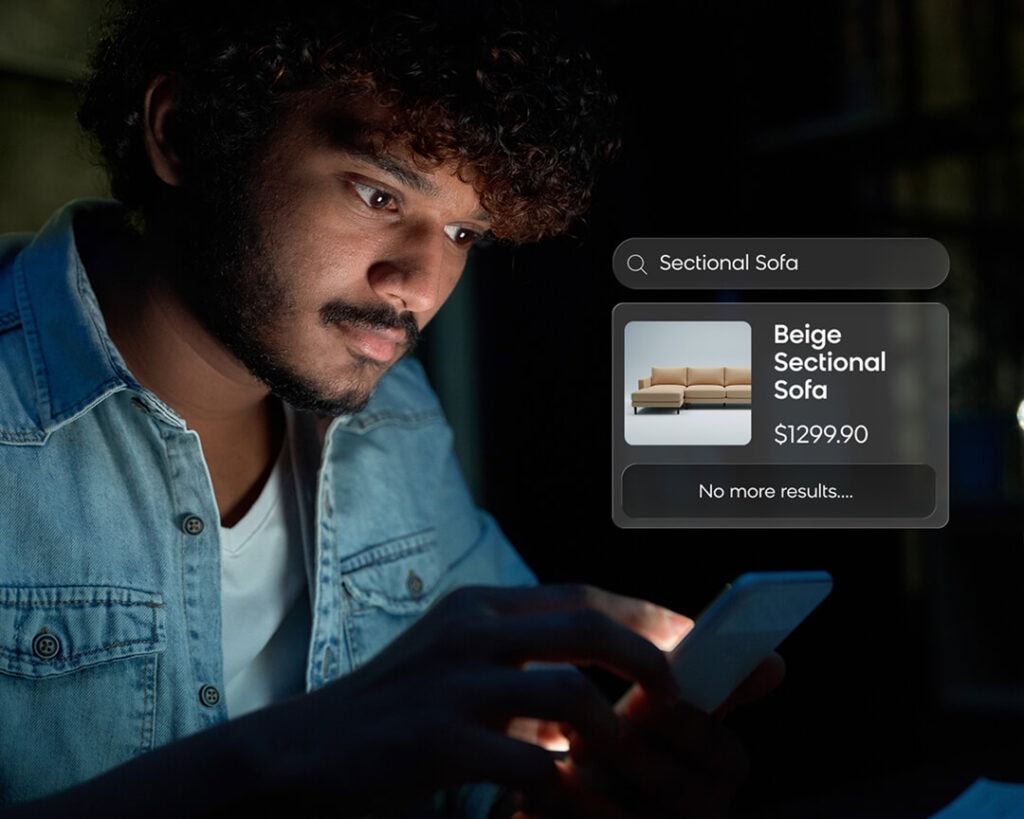

Every day, ecommerce sites lose revenue silently. A shopper searches for something, finds nothing, and bounces. Another customer sees slow results and gives up. A third searches for a color or size that exists but isn’t tagged properly, and leaves frustrated. These aren’t anomalies; they’re symptoms of a search engine that isn’t doing its job. What separates a search engine that captures revenue from one that quietly loses it comes down to a handful of specific capabilities. Here’s what to look for.
Part of the problem is language. A shopper types “blue shirt” when they actually want a men’s slim-fit navy button-down. A good search engine reads that intent, handles vague or misspelled queries, and still guides the shopper to the right product.
The Business Impact of Ecommerce Search
Between 30% and 50% of ecommerce visitors use site search during a session, and they’re the visitors most likely to buy. Hello Retail’s research, drawing on Econsultancy and Baymard Institute benchmarks, puts search conversion at 1.8x to 3x higher than non-search sessions, with higher average order values to match. A search query is a statement of intent, which makes search the highest-intent touchpoint on your site. McKinsey research notes that AI is reshaping how consumers search and shop, raising expectations around speed and relevance.
Zero-result searches, where a shopper submits a query and the engine returns no products, are a direct conversion killer that sends customers straight to your competitors. Every feature covered below exists to prevent that outcome. Understanding how AI site search boosts revenue starts with understanding what separates a search engine that captures intent from one that destroys it.
What Is the Role of Search Engines in Ecommerce?
These types of search engines function as virtual guides, helping your customers find the products they need. Its primary role is to take your site visitor’s search queries and sift through the vast amount of data on your site or product catalog to present the most relevant results.
A good ecommerce search engine will use artificial intelligence to elevate the shopping experience by making it easier for customers to navigate the site and find what they want. This convenience can lead to higher customer satisfaction and increased sales, as users are more likely to complete a purchase when they find what they need quickly and efficiently.

Search engines vary widely in accuracy, speed, and relevance, all of which are crucial to getting results right. If a customer searches for “running shoes,” they expect to see the most relevant options first, including bestsellers and items in their size. If the results are slow or irrelevant, it can lead to frustration, causing the customer to leave the site without buying.
Key Features of the Best Ecommerce Search Engines
A well-optimized search engine enhances the entire shopping experience, driving higher satisfaction and sales. To make the most of this critical tool, here are the essential features to consider when evaluating the best ecommerce search engine for your store.
Advanced Search Algorithms
Many retailers are losing sales because customers can’t find the right product. Don’t let that be you. Select a search engine with advanced search algorithms.
Algorithms use processes and rules to help customers find what they want. They process the query and search the site’s database to find the best match. Rather than simply showing all products related to the query, the algorithm sorts and ranks results to make them relevant and personalized. It considers factors like the product’s popularity and past shopping behavior.
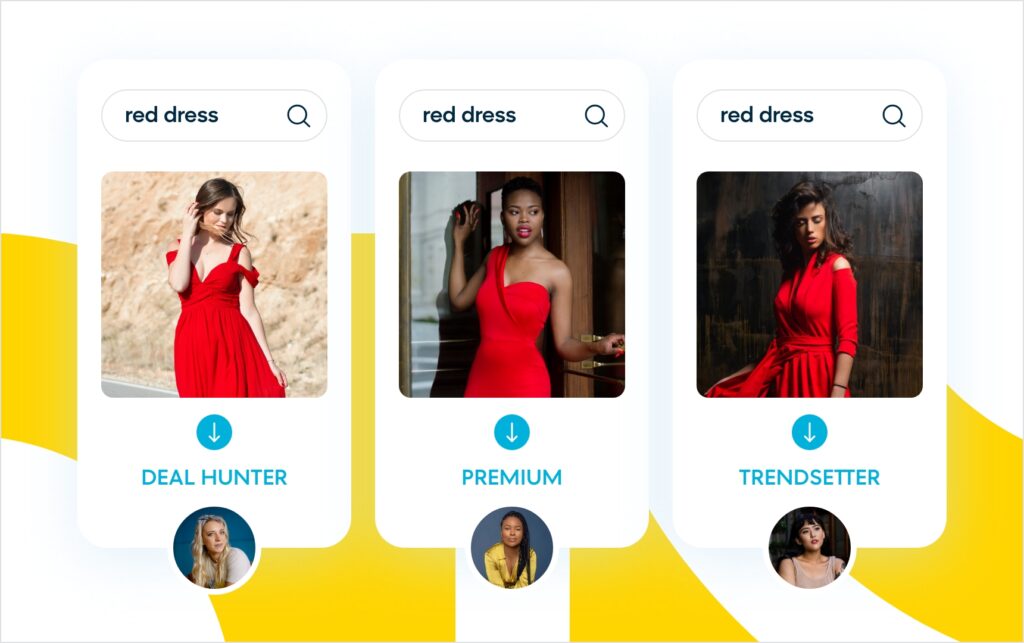
For instance, if your customer searches for a “red dress,” the algorithm will show a red dress of the right size, of a preferred brand, and even discounted options based on browsing and purchase history, rather than every red dress in the catalog.
Bloomreach offers AI-powered site search to ensure your customer is shown the most relevant product. Loomi search which is specifically built for ecommerce use cases so you can deliver the best ecommerce search available.
HD Supply, a multi-billion dollar commercial distributor, deployed Loomi search to let customers add products directly to cart from search results. The product image, part number, price, and an add-to-cart option all appear within the search bar itself. The results were a 16% increase in revenue from search and a 4% increase in add-to-cart rate from list and product detail pages. Their merchandising team can now identify and fix search query problems in under 30 seconds using the insights dashboard.
Read the HD Supply case study →
User Intent Prediction
User intent is why your customer types a query into the search engine. But as we discussed above, a customer can ask a vague query or make a spelling mistake.
Your search engine should understand the user’s intent despite the errors. Not everyone will realize they’ve made a mistake and correct it, or they may not know exactly what terms to put into the search bar. As a result, if they don’t find a specific product, they’ll assume your site doesn’t have it.
With Loomi, you get ecommerce site search with day zero learnings: our AI has been learning from 16+ years of data on how consumers shop, giving you a way to understand customer intent right from the start. Even before a user starts typing a query into the search bar, you’ve already benefited from years of commerce-specific data incorporated into our algorithms, informing our search retrieval and ranking processes. When a customer searches for a “black waterproof Bluetooth speaker,” Loomi identifies “speaker” as the product and recognizes “black” and “waterproof” as descriptors.
By harnessing natural language processing (NLP), Loomi enables semantic understanding, so you don’t have to worry about keyword matching alone. Our semantic engine parses out attributes and applies known synonyms, so your customers receive relevant search results even when their queries are unclear or contain typos. With machine learning (ML), Loomi adapts in real time, learning from user behavior to continually enhance performance. This combination ensures customers find what they’re looking for quickly and easily.
Zero-Result Handling and Query Relaxation
Zero-result searches happen when a shopper submits a query and the engine returns no products at all. They show up with vague queries (“something for a hiking trip”), misspellings (“waterpfoo jacket”), or use-case language that doesn’t match how your catalog is tagged. The industry average sits at 10-15% of searches, roughly one in every seven to ten, and poorly configured engines run above 20%. Every zero-result page is a missed sale, and many shoppers abandon the site rather than retry. Often it isn’t even a catalog gap, just a vocabulary mismatch: the shopper searched “sneakers” and your catalog says “trainers.”
Query relaxation is the mechanism that prevents this. When an exact match fails, the engine progressively broadens its criteria, dropping less essential modifiers to surface the core product category. A shopper searching for a “waterproof ultralight trail running vest” might first see trail running vests, then running vests more broadly, rather than an empty page. NLP-powered synonym libraries close the gap between how shoppers talk and how products are cataloged, and autocomplete intercepts ambiguous queries before they ever resolve to nothing.
For shoppers who don’t know exactly what to search for, AI-powered guided shopping bridges the gap between vague intent and the right product. And as covered in User Intent Prediction above, Loomi’s semantic understanding resolves most ambiguous or misspelled queries before they ever reach a zero-result state.
Personalization and Customization
Have you ever noticed how some online stores intuitively know what you want? That’s the power of personalization. Your ecommerce search engine can also offer personalized recommendations.
Picture this: a returning customer logs in and is immediately greeted with a pair of shoes they looked at last week but didn’t purchase, along with suggestions tailored to their past searches.

Providing a personalized customer experience is your key to increasing conversion rates and average order values. Even better, personalization transforms browsing into a more enjoyable experience, almost like having a personal shopping assistant at your fingertips.
Bloomreach analyzes each user’s behavior and preferences to rerank results in real time, so two shoppers searching the same term can see different results based on their individual histories. Whether it’s customizing the experience for different customer segments or adapting to individual browsing habits, Loomi tailors what each visitor sees.
Plus, with Loomi’s no-code product discovery platform, you can customize the algorithms that power your site. Make quick adjustments, test different strategies, and deploy changes without relying on your tech team. This includes support for industry-based search personalization, which tailors results based on a customer’s professional context for B2B retailers.
Annie Selke, the home goods brand behind Pine Cone Hill and Dash & Albert, deployed Loomi-powered search and merchandising through a SAP Commerce Cloud integration. In the first six months, the brand generated 40% more revenue from search and 34% more revenue from merchandising. It’s a clear example of what happens when personalization and search work together. Read the Annie Selke case study →
Faceted Search and Filtering Options
Filters and facets can significantly improve how customers interact with your site, helping them find exactly what they’re looking for more quickly and easily.
Filters are broad categories that narrow product search results based on general criteria, such as customer ratings or price ranges. They can be applied before or after a search, so customers can adjust their options to suit their needs.
Facets go deeper into specific attributes related to the search results. They let customers refine their searches by selecting particular features like brands, colors, or model years. Facets are especially helpful on search and category pages, as they rank options based on product count, relevance, and user engagement, making it easier for shoppers to discover what they want.
Bloomreach gives you control over facets so you can boost and always show facets across your entire site, or remove facets you never want to appear on promotional campaign pages. For a sense of what this looks like in practice, these examples of winning site search show how leading retailers combine facets and merchandising.
Merchandising Controls and Business Rules
The best ecommerce search engines give merchandising teams direct control over what shoppers see, extending well beyond filters. Look for the ability to boost high-margin or in-season products to the top of results, bury out-of-stock or discontinued items without dev support, and configure business rules at the campaign level. Bloomreach’s out-of-stock reranking automatically demotes unavailable products and promotes in-stock alternatives in real time. These no-code controls let merchandisers move fast: running a flash sale or seasonal campaign doesn’t require an engineering ticket.
Speed and Performance
Modern online users expect quick results, and even a slight delay can lead to frustration and lost sales. On mobile, Hello Retail’s research found that even a one-second delay in search results correlates with a measurable drop in engagement. If your search engine doesn’t deliver relevant results promptly, users will leave to look for a faster option.
Bloomreach bridges this gap with fast search capabilities and minimal downtime, so customers enjoy a swift shopping journey. A search engine that takes more than a few seconds to return results can lose a sale before the results ever appear. For high-traffic moments (Black Friday, Cyber Monday, major promotions, new product launches), uptime and response time are non-negotiable.
Integration Capabilities
The best ecommerce search engine must connect to your existing commerce stack without heavy custom development. Look for prebuilt connectors to major platforms (SAP Commerce Cloud, Salesforce Commerce Cloud, Shopify, BigCommerce) and a well-documented API for headless or custom implementations. The less custom engineering required to go live, the faster you can start capturing search revenue.
Bloomreach offers a broad partner directory of prebuilt integrations, giving you the flexibility to connect your search experience to your existing tech stack without starting from scratch.
How to Evaluate an Ecommerce Search Platform
Features matter most when you can weigh them against each other. Use the checklist below to score any platform on the criteria that separate an adequate search engine from a great one. Rate each on a simple scale (say, 1 to 5), and the gaps will tell you where a vendor will help or hurt your conversion rate.
| What to evaluate | Why it matters | What good looks like |
|---|---|---|
| Relevance and ranking | Decides whether high-intent searchers find the right product fast | AI ranking that weighs behavior, popularity, and inventory rather than keyword overlap alone |
| Intent understanding | Vague and misspelled queries are the norm, not the exception | Semantic NLP and synonym handling that read meaning, not exact strings |
| Zero-result handling | 10-15% of searches return nothing by default, and each one is a lost sale | Query relaxation and synonym expansion that hold the zero-result rate under 5% |
| Personalization | Searchers already convert 1.8-3x higher, and personalization compounds that | Real-time reranking based on each shopper’s behavior and history |
| Merchandising control | Teams need to run campaigns without waiting on engineering | No-code boost and bury rules plus campaign-level facet control |
| Speed and uptime | Even a one-second delay measurably cuts engagement | Sub-second results and proven stability through peak traffic events |
| Integration effort | Heavy custom work delays time to value | Prebuilt connectors for your platform and a well-documented API |
| Analytics | You can’t improve what you can’t measure | Built-in reporting on zero-result queries, search conversion, and revenue per search |
A platform that scores well across all eight is rare, so weight the criteria by what your catalog and team need most. A large catalog leans hard on relevance and zero-result handling; a lean merchandising team will value no-code control more than API depth.
Tips for Implementing an Ecommerce Search Engine Effectively
Usability Testing and User Feedback
Usability testing involves evaluating your search engine by observing real users as they interact with it. This hands-on approach provides valuable insights into how effectively your search performs. Watching users navigate your search engine surfaces the hurdles they encounter, such as a confusing layout or an ineffective search bar. Understanding these pain points lets you make the necessary adjustments.

Bloomreach streamlines this process by offering AI-driven tools that monitor user behavior in real time. It also lets you gather user feedback directly within the search interface, so you can solicit input from customers directly, creating a continuous feedback loop for ongoing improvements.
Continuous Optimization
A/B testing allows you to test changes to your search engine before rolling it out. By running these tests, you gain insight into what drives conversions, enabling data-backed decisions to boost your conversion rates.
Bloomreach lets you test every element of your search engine, from redirects to category rankings, ensuring every change directly enhances the user experience and increases sales. The platform’s flicker-free technology guarantees customers only see the content you want them to see.
Beyond A/B testing, Bloomreach uses first-party data to provide reliable, actionable insights from the moment a customer engages with your site. This means you can continuously refine your search functionality, tailoring it to meet user needs and drive higher conversion rates.
Analytics and Reporting Tools
Things move fast in ecommerce, and you need quick insights to thrive. Effective search analytics tools transform complex data into actionable insights, allowing you to track user behavior, identify search trends, and enhance the overall search experience.
By monitoring key metrics such as search conversion rates and click-through rates, you can gauge how well your search functionality is meeting user needs. For instance, if many people search for a specific item but don’t find it, Bloomreach’s analytics can highlight this issue, prompting you to adjust your inventory or customize your search rules accordingly.
Bloomreach’s intuitive platform simplifies data analysis, so you don’t need a technical background to interpret the information. With customizable dashboards, you can visualize the data that matters most to your business, making it easier to identify trends and spot opportunities.
Analyze Search Query Results
Search query reports help you understand user behavior and identify search patterns. They provide insight into how users interact with your website’s search functionality, allowing you to optimize the relevance and accuracy of search results.
Search relevance measures how well the search results align with the user’s query. By analyzing search queries, you can improve relevance by tailoring results based on factors such as user intent, business goals, textual relevance, spelling accuracy, and geographical location. For example, if customers frequently add a specific cocktail dress to their cart, you can surface that item more often in the results, improving the chances of conversion.
Bloomreach’s analytics tools are designed to assist with this process. With features like real-time search query tracking, you can gain immediate insights into search queries, identify trending products, and spot zero-result searches that indicate gaps in your offerings. This data lets you make informed adjustments to your search functionality, and our guide to ecommerce search best practices walks through how to act on it.
Build Stronger Search Functionality for Your Ecommerce Website With Loomi
By investing in a strong site search solution for your online store, you can start providing relevant search results that boost revenue, enhance customer satisfaction, and position you as an industry leader.
Loomi search is a solution that meets all your needs and more. With AI-driven features like real-time search tracking and semantic understanding, Loomi ensures your customers find exactly what they want. If you’re evaluating ecommerce site search solutions, Loomi is built to perform from day one, with 16+ years of commerce data already informing its algorithms.
Want to see how it works? Get started with a personalized demo today.
Frequently Asked Questions
What is an ecommerce search engine?
An ecommerce search engine is software that helps shoppers find products within an online store. Unlike web search engines like Google, it searches only within a retailer’s product catalog and is optimized for product discovery, filtering, and conversion. Its purpose is to drive product discovery and sales rather than to index web content.
How is an ecommerce search engine different from Google?
Google indexes the entire web and ranks pages by authority and relevance to a query. An ecommerce search engine indexes only your product catalog and ranks results based on factors like product availability, purchase history, relevance, and business rules set by your merchandising team. The goal is to move a shopper from query to cart as efficiently as possible.
What features should I look for in an ecommerce search platform?
The most important features are AI-powered relevance algorithms, natural language understanding (NLP), personalization based on shopper behavior, faceted filtering, fast response times, zero-result query handling, and no-code merchandising controls. The best platforms combine these with prebuilt integrations to your commerce stack.
How does AI improve ecommerce search results?
AI allows a search engine to understand what a shopper means, including synonyms, misspellings, and product attributes drawn from natural language, and to personalize rankings in real time based on individual behavior. Over time, machine learning models improve as they process more shopping data.
What is a zero-result search and how do I reduce it?
A zero-result search happens when a shopper submits a query and the engine returns no products. This is a direct conversion loss. To reduce it, look for a search platform with query relaxation (broadening search criteria automatically), NLP-based synonym libraries, and autocomplete that catches ambiguous queries before they resolve to an empty page.
How long does it take to implement an ecommerce search engine?
Implementation timelines vary by platform and your existing tech stack. SaaS solutions with prebuilt platform connectors (Salesforce Commerce Cloud, SAP, Shopify, etc.) typically go live in weeks. Custom or headless implementations may take longer depending on catalog complexity and integration requirements. Bloomreach offers a library of prebuilt integrations to accelerate deployment.