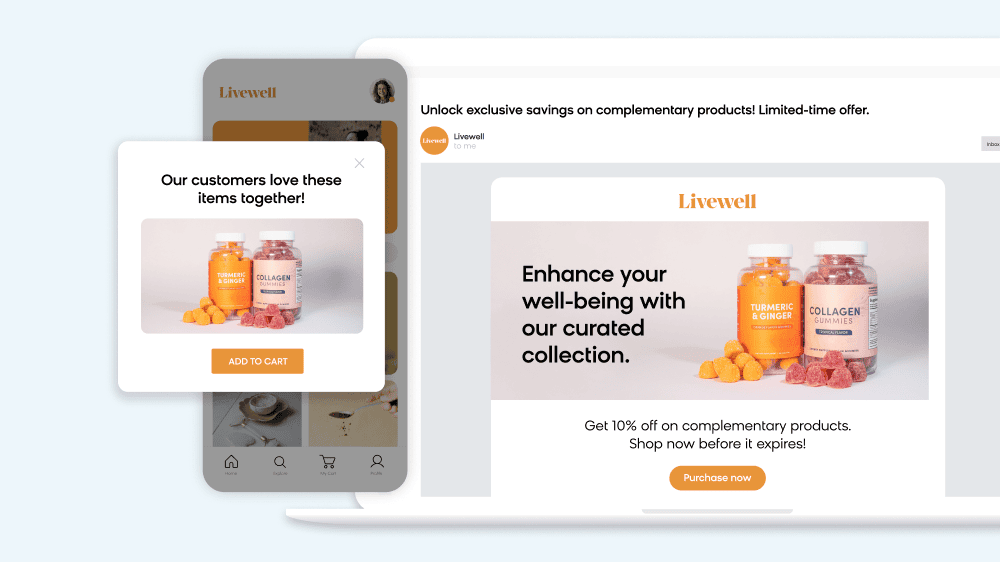

Marketing automation software helps brands deliver personalized campaigns across email, SMS, web, mobile, and ads without having to manually manage every message. This automation is a great way for brands to scale up and deliver better personalization in real time.
But with dozens of tools claiming to be the best marketing automation software, choosing one that fits your business is harder than it should be. Some platforms focus on email alone, not all platforms integrate AI with the same depth, and many were built for B2B workflows that don’t translate to the speed and scale of modern consumers.
This guide evaluates the 10 best marketing automation platforms for 2026, with a focus on what actually matters: personalization depth, omnichannel reach, AI sophistication, and ecommerce readiness.
How To Choose the Best Marketing Automation Software
Before comparing platforms, it helps to know what separates “good enough” marketing automation from tools that drive measurable revenue. Here are the criteria that matter most:
AI and Personalization Capabilities
Basic segmentation (age, location, purchase history) is now the bare minimum. The platforms that move the needle use AI to predict customer behavior, optimize send times, generate content variations, and personalize experiences in real time. Look for tools where AI is built into the core architecture, not layered on top.

Omnichannel Reach
Email is the foundation, but modern marketing automation extends across SMS, web personalization, mobile push, in-app messaging, ads, and product discovery. Platforms that unify these channels under a single customer view eliminate the silos that lead to disjointed experiences.
Customer Data Foundation
Marketing automation is only as good as the data behind it. Platforms with a built-in customer data layer (or native CDP) can act on real-time behavioral signals rather than static lists built hours or days ago. This matters for time-sensitive campaigns like abandoned cart recovery, price drops, and inventory alerts.
Ecommerce Integrations
If you sell online, your marketing automation software needs to connect with your commerce stack: Shopify, Magento, BigCommerce, or a headless architecture. Native integrations with product catalogs, order data, and browsing behavior make the difference between generic messages and campaigns that feel relevant.
Meaningful Automation
Drag-and-drop workflow builders are common. What varies is depth: Can you build multi-branch journeys with conditional logic? A/B test full workflows (not just subject lines)? Trigger automations from real-time events like page views or cart changes? The best marketing automation tools go beyond simple drip sequences.
Analytics and Attribution
You need to connect campaign activity to revenue, which means going beyond opens and clicks. Look for platforms that offer campaign-level attribution, customer lifetime value tracking, and predictive analytics.
Scalability and Enterprise Readiness
A platform that works for 10,000 contacts may break at 10 million. Enterprise brands need high-throughput sending, dedicated infrastructure, GDPR compliance, and the ability to manage multiple markets from a single instance.
The 10 Best Marketing Automation Software Platforms
| Platform | Best For | Key Differentiator |
|---|---|---|
| Bloomreach | AI-powered omnichannel personalization | Loomi AI — an agentic platform with real-time activation |
| HubSpot | All-in-one inbound marketing | Integrated CRM with extensive free tools |
| Klaviyo | Growing ecommerce brands | Predictive analytics and prebuilt ecommerce flows |
| ActiveCampaign | Small business automation | Large prebuilt workflow library |
| Brevo | Affordable multi-channel marketing | Email + SMS + WhatsApp on free tier |
| Omnisend | Ecommerce email and push | Generous free plan with advanced segmentation |
| Salesforce Marketing Cloud | Enterprise B2B marketing | CRM integration and account-based marketing |
| Adobe Marketo Engage | B2B demand generation | Cross-channel nurturing at enterprise scale |
| Customer.io | Product-led lifecycle automation | Event-driven messaging across 6+ channels |
| Mailchimp | Getting started with email marketing | Low barrier to entry with AI content tools |
Best for AI-Powered Omnichannel Personalization: Bloomreach
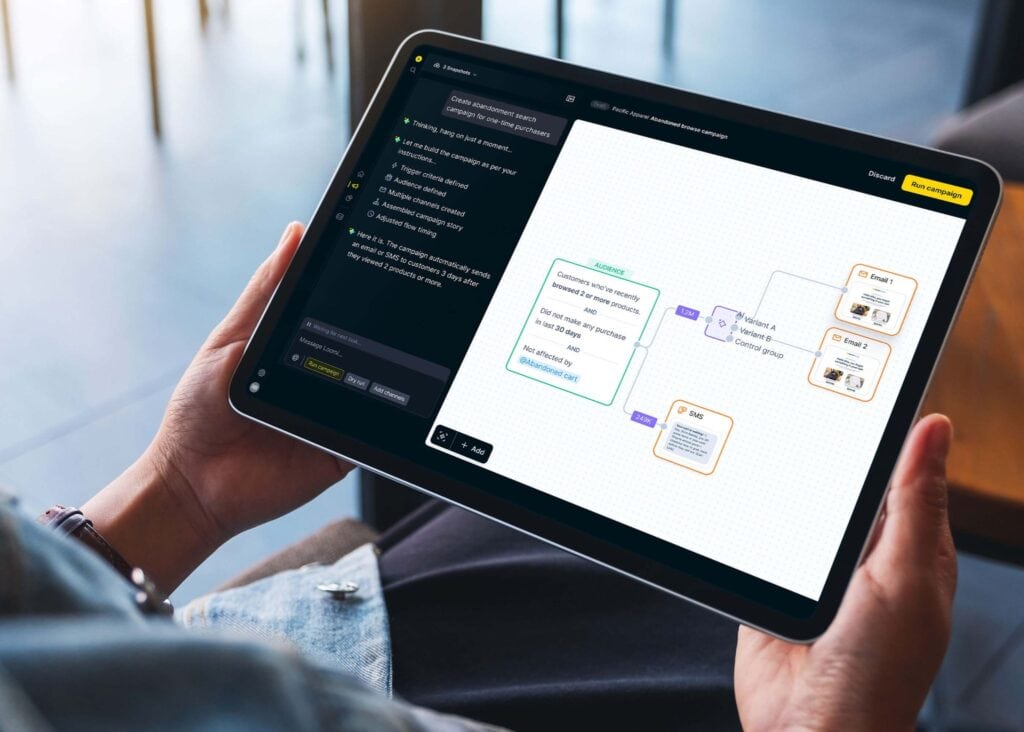
Bloomreach personalizes the customer experience with Loomi AI, an agentic platform that understands every customer in context and tailors their experience in real time. It connects personalization across all your channels — including email, SMS, web, mobile apps, ads, and site search — serving brands in retail, financial services, hospitality, travel, iGaming, and more.
What sets Bloomreach apart is the depth of its customer data foundation. Loomi AI processes first-party behavioral and product data to activate personalization in real time (5 milliseconds to 2 seconds*), so it can adapt to experiences while a shopper is still browsing. Bloomreach’s Campaign Agents continuously optimize subject lines, send times, and content variations without manual A/B testing. Bloomreach offers a native integration with Shopify, as well as Magento, BigCommerce, and headless commerce stacks.
*Response times reflect typical deployment conditions and may vary based on implementation configuration and data volume.
Brands like Lovall have achieved a 310% increase in automated email revenue using Bloomreach, Revolution Beauty saw a 5x increase in revenue per email, and HMV saw a 14% increase in ad campaign revenue from Loomi AI-powered AutoSegments. A Forrester Total Economic Impact study also found that companies using Bloomreach can see up to a 251% ROI over three years.*
*The Forrester Total Economic Impact study was commissioned by Bloomreach and independently conducted by Forrester Consulting. Actual results may vary.
Bloomreach is modular: brands can start with marketing automation and expand into search, categories, or conversational shopping as their needs grow. Each product shares the same data and AI layer, meaning the more touchpoints you connect, the smarter the personalization becomes.
Best for: Enterprise and mid-market brands across industries that want AI-native personalization across every customer touchpoint.
Best All-in-One for Inbound Marketing: HubSpot
HubSpot is a CRM platform with marketing, sales, and service tools under one roof. Its Marketing Hub offers a visual workflow builder, email automation, ad management, social scheduling, and robust reporting, all connected to a powerful CRM that tracks every customer interaction.
HubSpot’s strength is its breadth. Free tools for forms, email, and chatbots make it accessible for growing teams, while Marketing Hub unlocks multi-step automation, A/B testing, and custom reporting. The platform also offers Breeze, a suite of AI features for content generation, data enrichment, and automated workflows.
With a wide range of native integrations and an extensive academy of certifications and training, HubSpot has one of the largest ecosystems in the marketing automation space. It works across industries but is particularly popular with B2B and SaaS companies.
Best for: Mid-market and growing companies that want marketing, sales, and service on a single platform with a strong CRM foundation.
Best for Growing Ecommerce Brands: Klaviyo
Klaviyo is a marketing automation platform built for ecommerce. It integrates with Shopify, BigCommerce, WooCommerce, and other platforms, pulling in order history, browsing behavior, and customer lifetime value data to power personalized campaigns.
The platform offers 80+ prebuilt workflow templates for abandoned carts, post-purchase follow-ups, win-back campaigns, and more. Its drag-and-drop builder makes creating flows and email templates intuitive, and its predictive analytics (expected next order date, churn risk) add another layer of intelligence.
Best for: Growing ecommerce brands that want accessible automation with strong segmentation and predictive analytics.
Best for Small Business Automation: ActiveCampaign
ActiveCampaign combines email marketing, automation, and a lightweight CRM in a package designed for small to mid-sized businesses. Its standout feature is the automation library, a large collection of prebuilt workflows covering industry-specific use cases, reengagement campaigns, deal management, and more.
The platform also supports AI-powered campaign building: describe what you want to automate, and ActiveCampaign’s chatbot builds the workflow for you.
Best for: Small and mid-sized businesses that want some automation capabilities without enterprise pricing.
Best Affordable Multi-Channel Option: Brevo
Brevo delivers accessible email, SMS, and WhatsApp automation, including offering a free plan (a rarity in the marketing automation space). Its workflow builder supports conditions like delays, A/B splits, and CRM updates, and the platform doubles as a lightweight CRM and meeting scheduler.
The main trade-off is scalability. Free and Starter tiers limit email volume and branding options, and advanced features like predictive sending and Facebook Ads integration are locked behind higher tiers.
Best for: Budget-conscious businesses that want multi-channel automation (email, SMS, WhatsApp) without a large upfront investment.
Best for Ecommerce Email and Push: Omnisend
Omnisend is purpose-built for ecommerce, offering email, SMS, and push notification automation with deep integrations into Shopify, WooCommerce, BigCommerce, and other platforms.
The platform provides prebuilt automation workflows spanning the full customer journey: welcome series, browse abandonment, cart recovery, and post-purchase. An AI assistant helps with email copy, brand asset generation, and churn prediction.
Best for: Small to mid-market ecommerce brands that need a focused, affordable automation platform with strong customer support.
Best for Enterprise B2B Marketing: Salesforce Marketing Cloud
Salesforce Marketing Cloud is a B2B automation solution designed for large organizations. Its value lies in native integration with the Salesforce CRM ecosystem, giving marketing and sales teams a shared view of every account and contact.
The platform offers AI-powered lead scoring, dynamic list management, real-time activity alerts, and ROI reporting. It works across the full B2B buyer journey, from demand generation to account-based marketing, and is best suited for organizations already invested in the Salesforce ecosystem.
Best for: Large B2B organizations that use Salesforce CRM and need account-based marketing automation at scale.
Best for B2B Demand Generation: Adobe Marketo Engage
Adobe Marketo Engage focuses on cross-channel nurturing and lead management for B2B companies. It uses behavioral tracking and AI-powered content personalization to deliver tailored experiences across email, web, and ads.
The platform offers a customer data environment that segments audiences using engagement history and integrated profiles. Its analytics suite provides marketing impact attribution, helping teams demonstrate the ROI of their campaigns.
Marketo is a good fit for large marketing teams managing complex buyer journeys, though its custom pricing and steep learning curve can be barriers for smaller organizations.
Best for: B2B marketing teams that need sophisticated lead nurturing, scoring, and cross-channel engagement at enterprise scale.
Best for Product-Led Lifecycle Automation: Customer.io
Customer.io is a messaging platform built for product-led companies. It automates email, SMS, push notifications, Slack messages, and more, all triggered by real-time user behavior inside your product.
The workflow builder includes multi-split branches, webhook triggers, campaign nesting, and A/B testing. Customer.io also supports Liquid for dynamic content personalization and offers platform-wide AI for segment suggestions and email analysis.
Best for: SaaS and product-led companies that want behavior-driven lifecycle messaging across multiple channels.
Best for Getting Started With Email Marketing: Mailchimp
Mailchimp remains one of the most recognizable names in email marketing. Its free plan supports up to 500 contacts, and its email builder and template library make it easy for beginners to create professional-looking campaigns.
The platform has expanded beyond email to include automation workflows, landing pages, websites, and AI content tools, with integration into Shopify and Facebook Ads for broader campaign management.
Mailchimp’s strength is accessibility, though its email marketing capabilities are deeper than its general automation. Brands with complex, multi-channel needs may outgrow it.
Best for: New businesses and small teams that want an easy entry point into email marketing with room to grow.
Why Bloomreach Stands Out for Ecommerce Brands
The platforms on this list each have strengths in specific areas, but for ecommerce brands that need personalization to span every touchpoint, Bloomreach offers something distinct.
AI Built Into the Foundation
Loomi AI is the agentic platform on which every Bloomreach application runs. This means personalization decisions happen in real time using first-party customer and product data.
Every Channel, One Customer View
Most marketing automation tools handle email well and can handle several other channels, like SMS or push. Bloomreach connects email, SMS, web personalization, mobile push, in-app messaging, ads, and even ecommerce search, all powered by the same customer data. When a shopper browses a product category on your site, their next email, push notification, and search results can all reflect that intent.

Incredible Flexibility and Scalability
With Bloomreach, brands can start with marketing automation and later add search, categories, or a conversational shopping agent. Because every product shares the same data foundation and AI layer, insights from one channel make every other channel smarter. Data from email engagement improves product recommendations, and search behavior informs campaign segmentation. This makes it easy for brands to grow and scale more effectively.
Ready To See Bloomreach in Action?
Marketing automation should do more than send emails on a schedule. It should understand your customers, anticipate what they want, and deliver personalized experiences across every channel in real time.
Book a demo to see how Bloomreach and Loomi AI personalize the customer experience for ecommerce brands around the world.
FAQ: Marketing Automation Software
What is the best marketing automation software?
The best marketing automation software depends on your business type and goals. For brands that need AI-powered personalization across email, SMS, web, mobile, ads, and search, Bloomreach is a strong choice across industries, including retail, financial services, and travel and hospitality. HubSpot works well for inbound-focused B2B teams that want an all-in-one CRM. Klaviyo is popular with growing ecommerce brands for its prebuilt flows and predictive analytics. ActiveCampaign offers sophisticated automation at small business prices.
What is the difference between email marketing and marketing automation?
Email marketing focuses on sending campaigns to a subscriber list. Marketing automation is broader: it orchestrates multi-channel, behavior-driven workflows that can include email, SMS, web personalization, push notifications, and ads. Marketing automation platforms typically include email marketing as one component of a larger engagement strategy.
Is marketing automation software worth it for small businesses?
Yes, especially for ecommerce businesses where automated workflows like welcome series, abandoned cart emails, and post-purchase follow-ups drive measurable revenue. Many platforms offer free tiers or affordable starting plans. The key is choosing a tool that matches your current needs and can grow with you.
What features should I look for in marketing automation software?
The most important features to evaluate are: AI and personalization capabilities, multi-channel support (email, SMS, web, mobile), workflow automation with conditional logic, customer data integration, ecommerce platform compatibility, reporting and analytics, and scalability. See our evaluation framework above for a detailed breakdown.
All trademarks are the property of their respective owners.