

Agentic commerce is already here. AI agents are browsing, comparing, and buying on behalf of consumers right now, and retailers who haven’t structured their catalogs for agent discovery are already losing the sale before a human visitor ever lands on their site.
What makes evaluation difficult is that agentic commerce requires two simultaneous decisions. Your platform must be discoverable by external AI agents (ChatGPT, Claude, Perplexity, etc.) while also powering your own on-site and marketing agents.
This guide is a structured evaluation framework for retailers actively in the buying process: five criteria, specific vendor questions for each, and real results from production deployments.
What Is an Agentic Commerce Platform?
Before evaluating vendors, you need a precise definition of an agentic commerce platform. That’s because “agentic” is being applied to everything from basic chatbots to actual autonomous systems, and the gap between those two things is enormous.
An agentic commerce platform is a system that enables, orchestrates, and governs AI agents within commerce contexts (product discovery, transaction, marketing, and operations). Not every AI tool qualifies — a platform provides four things a standalone tool doesn’t: a data layer that agents can query in real time, the agent logic itself, connectivity to external systems and protocols, and governance controls that keep agents operating within defined boundaries.
As for AI agents, you’ll need to make sure you differentiate between an AI tool and an autonomous agent. Here’s a breakdown of existing AI tools vs. what agents are capable of:
| Not an agent | What an agent does |
|---|---|
| AI-powered search (retrieval and ranking) | Goal-directed, multi-step reasoning |
| Personalization engine (ranking content) | Autonomous action without per-step instruction |
| Rule-based automation (“if cart abandoned, send email”) | Adaptive behavior based on observed outcomes |
| Reactive chatbot (answers what users ask) | Proactive decision-making toward a defined objective |
Not all agentic deployments are the same. At one end of the spectrum, you have fully autonomous agents that execute end-to-end without human review. At the other end, you have human-in-the-loop systems where an agent recommends and a human approves before execution. Most enterprise retailers will start closer to the latter, and that’s appropriate. The platform you choose should support both modes and let you define where on that spectrum each agent operates.
Why Agentic Commerce Is Arriving Now
It’s crucial to start acting on agentic commerce now instead of watching and waiting. That’s because agentic commerce can be huge for your business — it’s estimated to generate $3-5 trillion annually worldwide by 2030, with the US B2C retail market representing a significant portion.
And consumer behaviors are already shifting. More people are turning to platforms like ChatGPT and other conversational interfaces to shop, which means you need to make sure you appear in external tools if you want to stay in front of shoppers.
Plus, research shows that AI shopping agents respond to different signals than human shoppers do. Promotional urgency, brand-heavy copy, and discounting language have little effect on AI recommendations. What matters to an AI agent is how complete product attributes are and how accurate pricing is. That finding should change how you think about both your product data strategy and your platform requirements. If AI is reshaping retail at the discovery layer, the tools you’ve built to influence human shoppers won’t transfer automatically.
The primary protocols that enable agentic commerce have also reached deployable maturity. MCP (Model Context Protocol), the Anthropic-originated standard, has broad adoption across AI systems. Meanwhile, ACP (Agent Commerce Protocol) is newer and still being formalized.
So, while agentic AI capabilities have been available for years, the standardized infrastructure for connecting agents to commerce systems was not. Now that they’re more readily available, you should treat agentic commerce platforms as an operational priority.
The Two Sides of Agentic Commerce (And Why Most Platforms Only Cover One)
There are two sides to a good agentic commerce platform: how it handles external agents and how it deploys internal agents. Unfortunately, many platforms only focus on one aspect — here’s why that framing is incomplete, and why treating these as separate decisions is a mistake.
Handling External Agents
External AI agents don’t browse your website the way a human does. ChatGPT, Perplexity, Claude, and similar systems query product data through structured feeds and APIs. If your catalog isn’t structured for agent consumption, you become invisible to a growing share of discovery traffic, regardless of how well your website performs for human visitors.
The technical requirements for external agent readiness include:
- Structured product data feeds that AI systems can index, covering machine-readable attributes beyond human-readable SEO copy
- ACP and MCP protocol compatibility for real-time product queries
- Checkout API access that allows agent-initiated transactions to complete
- Product attributes optimized for semantic search and AI retrieval
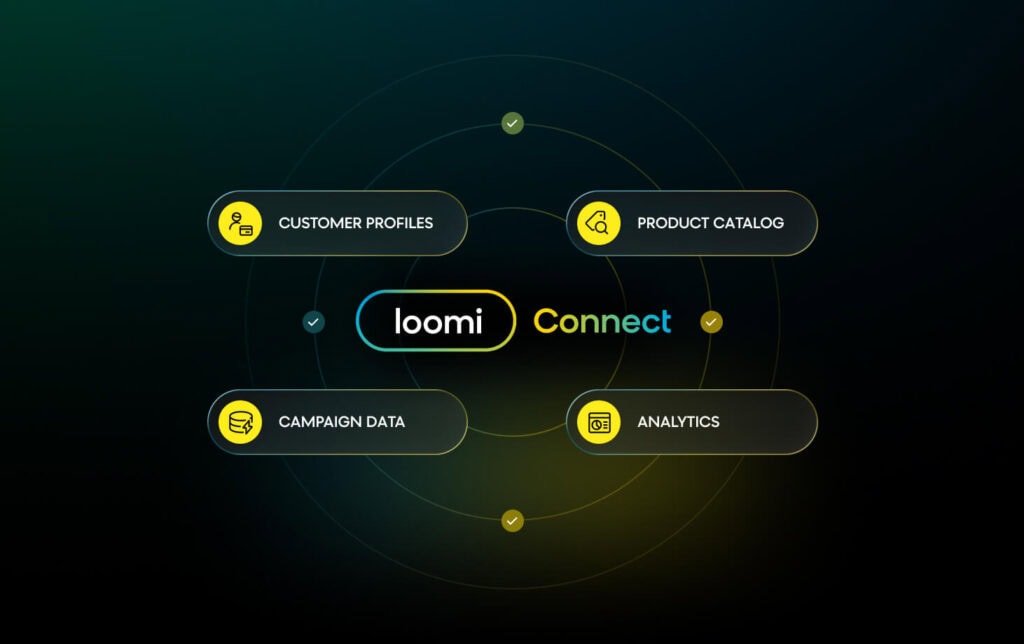
When evaluating platforms, don’t just ask vendors whether they support AI — you should specifically ask which agent protocols they support natively, and what their structured data delivery looks like for external agents.
Deploying Internal Agents
The second side is deploying your own agents, both on-site and in your marketing stack. On-site, this means conversational shopping agents that can engage customers in nuanced dialogue, understand product complexity, and guide them from vague intent to the right product. In marketing, it means agents that can receive a campaign goal and understand audience, content, channel, and timing without a human configuring each variable.
This is where platforms diverge significantly. Some tools offer reactive chatbots that answer questions but don’t reason toward goals. Others offer rule-based marketing automation that follows decision trees but doesn’t adapt. A top-tier agentic commerce platform deploys agents capable of agentic personalization, where the agent reasons about each individual customer’s context rather than applying a segment-level rule.
Why Both Sides Matter
A retailer that only solves external agent readiness becomes discoverable, but can’t control the experience once an agent drives a user to their site. A retailer that only deploys internal agents misses the emerging external discovery channel entirely. The platforms worth evaluating solve both, and the evaluation framework below is designed to surface which vendors actually do.
Bloomreach addresses both internal deployment surfaces through Loomi conversational agent (on-site) and Loomi marketing agent (campaigns), with external agent connectivity through Loomi Connect. We cover how these map to the five evaluation criteria below.
5 Criteria for Evaluating an Agentic Commerce Platform
Instead of only stopping at a feature list, we’re providing a structured framework for finding the right agentic commerce platform: what each criterion means, why it matters, and the specific questions you should ask in every vendor conversation. These criteria reflect our point of view of what separates platforms that deliver on the agentic promise from those that don’t. Buyers with different priorities (deeper CRM integration, headless flexibility, or B2B-specific workflows) may weigh them differently.
On-Site Conversational AI Quality
What it means: The platform’s ability to power an on-site agent that understands product complexity (technical specifications, compatibility constraints, use cases), accesses real-time inventory, and guides a shopper from vague intent to the correct product, without falling back on keyword matching or canned responses.
Why it matters: A chatbot that can’t reason through “which running shoe is best for overpronation on trails under $150” is not an agent — it’s a search bar with a voice interface. The quality of multi-step conversational reasoning is the key distinction between agentic capability and chatbot capability, and it’s extremely difficult to assess from a demo alone. You need to stress-test it.
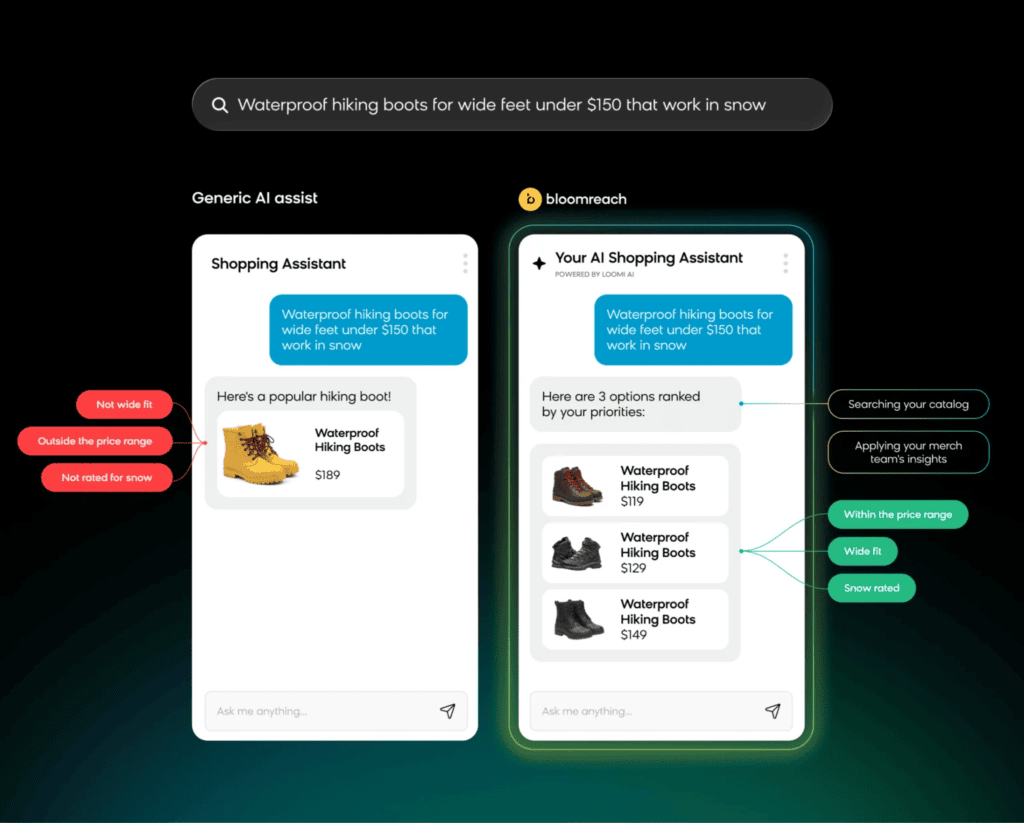
Questions to ask vendors:
- “Can the agent handle multi-turn conversations that require reasoning across product attributes, compatibility constraints, and inventory availability simultaneously, without losing context in between?”
- “How does the agent handle out-of-stock scenarios? Does it reason to comparable alternatives, or does it return a dead end?”
- “What is the agent’s latency from query to response, and how does it perform under peak traffic load? Can you share production metrics rather than sandbox performance?”
Connectivity With External Agent Ecosystems
What it means: Native support for ACP and MCP protocols, the ability to optimize product feeds for AI indexing, and checkout API access that enables external agents to discover, present, and complete transactions with your products.
Why it matters: AI shopping agents don’t respond to the same signals that influence human shoppers. Your product data architecture becomes your primary “marketing” channel for external agents. If your platform doesn’t surface structured, attribute-rich data in formats these agents can consume, your products won’t appear in AI-generated recommendations regardless of your brand strength or advertising budget.
Questions to ask vendors:
- “Does your platform support ACP and MCP protocols natively, or does it require third-party middleware for each external integration?”
- “How are product feeds structured for AI retrieval? Are attributes optimized for semantic search queries, or are they formatted for traditional SEO only?”
- “Does the platform support agent-initiated checkout via API, including payment confirmation and fulfillment status updates, or does it only handle discovery?”
Autonomous Marketing
What it means: The platform’s ability to deploy marketing agents that receive a goal (such as “reengage lapsed customers over a 30-day window”) and then determine the right audience, create content, set the channel mix and send times, and test design, without requiring a human to configure each variable.
Why it matters: The competitive advantage of autonomous marketing agents is speed and scale. An agent that can design, launch, and begin optimizing a campaign in minutes or hours rather than days will help drive faster time to revenue. Most production deployments today represent execution autonomy: the agent handles audience analysis, content selection, send timing, and optimization within human-defined campaign goals and brand guardrails.
That’s meaningfully different from “automated segmentation,” where a human configures the logic step by step. It’s also different from full strategic autonomy, where an agent sets its own objectives. What to probe for in vendor conversations is where on that spectrum each platform actually sits, and whether the autonomy applies to the parts of campaign work that consume the most time for your team.

Questions to ask vendors:
- “Can your marketing agent receive a campaign goal stated in business terms (like a revenue target or reengagement rate) and determine its own audience, channel mix, content, and send timing without human interference at every step?”
- “What guardrails does the platform provide to prevent the marketing agent from executing actions outside approved budget constraints or audience permissions?”
- “Can the agent run multivariate experiments autonomously and adjust its own strategy based on early performance signals, or does optimization require human review?”
First-Party Data Foundation
What it means: Agent decisions are only as good as the data they run on. A platform operating on stale batch data, siloed channel data, or third-party audience data will produce agent decisions that aren’t aligned with actual customer context. You need a unified, real-time first-party data layer available to every agent at the moment of decision.
Why it matters: An agent that recommends a product a customer purchased two hours ago or triggers a reengagement campaign for someone who just converted wastes budget and erodes customer trust. A real-time data foundation is the difference between agents that feel genuinely intelligent and agents that feel clumsy and outdated.
Questions to ask vendors:
- “How quickly does a customer action (a purchase, a browse event, or an abandoned cart) propagate into the data layer that agents query? Are we talking seconds, minutes, or hours?”
- “Is the customer data profile that powers on-site agents the same unified profile that powers email and campaign agents, or are these maintained as separate systems that sync on a schedule?”
- “How does the platform handle identity resolution for anonymous-to-known customer transitions, and across sessions and devices?”
Governance, Trust, and Human Override Controls
What it means: As agents autonomously execute across campaigns and checkout flows, the platform must provide permission scoping, audit trails, and human override controls that prevent unauthorized or erroneous agent actions.
Why it matters: Governance and trust are major barriers to enterprise retailers adopting agentic commerce. This isn’t overcaution — companies have legal, compliance, brand, and financial obligations that can’t be fully delegated to an AI system, regardless of how capable that system is. A platform without production-grade governance controls is not ready for enterprise deployment, even if its agents are technically impressive in a demo environment.
Questions to ask vendors:
- “What is the permission model for agent actions? Can specific action types (such as applying discounts or sending to lists with over 100K recipients) be gated behind mandatory human approval?”
- “Does the platform maintain a full, human-readable audit trail of agent decisions and the data inputs that drove each decision?”
- “What is the escalation path when an agent encounters an edge case outside its confidence threshold? Does it fail silently, surface the decision to a human reviewer, or default to a predefined safe action?”
As more retailers move from pilot to production deployments, governance controls become the operational factor that separates platforms that scale from those that stay in the sandbox.
How Bloomreach Approaches Agentic Commerce
The five criteria above describe what a capable agentic commerce platform should do. Here’s how Bloomreach’s Loomi platform maps to each of them.
Loomi features a customer data engine that unifies first-party data in real time. This acts as a single engine for data, context, and real-time execution, ensuring that customers get consistent and seamless experiences, no matter where they’re shopping from.
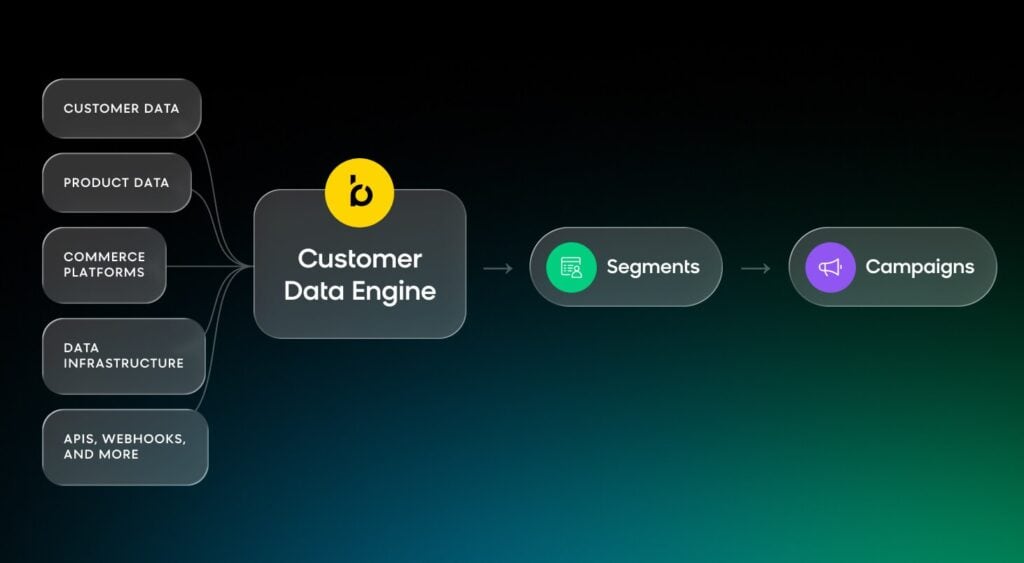
The Loomi marketing agent autonomously creates full campaigns from a natural language prompt in minutes. This allows your team to scale up faster — a marketer simply needs to enter the goal, and the agent will build the audience, determine the optimal timing, and personalize the content.
On your site, the Loomi conversational agent acts as an autonomous, end-to-end shopping companion. The agent remembers shopper preferences, reasons through nuanced or complex requests, and guides customers from their first search through checkout. Our conversational agent can also seamlessly pass the full context of the conversation to support teams, so shoppers don’t have to repeat themselves.
And, when it comes to governance, our agentic infrastructure includes scenario-level approval workflows: before a campaign scenario executes, human review can be configured at three enforcement levels (optional, required before first launch, or required before every execution). Every agent action produces an audit trail that records the decision logic, the data inputs, and the policy under which the action was taken. Agents that encounter edge cases outside their confidence threshold surface those decisions to human reviewers rather than proceeding silently. These controls are the difference between a platform that’s technically capable and one that’s operationally deployable at enterprise scale.
Ready to get started with an agentic commerce platform? Make sure you follow the criteria laid out in this post to find the right platform for you. If you want to see Loomi’s agentic capabilities in action, request a demo today.
Frequently Asked Questions
What’s the difference between agentic commerce and conversational commerce?
Conversational commerce uses natural language interfaces, including chatbots and messaging apps, to facilitate shopping. It’s typically reactive: the system responds to what the user says, one step at a time. Agentic commerce requires more from the system. An agent sets a goal, reasons across multiple steps, takes autonomous action, and adapts based on outcomes, without waiting for the user to prompt each move. A conversational commerce tool answers the query, “Do you have this in blue?” An agentic commerce platform can independently identify that a customer is likely to churn, figure out the most effective recovery offer for that specific customer, and execute a personalized campaign without any human instruction initiating the sequence. Conversational interfaces are one surface through which agents can operate. The two concepts are related but not equivalent.
Do I need to replatform to add agentic commerce capabilities?
Not necessarily. Some agentic capabilities, particularly on-site conversational agents and marketing agents, can be added as a layer on an existing commerce stack through API integrations. The more important constraint is your data architecture. If customer and product data are fragmented across disconnected systems, agents will make poor decisions regardless of how capable the AI model is. Before assuming you can add agentic capabilities without infrastructure investment, assess whether your current stack can support real-time, unified customer profiles accessible to every agent at the moment of decision. Retailers whose data is too siloed for real-time activation may find that meaningful agentic commerce performance requires foundational data infrastructure work before the agents themselves can deliver results.
How do external AI agents like ChatGPT access and recommend my products?
External AI agents (ChatGPT, Perplexity, Claude, etc.) access product data through structured product feeds, ACP protocol integrations, or direct API connections. They do not crawl your website the way a traditional search engine does. For a retailer to be discoverable and transactable through these agents, their platform needs to publish structured product feeds in a format these agents can index, support ACP or MCP protocol connections for real-time product queries, and expose checkout APIs that enable agent-initiated transactions to complete. Traditional SEO tactics (specifically promotional copy, urgency signals, and brand-heavy language) have limited impact on how AI agents evaluate and recommend products. What matters most is how complete your product attributes are, how accurate your pricing is, and the quality of your structured data.
What results are production agentic commerce deployments achieving?
Results vary based on implementation needs, the complexity of your product catalog, and what your baseline is. Published results from production deployments include: nearly a 3% increase in add-to-cart rate (Defender, on-site conversational agent); a 35.2% increase in conversion rate (TFG, on-site conversational agent); and 5x revenue per email (Revolution Beauty, autonomous campaign execution). Retailers should approach agentic commerce with a phased mindset, starting with one high-impact use case and expanding based on measured results. The deployments that deliver the strongest early results typically focus on a specific, high-friction point in the shopping journey rather than attempting platform-wide agentic transformation from the start.
Is agentic commerce only for large enterprise retailers?
No. While enterprise retailers have dominated early deployments due to larger technology budgets and dedicated AI teams, the infrastructure supporting agentic ecommerce is increasingly accessible to mid-market retailers. However, the evaluation criteria may shift slightly at a smaller scale: connecting an external agent ecosystem (making products discoverable through ChatGPT and Perplexity) may deliver faster ROI than building a fully autonomous marketing agent from scratch. Mid-market retailers should prioritize platforms that support modular deployment, where agentic capabilities can be added incrementally rather than requiring a full-stack replacement. Starting with one high-impact use case (on-site conversational discovery or external agent connectivity) and expanding based on measured results is a more sustainable path than attempting platform-wide transformation from the start.
What governance controls should an agentic commerce platform include?
Any agentic commerce platform deployed in production should include: role-based permission controls that limit which agent actions can execute without human approval; a human-in-the-loop override mode for high-stakes actions (e.g., large-list sends, discount application, pricing modifications); a full, human-readable audit trail of agent decisions and the data inputs that drove each one; confidence thresholds that escalate edge cases to human review rather than failing silently; and clear accountability mapping that records which goal each agent action was serving and which human-set policy governed the decision. These controls act as the governance layer that makes enterprise-scale deployment operationally feasible, and their absence is the most common reason agentic commerce pilots don’t reach production.