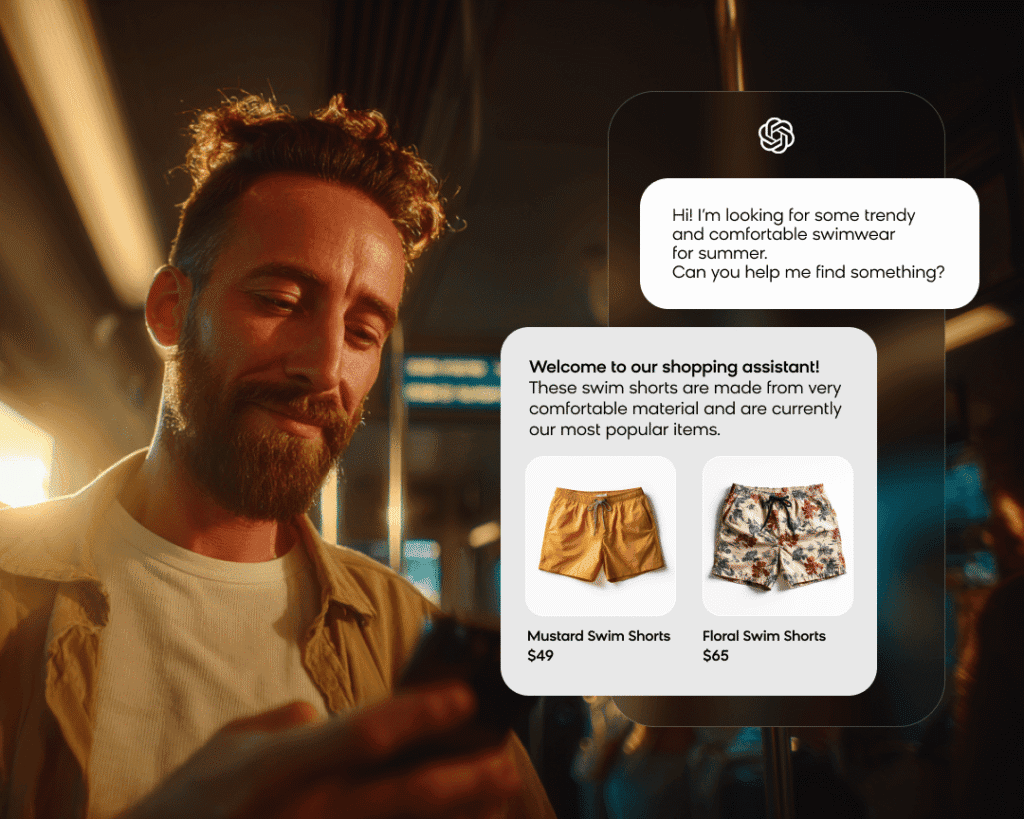
Let’s say a shopper is looking for a new carry-on bag that’s under a certain weight, under a certain price, and ships within two days. Instead of manually searching for this, they simply explain what they’re looking for to an AI assistant, which doesn’t need to open a browser tab or scroll through sponsored results. Instead, it queries multiple merchant catalogs, compares structured product attributes, surfaces the best match, and can even complete checkout, without any work needed from the shopper.
This is agentic commerce in practice: AI agents acting autonomously on a consumer’s behalf across the entire buying journey, from intent to transaction. The brands whose products surface in that process aren’t winning on brand recognition or ad spend. They’re winning on data quality and infrastructure.
McKinsey projects agentic commerce will generate $900 billion to $1 trillion in the US alone, and $3 to $5 trillion globally, by 2030. Other forecasters are more conservative: Morgan Stanley estimates $190 billion to $385 billion, and Bain projects $300 to $500 billion. Even at the low end, this is one of the largest commercial shifts since the original ecommerce transformation.
The infrastructure enabling it is already live. ChatGPT has 800 million weekly users. Google AI Overviews reach 1.5 billion users per month. And platforms like Perplexity and Amazon Alexa Plus are already completing purchases on behalf of consumers.
For brands, the question is no longer whether this shift will happen. It’s whether your product data, search infrastructure, and APIs are ready when the agents come calling.
What Is Agentic Commerce?
Agentic commerce is the use of AI agents to autonomously research, compare, negotiate, and complete purchases on behalf of a consumer or business buyer. Unlike traditional ecommerce, where a human navigates a website, evaluates options, and clicks “buy,” agentic commerce delegates those decisions to an AI system that acts with minimal human oversight.

It’s important to distinguish AI agents from chatbots and recommendation engines. A chatbot responds to questions, and a recommendation engine suggests products based on browsing history. An agentic commerce system, on the other hand, does the shopping: it interprets intent, queries catalogs, evaluates options against constraints, and executes the transaction. The agent isn’t assisting the shopper — it is the shopper.
So why is agentic commerce suddenly a thing? First, large language models have reached the capability threshold to handle multi-step reasoning and real-world transactions. Next, new protocols (more on those below) are standardizing how agents interact with merchant systems. And finally, consumers are ready: 44% already say AI-powered search is their “primary and preferred” source for product research. Meanwhile, another study found that 45% of consumers already use AI in their buying journeys.
The shift is early, but the trajectory is steep. Roughly 23% of Americans have bought something via AI in the past month, and there was a 769% year-over-year increase in AI-driven traffic to US retail sites in November 2025. And in our consumer research, we found that nearly 50% of respondents shop with ChatGPT weekly, with 41% saying they’d choose it over traditional ecommerce sites.
How Does Agentic Commerce Work?
Agentic commerce largely mirrors the traditional buying journey, only most of the process is executed by AI instead of a person.
Here’s what it might look like in action: A consumer expresses intent (spoken or typed), and an AI agent takes over. The agent researches available options across brand catalogs, compares product attributes against the consumer’s constraints, selects the best match, handles the transaction (with the shopper’s sign-off), and manages post-purchase logistics like tracking and returns.
There are three potential interaction models for how this plays out:
- Agent-to-site: An AI agent navigates a merchant’s website or app directly, interacting with search, filters, and checkout flows the way a human would. This is the most common model today.
- Agent-to-agent: A shopper’s AI agent communicates with a merchant’s AI agent. Both sides negotiate on behalf of their principals, handling everything from price comparison to fulfillment terms.
- Brokered agent-to-site: A platform intermediary (like ChatGPT or Perplexity) brokers the interaction between consumer agents and merchant catalogs, handling the matching and transaction orchestration.
The Protocol Layer
A critical piece of the puzzle is the emerging protocol stack that standardizes how agents interact with merchant systems:
- Model Context Protocol (MCP), released by Anthropic in November 2024, establishes a standard for connecting AI assistants to the systems where data lives, including product catalogs, inventory, and pricing
- Agentic Commerce Protocol (ACP), co-developed by OpenAI and Stripe, powers features like ChatGPT’s Instant Checkout and standardizes how agents handle payment and order fulfillment
- Agent-to-Payments Protocol (AP2), launched by Google, introduces cryptographic identity verification and secure transaction processing for agent commerce
- Agent2Agent (A2A), developed by Google, enables communication and coordination between independent AI agents across different platforms, covering capability discovery, task delegation, and secure messaging
- Universal Commerce Protocol (UCP), announced by Google in January 2026, is an open standard designed to cover the full shopping lifecycle, from product discovery through checkout
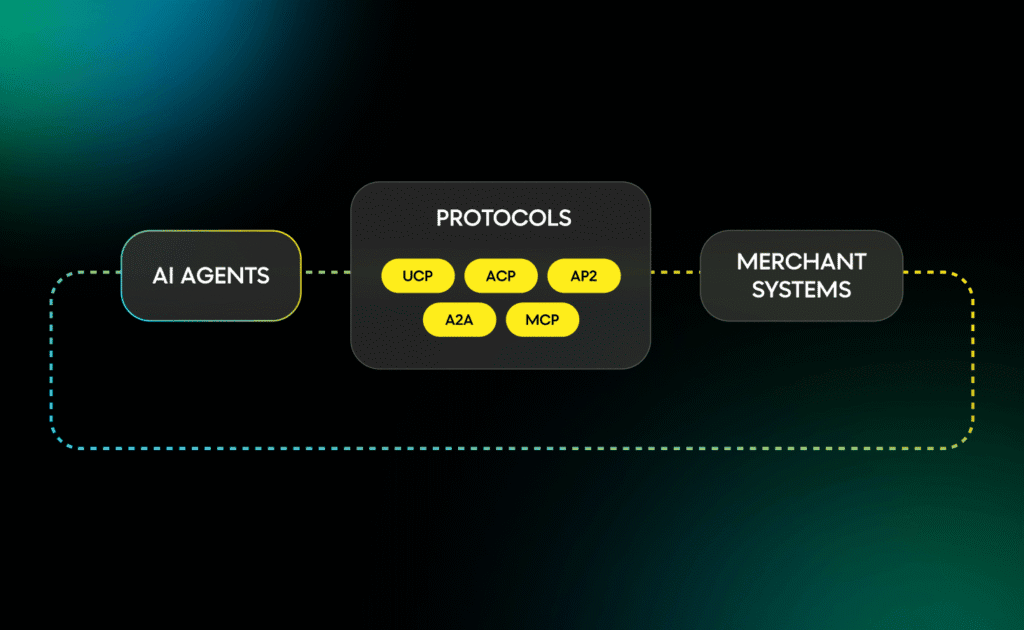
These protocols are what transform agentic commerce from a concept into an operational reality. Without them, every agent-to-merchant interaction would require custom integration. With them, merchants can expose their catalog, pricing, and fulfillment data through standardized interfaces that any agent can access.
Agentic Commerce vs. Agentic AI: What’s the Difference?
Agentic AI is the broad concept: autonomous AI systems that can plan, reason, use tools, and take actions to accomplish goals with minimal human oversight. It applies to everything from code generation to customer service.
Agentic commerce is agentic AI applied specifically to buying and selling. It’s the commerce-specific implementation of the same underlying capabilities, focused on product discovery, price comparison, completing transactions, and post-purchase management.
Think of it this way: agentic AI is the engine, and agentic commerce is one of the vehicles it powers.
The distinction matters for merchants because agentic commerce carries specific requirements that generic agentic AI doesn’t. Your product data needs to be machine-readable. Your pricing must be accessible via APIs. Your search infrastructure needs to handle natural language queries from agents, well beyond keyword searches from humans. These are commerce-specific preparations that the broader agentic AI conversation often glosses over.
Types of Agentic Commerce
Agentic commerce isn’t a single use case. It spans several distinct categories, each with different implications for how merchants should prepare.
Consumer-Facing Shopping Agents
These include tools like ChatGPT’s shopping research, Perplexity’s Buy with Pro, Amazon’s Alexa+, and Google Gemini. A consumer describes what they want, and the agent handles research, comparison, and (increasingly) checkout. Consumer-facing shopping agents represent the early revenue concentration in the projected agentic commerce market.
Merchant-Side Agents
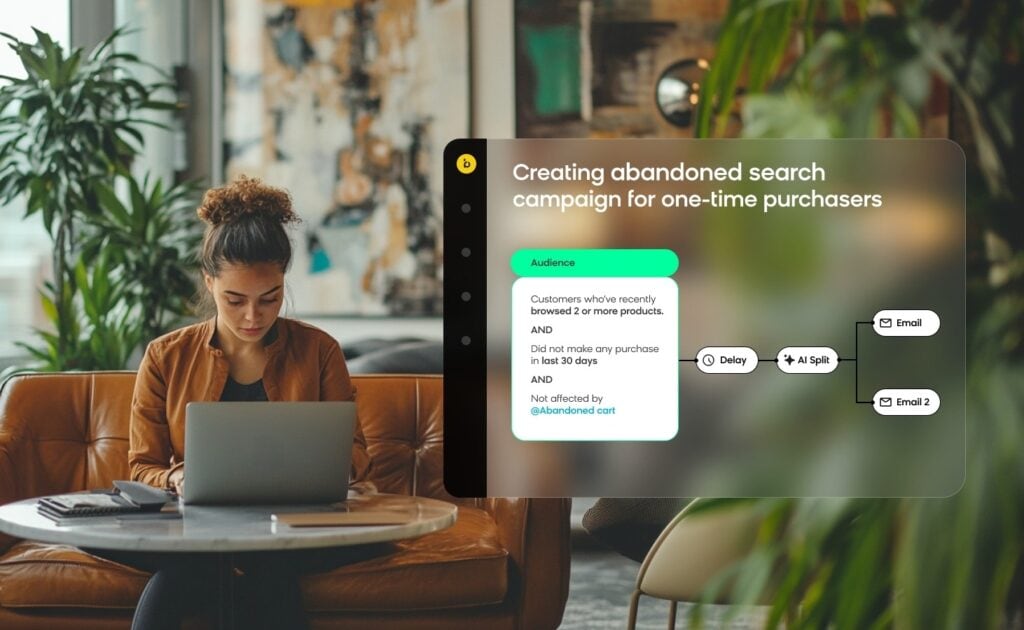
These agents operate inside the merchant’s own stack, automating internal operations like promotional campaign creation, merchandising decisions, inventory optimization, and customer segmentation. They’re less visible to consumers but equally transformative. Our own campaign agents, for example, continuously test and optimize email copy variants, freeing marketing teams from manual processes.
B2B Procurement Agents
In B2B commerce, agents manage vendor selection, quote negotiation, purchase order management, and supply chain coordination. Gartner predicts that AI agents will control over $15 trillion in B2B purchasing by 2028. Forrester estimates that 20% of B2B sellers will be forced into agent-led quote negotiations within the same timeframe. These agents evaluate suppliers on price, reliability, lead time, and compliance simultaneously, moving faster than any human procurement team.
Subscription and Service Management Agents
A growing category involves agents that manage ongoing relationships rather than one-time purchases. These handle subscription renewals, plan optimization, service cancellations, and loyalty program management. When a consumer’s agent identifies a better phone plan or insurance rate, it can initiate the switch autonomously.
What Agentic Commerce Means for Merchants
This is where the conversation shifts from “what is it” to “what do I do about it.” Most industry analysis treats agentic commerce as a technology trend to watch. But for brands, it’s an operational shift (and a huge opportunity) that requires concrete infrastructure changes.
Your Products Need To Be Discoverable by Machines
When an AI agent shops for a specific item, it doesn’t browse your homepage or scroll your category page. It queries structured data. If your product catalog is missing complete, machine-readable attributes (weight, dimensions, materials, shipping speed, price, availability, etc.), the agent has nothing to evaluate. You’re essentially invisible.
This is the same principle behind AI-powered product discovery, extended to external agents. The search infrastructure powering your site is now the interface through which AI agents evaluate your catalog.
First-Party Data Beats Synthetic Data
Here’s a key point to keep in mind: When AI agents make purchase decisions on behalf of consumers, the quality of the personalization they receive depends entirely on the quality of the behavioral data powering it.
Synthetic data and LLM-generated product descriptions get plenty of attention in AI commerce conversations. But agents making real purchase decisions need signals grounded in actual customer behavior: what real shoppers searched for, what they clicked, what they bought, and what they returned. First-party behavioral data produces more accurate personalization, better product rankings, and higher-quality recommendations than any synthetic alternative.

This is a structural advantage for brands who’ve invested in collecting and activating first-party data at scale, and a significant gap for those relying on third-party or synthetic proxies.
New Metrics, New Optimization Targets
Traditional ecommerce optimization centers on metrics designed for human shoppers, like bounce rate, time on page, and click-through rate. In an agentic commerce world, the relevant metrics are a bit different.
- Agent-driven conversion rate measures how often an agent interaction results in a completed transaction. Unlike human conversion, there’s no browsing or comparison shopping on your site; the agent either selects your product or it doesn’t.
- Agent-mediated RPV tracks the revenue generated per agent visit, which may differ significantly from human RPV because agents tend to convert at higher rates on lower-consideration purchases.
- API response quality becomes a performance metric in its own right: how fast your systems return structured product data, how complete that data is, and whether the agent received enough information to make a selection without a follow-up query.
To track these, organizations need to distinguish agent traffic from human traffic in their analytics (user-agent strings and API authentication patterns are early signals), then build reporting that surfaces agent-specific funnels alongside traditional ones.
How To Prepare Your Business for Agentic Commerce
There is still a big gap in how ready brands are to handle agentic commerce, especially as shoppers increasingly turn to AI agents for help. Here’s what you can do now to be prepared:
1. Make Your Product Data Machine-Readable
Structured product attributes are the foundation. Every product in your catalog needs complete, standardized data: GS1 identifiers, schema.org markup, detailed specifications, and clear taxonomy. If a human merchandiser has to look at the product to understand what it is, an agent can’t process it.
2. Expose APIs for Catalog, Pricing, and Inventory
Agents need programmatic access to your product data. This means well-documented APIs that return real-time pricing, inventory levels, and fulfillment options. The MCP and ACP protocols provide the standardized wrapper, but the underlying data infrastructure has to exist first.
3. Invest in AI-Powered Search and Personalization
If your on-site search already falters on natural language queries from humans, it won’t fare better with AI agents. AI-powered search that understands intent, synonyms, and contextual meaning is the baseline for agent readiness. Pair it with a conversational shopping agent that handles natural language product discovery, and you’ve built the interface that both consumers and AI agents can use. Merchants who’ve made this investment are already seeing returns (more on that below).

4. Prioritize First-Party Data Collection
Start capturing and activating behavioral signals now. Every search query, product view, add-to-cart, purchase, and return creates a data point that improves how agents interact with your catalog. The merchants with the deepest first-party data (especially when it’s unified in a single platform) will power the most relevant agentic personalization experiences, and relevance is what determines whether an agent selects your product or someone else’s.
5. Connect to Emerging Agent Protocols
MCP and ACP adoption is still early, but the merchants who integrate now will have a head start when agent traffic scales. We’re already building for this: Loomi Connect enables Bloomreach-powered product catalogs to surface directly in ChatGPT with full ranking and personalization, and its MCP server opens up the same capabilities for custom agent integrations.
6. Rethink SEO for AI Discovery
Traditional SEO optimizes for search engine result pages. Generative engine optimization (GEO) is the practice of structuring content so AI systems can accurately retrieve, cite, and act on it. Where SEO targets ranked links, GEO targets AI-generated answers and agent-driven product discovery. In practice, that means ensuring product data is comprehensive enough for agents to evaluate without visiting your site, structuring content so LLMs can cite it accurately, and building authority signals that AI systems recognize. The playbook is different, and merchants who adapt early will capture a greater share of agent-driven traffic.
Examples of Agentic Commerce
Consumer Agent Completing a Purchase
A traveler tells their AI assistant to find a weekend flight to Lisbon under $400, departing Friday evening, with carry-on included. The agent queries airline APIs and OTA catalogs, filters by the traveler’s constraints, checks seat availability and loyalty program status, and returns three options ranked by total value. The traveler approves one, and the agent books the flight and adds it to their calendar.
Conversational Shopping Driving Conversion
When TFG’s Bash platform implemented our conversational shopping agent, the brand’s Black Friday A/B test showed a 39.8% increase in revenue per visit, a 35.2% lift in conversion rate, and a 28.1% reduction in exit rate among customers who interacted with the agent. The same natural language interface that served human shoppers is the foundation for agent-to-site interactions, where AI agents query the same conversational layer programmatically.
Search Infrastructure Driving Agent Readiness
Patrick Morin, a Quebec-based home improvement retailer with 26+ stores, replaced its legacy search with our AI-powered ecommerce search and saw a 25% increase in search-driven conversions, a 10% lift in search revenue, and an 8% boost in RPV. The same NLP capabilities, synonym handling, and behavioral optimization that improved the brand’s human shopping experience are exactly what agent interactions require: a search system that understands intent beyond keywords alone.
Scaling AI-Powered Discovery Across Brands
Canadian Tire, one of Canada’s largest retailers with 1,700+ store locations, adopted our AI-powered search and achieved a 20%+ increase in conversions across its Atmosphere, Mark’s, and SportChek brands. Delivering accurate results across a broad, multi-brand catalog through NLP and behavioral ranking is the same capability that lets agents navigate complex product assortments efficiently.
Products Surfacing in Agent Ecosystems
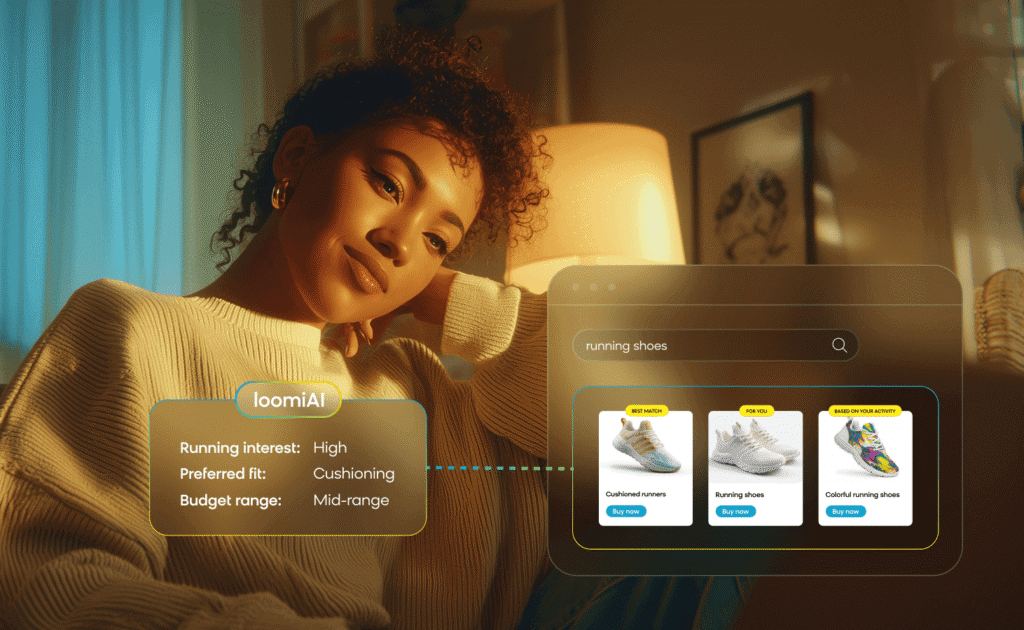
Loomi Connect represents the direct bridge between a merchant’s catalog and the agent ecosystem. Products managed through Bloomreach surface in ChatGPT’s shopping experience with full personalization and ranking intelligence intact. The interaction data flows back into Loomi AI, creating a feedback loop where agent interactions make future product discovery more accurate across every channel. The more touchpoints connected to Loomi AI, the smarter every individual channel becomes. A query an agent makes in ChatGPT improves the personalization a human shopper receives on your website, and vice versa.
How Bloomreach Powers Agentic Commerce
Here’s how we’re enabling agentic commerce at scale.
Conversational shopping agent: Already live on customer sites, our conversational shopping agent delivers a 9% average conversion rate and 20% higher average order value across deployments. It serves as the consumer-facing agentic experience that handles natural language product discovery and guided shopping.
Loomi Connect: Our bridge to the agent ecosystem. Loomi Connect puts your products directly into ChatGPT’s marketplace with the same ranking, personalization, and behavioral intelligence that powers your on-site experience. It’s built on an MCP server that any LLM can connect to, so custom agents can access your Bloomreach-powered catalog programmatically beyond the major consumer platforms. Interaction data flows both ways.
Loomi AI: The intelligence platform connecting it all. Loomi AI combines first-party customer data, real-time infrastructure (5ms-2s from data ingestion to activation), AI decisioning, and orchestration across channels. When agents interact with a Bloomreach-powered storefront, Loomi AI ensures they get personalized, relevant results grounded in real behavioral data, not synthetic approximations.
It may still feel like early days for agentic commerce, but brands that get ahead of it will reap the rewards. Learn how Bloomreach can help your brand deliver truly impactful agentic commerce experiences. Schedule a personalized demo today to see the platform in action.
Frequently Asked Questions
What is agentic commerce?
Agentic commerce is the use of AI agents to autonomously research, compare, and purchase products on behalf of a consumer or business buyer. Unlike traditional ecommerce, where humans navigate websites and make decisions manually, agentic commerce delegates the entire buying journey to AI systems that act with minimal human oversight.
What is the difference between agentic commerce and agentic AI?
Agentic AI is the broad category of autonomous AI systems that plan, reason, and take actions to accomplish goals. Agentic commerce is the specific application of agentic AI to buying and selling, focused on product discovery, price comparison, transactions, and post-purchase management. Every agentic commerce system uses agentic AI, but not every agentic AI system involves commerce.
What are the different types of agentic commerce?
The four main types are consumer-facing shopping agents (ChatGPT, Perplexity, Alexa), merchant-side agents (internal operations like campaign optimization and merchandising), B2B procurement agents (supply chain and vendor management), and subscription/service management agents (ongoing relationship optimization). Each requires different kinds of preparation from the merchant.
What is the agentic commerce protocol?
The agentic commerce protocol refers to a set of emerging standards that define how AI agents connect to merchant systems, handle payments, and complete transactions. The main protocols include ACP (Agentic Commerce Protocol) from OpenAI and Stripe for payments and checkout, MCP (Model Context Protocol) from Anthropic for connecting agents to data systems, A2A (Agent2Agent) from Google for inter-agent communication, AP2 (Agent-to-Payments Protocol) from Google for secure transactions, and UCP (Universal Commerce Protocol) from Google for the full shopping lifecycle. Together, they create the standardized infrastructure that makes agent-to-merchant interactions scalable.
What is the prediction for agentic commerce?
McKinsey projects $900 billion to $1 trillion in US agentic commerce value and $3 to $5 trillion globally by 2030. Morgan Stanley estimates $190 billion to $385 billion in US ecommerce alone (10-20% market share). Bain projects $300 to $500 billion in US agentic commerce, representing 15-25% of online retail. Gartner predicts AI agents will control over $15 trillion in B2B purchasing by 2028.