Shopping behavior is shifting beneath our feet, and the numbers tell a story that’s impossible to ignore.
According to a recent Bloomreach survey* of more than 1,000 U.S. consumers, nearly half of respondents (49.5%) use ChatGPT for shopping-related tasks several times per week or more. That’s not a niche use case — that’s mainstream adoption.
And it’s accelerating: 54.2% of respondents report using ChatGPT for shopping more now than they did just six months ago.
This means widespread adoption of ChatGPT as a shopping channel isn’t some far-flung prediction — it’s already happening.
The Trust Problem Hiding in Plain Sight
Here’s where it gets interesting. When ChatGPT recommends products, 36% of consumers say they’re very confident the information is accurate — that items are in stock, available in their size, and priced correctly.
But the reality is that generic AI models don’t have access to your real-time inventory, your pricing strategy, or your merchandising rules. They’re often making recommendations based on outdated or incomplete information. Consumers trust what they’re seeing, but that trust is built on thin ice.
This creates a massive opportunity for brands willing to step in. Because when you control your presence in conversational channels, you deliver the accuracy consumers expect — and capture the revenue that comes with it.
The Data That Demands Action
The consumer behavior we’re tracking reveals something crucial: Conversational shopping isn’t replacing traditional ecommerce. Instead, it’s expanding the playing field.
Consider this: 46.3% of respondents have already purchased a product that ChatGPT recommended. Those conversions are happening in a channel that didn’t exist as a shopping destination a year ago. And while 58.9% of consumers would still prefer shopping directly on a brand’s site if forced to choose, 41.1% would choose ChatGPT. That’s not a small minority — that’s nearly half your potential customers signaling their channel preference.
What makes this even more compelling is that 60.6% of consumers say they’d be very or extremely likely to shop through ChatGPT if their favorite brand offered that capability directly. They want this experience. They’re ready for it.
Personalization Isn’t Optional
Here’s what separates winning from losing in this channel: 64.1% of consumers say it’s important that product recommendations reflect their personal preferences and past shopping behavior.
Consumers aren’t looking for generic product dumps. They expect the same level of personalization they’ve grown accustomed to across every other channel. The problem is that most conversational platforms can’t deliver that without your help.
When consumers shop through ChatGPT, 42.7% ask for recommendations from specific brands. They’re not just browsing — they’re seeking you out. But if you’re not there to meet them with personalized, accurate recommendations, you’re sending them straight to your competitors.
And incentives also play a role here: 41.8% of consumers say exclusive deals or promotions would make them more likely to shop through conversational AI. That’s a clear signal that you can drive adoption and conversion by treating this channel strategically and not like an afterthought.
The Channel Strategy You Can’t Ignore
Think about how your brand approached email, SMS, social media, and every other channel that emerged over the past two decades. You didn’t wait for perfect adoption. You built a presence, tested, learned, and scaled.
Conversational commerce deserves the same strategic approach.
The brands that win in this space will be the ones who recognize that ChatGPT isn’t a threat to their ecommerce site — it’s an extension of their customer experience. It’s another touchpoint where personalization, merchandising strategy, and brand control need to flow seamlessly.
That’s exactly why we built Loomi Connect.

Loomi Connect: Your Brand, Your Rules, Every Channel
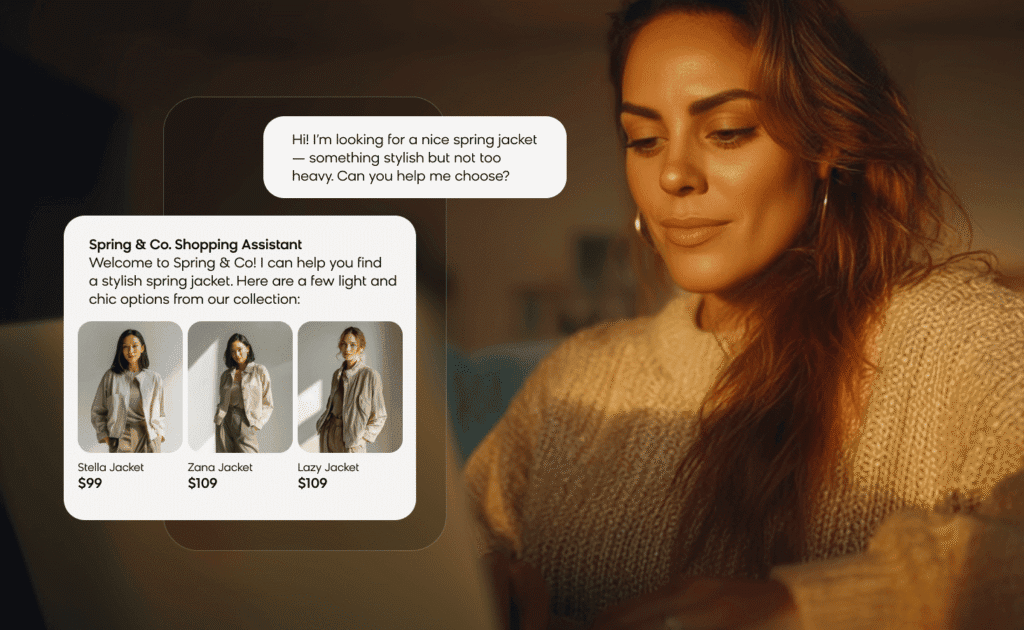
Loomi Connect extends Loomi AI directly into conversational environments through the Model Context Protocol (MCP). That means your product recommendations in ChatGPT reflect your real-time inventory, your merchandising rules, your pricing strategy, and your personalization engine.Looomi Connect also captures interaction data and feeds it back into customer profiles, enabling personalization to flow seamlessly between ecommerce sites and conversational channels.
This is what it means to control your customer relationships across every channel. Same intelligence, same personalization, and same brand governance — Just delivered through a fundamentally different interface.
Build for Tomorrow, Today
The data makes one thing crystal clear: Conversational shopping isn’t coming soon, it’s already here. Consumers are using it weekly, trusting it for recommendations, and converting from it.
The question isn’t whether you should have a presence in conversational channels. It’s whether you’ll lead with strategy, intelligence, and control — or cede that ground to generic AI that doesn’t understand your brand or your customers.
Your customer relationships are too valuable to leave to chance.
Ready to take control of your brand’s presence on ChatGPT? Watch a recent webinar previewing Loomi Connect to see how we’re helping brands win in this new channel.
*Based on a survey of 1,010 respondents conducted on December 17, 2025 by Propeller Insights on behalf of Bloomreach.