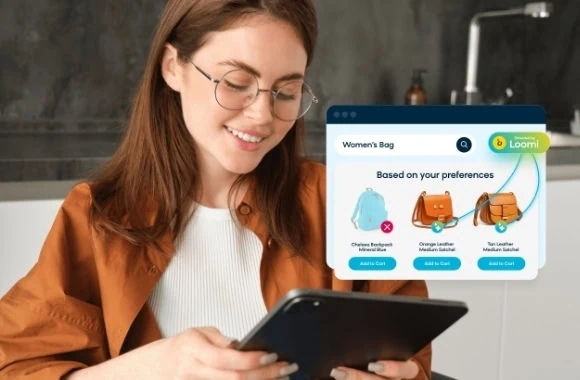

Most marketing teams didn’t set out to build a complicated stack — it happened one tool at a time. An email service provider here, a push notification tool there, a separate platform for SMS, a customer data platform to tie it together, and an analytics layer on top of it all. Each tool solved a real problem, but together, they created a new one: customer data scattered across systems that don’t talk to each other, and a customer experience that feels disjointed as a result.
A customer engagement platform is the answer many teams are now reaching for. Gartner has found that marketers use less than half the capabilities in the martech they already own, and the complexity of the stack is a leading barrier to getting more from it. Instead of stitching channels together after the fact, a customer engagement platform treats engagement as one connected system, with shared data and a single place to orchestrate every interaction. The category has matured fast, and the platforms in it now differ sharply in how they handle data, how they apply AI, and which kinds of businesses they serve best.
Here’s an overview of the best customer engagement platforms out there, along with a breakdown of which one might be the best fit for you.
What Is a Customer Engagement Platform?
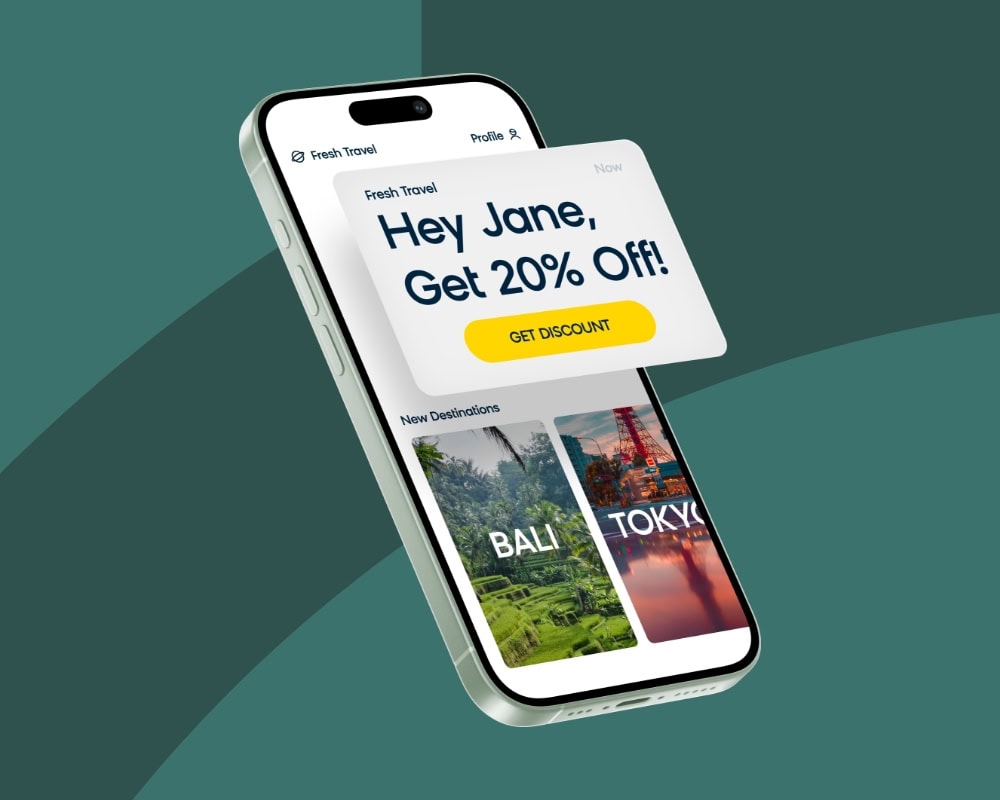
A customer engagement platform (CEP) is software that unifies customer data and orchestrates personalized interactions across every channel a brand uses, including email, SMS, web, mobile apps, push notifications, and ads. Rather than managing each channel in isolation, marketers use a CEP to coordinate messaging based on a single, shared view of each customer’s behavior and history.
Some CEPs approach engagement from a customer service angle, focused on support tickets, live chat, and contact center routing. Others approach it from a marketing angle, focused on campaigns, lifecycle automation, and personalization that drives revenue. This guide focuses on the marketing-led category, where the goal is to turn customer data into relevant, timely experiences across the buying journey.

A CEP also differs from two adjacent categories it often gets confused with. A customer data platform (CDP) collects and unifies customer data but doesn’t necessarily activate it across channels. A CRM solution stores customer records and manages relationships, usually with a sales or service focus. A customer engagement platform sits closer to the point of action: it uses unified data to actually deliver the experience. The strongest platforms increasingly fold CDP-style data unification into the engagement layer, so marketers don’t have to choose between owning their data and acting on it.
What To Look for in a Customer Engagement Platform
Before comparing vendors, it’s important to define what matters most for your business. These six criteria will help you structure that evaluation.
Omnichannel Support
Does the platform support every channel you use today, and the ones you plan to add? Look past email and SMS to web personalization, mobile apps, push, and ad audiences. An effective omnichannel engagement strategy depends on channels that share data and work together, not a collection of separate tools under one login.
AI and Real-Time Personalization
How does the platform actually use AI? Some only offer basic segmentation and send-time optimization. Others apply AI across the whole experience: predictive analytics, real-time decisioning, and content generation. The platforms that pull ahead combine rich first-party data, real-time infrastructure, and AI that understands each customer in context. AI in customer engagement has moved from a nice-to-have to the core of how these platforms differentiate.
Unified Customer Data
Can the platform serve as your customer data foundation, or will you need a separate CDP alongside it? Unified data reduces integration overhead and makes sophisticated targeting possible. Rather than fixating on the “CDP” label, look at whether the platform can actually bring customer and product data together, keep it fresh in real time, and let marketers act on it directly rather than routing every change through engineering.
Commerce and Industry Fit
If you sell online, evaluate whether the platform was built for commerce or adapted to it. Native product catalogs, purchase-behavior tracking, and merchandising matter for retail and ecommerce teams. If you operate in financial services, travel, or another regulated or high-consideration industry, look for proven deployments in your space rather than a generic feature list.
Time to Value
How quickly can you launch and see results? Some platforms need months of implementation before the first campaign goes out. Others deliver value within weeks, especially when prebuilt use cases and native integrations remove the heavy lifting.
Total Cost of Ownership
Look beyond the license fee. Factor in implementation, the integrations you’ll need, and the ongoing technical resources required to keep the platform running. Total cost of ownership often looks very different from the license fee alone.
The Best Customer Engagement Platforms for 2026
The platforms below represent the strongest marketing-led customer engagement options heading into 2026. Assessments draw on vendor documentation, published capabilities, and verified user reviews from sources such as G2 and Gartner Peer Insights.
1. Bloomreach: Best for Unified, AI-Powered Personalization Across the Customer Journey
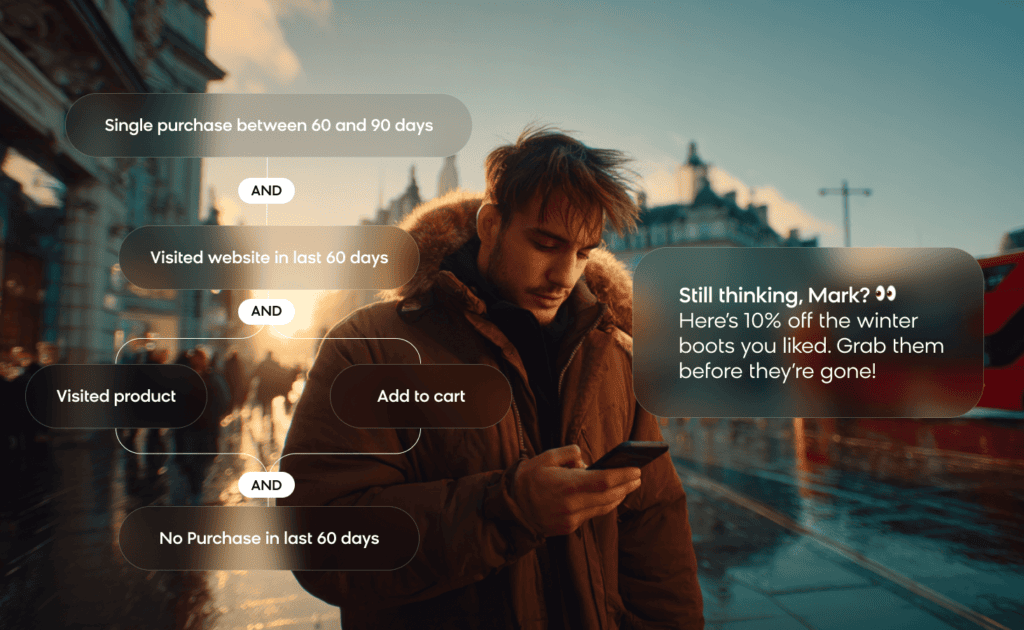
Bloomreach is an AI company for personalization. Its agentic personalization platform, Loomi, understands every customer in context and tailors their experience in real time. Loomi personalizes the whole journey from one platform, across email, mobile messaging, web, ads, and search, and powers agents for marketing and conversational shopping.
The foundation is what sets the approach apart. Loomi brings together first-party data, real-time infrastructure, and a mix of rules-based AI, machine learning, and generative AI. That shared intelligence is behind every app and agent on the platform, so each touchpoint draws on one current understanding of the customer instead of a synced copy of the data that ages by the hour.
Key capabilities:
- Unified customer data and activation, without a separate CDP required for advanced segmentation
- Orchestration across email, SMS, WhatsApp, RCS, web, mobile app, ad platforms, and more
- Real-time personalization and predictive analytics
- AI-powered ecommerce search and product recommendations on the same platform
- The Loomi marketing agent, which builds and orchestrates campaigns from a stated goal
- Over 100 native integrations, including Shopify, Magento, BigCommerce, Snowflake, and Databricks
- Prebuilt use cases to launch campaigns quickly
Best for: Mid-market to enterprise brands that want one platform for personalization across every channel, or teams that want to start with a single capability like marketing automation and expand over time.
2. Braze: Best for Mobile-First Cross-Channel Messaging
Braze is a customer engagement platform known for cross-channel messaging at scale, with particular strength in push notifications and in-app messaging. It processes data in real time and is a common choice for mobile-first brands and enterprises with dedicated marketing operations teams.
Best for: Mobile-first brands and enterprises that center their engagement strategy on app and push messaging.
3. Salesforce Marketing Cloud: Best for Enterprises Standardized on Salesforce CRM
Salesforce Marketing Cloud (now Agentforce Marketing) is a broad marketing suite that connects tightly to the wider Salesforce ecosystem. For organizations already running Salesforce CRM, it offers email, journey orchestration, and audience management within a familiar environment.
Best for: Large enterprises already invested in Salesforce that want their engagement tooling in the same ecosystem.
4. Iterable: Best for Enterprise Cross-Channel Orchestration
Iterable is a cross-channel marketing platform aimed at enterprise teams. It offers a visual journey builder, a flexible data model with strong API support, and orchestration across email, SMS, push, and in-app messaging.
Best for: Large enterprises with marketing operations teams that want flexible cross-channel orchestration.
5. Insider: Best for Individualized B2C Marketing Across Web and App
Insider focuses on individualized marketing across web, mobile, and messaging channels, using machine learning to predict behavior and tailor experiences. It’s used widely by large B2C brands in retail, travel, and financial services.
Best for: Large B2C enterprises that want individualized marketing across web and app channels.
6. MoEngage: Best for Insights-Led Mobile App Engagement
MoEngage positions itself as an insights-led customer engagement platform with particular strength in mobile apps. It combines push, in-app messaging, email, and SMS with built-in analytics and AI for send-time optimization and segmentation.
Best for: App-centric businesses that want mobile engagement paired with behavioral analytics.
7. CleverTap: Best for High-Volume Mobile Engagement and Analytics
CleverTap combines mobile engagement with deep behavioral analytics, capturing extensive user event data for granular segmentation. It’s oriented toward digital businesses with large, active user bases.
Best for: High-volume mobile apps and digital businesses that need engagement and product analytics together.
8. Klaviyo: Best for SMB Ecommerce Email and SMS
Klaviyo is an email and SMS platform that has become a default for small to mid-sized ecommerce brands. It pairs prebuilt automation flows with segmentation based on purchase behavior and straightforward ecommerce integrations.
Best for: Small to mid-market ecommerce brands that primarily need email and SMS automation.
Quick Comparison
| Platform | Best for | Key strength | Typical buyer |
|---|---|---|---|
| Bloomreach (Loomi) | Unified AI personalization across the journey | One platform for engagement, search, and data | Mid-market to enterprise |
| Braze | Mobile-first cross-channel messaging | Push and in-app at scale | Enterprise |
| Salesforce Marketing Cloud | Enterprises on Salesforce CRM | CRM-ecosystem integration | Enterprise |
| Iterable | Enterprise cross-channel orchestration | Visual journey builder | Enterprise |
| Insider | Individualized B2C marketing | Web and app personalization | Enterprise |
| MoEngage | Insights-led mobile engagement | Analytics-led segmentation | Mid-market to enterprise |
| CleverTap | High-volume mobile engagement | Behavioral analytics depth | Mid-market to enterprise |
| Klaviyo | SMB ecommerce email and SMS | Prebuilt ecommerce flows | SMB to mid-market |
Why Loomi Stands Out for Customer Engagement
For brands that want engagement, data, and personalization to work as one system, we built Loomi to remove the seams that come from stitching point solutions together. Here’s what that looks like in practice.
The Power of Connected Data
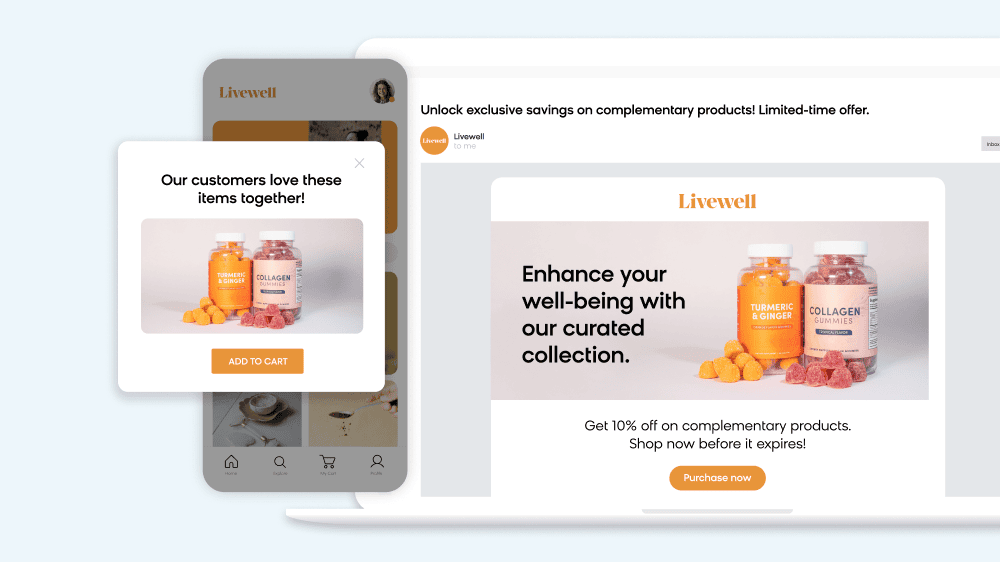
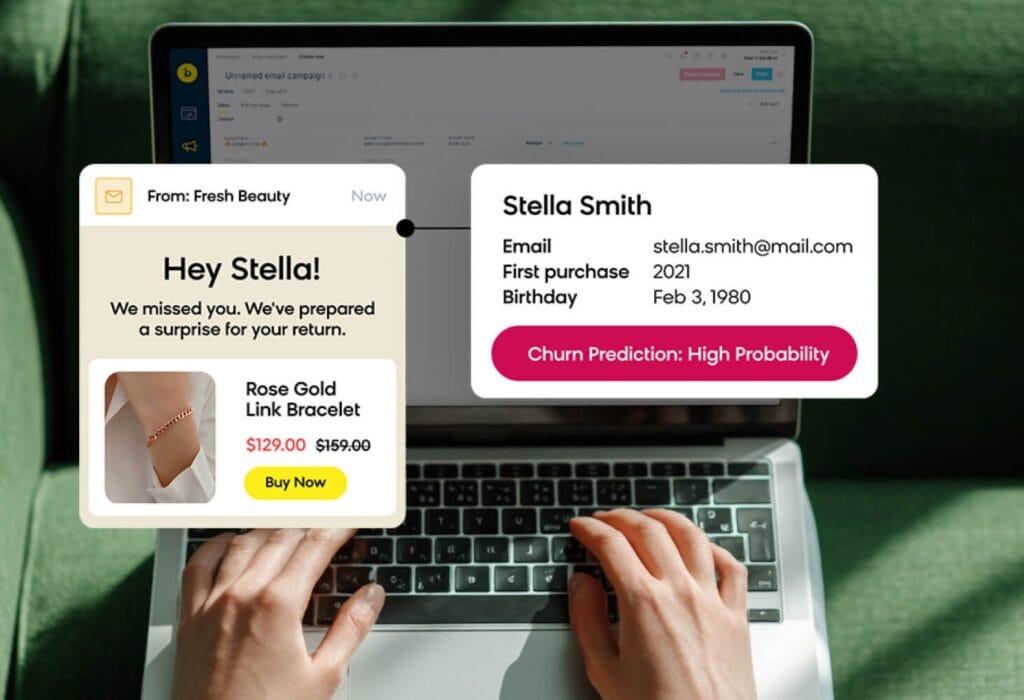
When email campaigns, web personalization, and product recommendations all run on the same platform, each touchpoint makes the others smarter. A customer’s search behavior shapes their email content, and their email clicks improve what they see on site. That increased value depends on the touchpoints sharing one live view of the customer, which is hard to achieve when each runs on a separate tool with its own copy of the data.
Modular by Design
You don’t have to adopt everything at once. Teams often start where the need is sharpest (which is often email marketing), and expand into other channels or product discovery over time. Beauty retailer Notino had used Loomi for email, then added in SMS when it was ready to expand. As a result, the brand was able to drive 11% of Black Friday orders via SMS shortly after adding the channel, as well as driving 60% of customer orders during an anti-churn campaign through SMS.
Built for Commerce, Proven Across Industries
Loomi was built for commerce from the ground up, with native product catalogs and purchase-behavior tracking. But the engagement engine works well beyond retail. Oliver Bonas, a British lifestyle retailer, built a single customer view on Loomi and saw a 762% increase in revenue along with a 97% lift in email click-through rate. Arriva UK Bus, in passenger transport, set up automated cross-channel scenarios spanning email, push, and webhooks, and grew CRM revenue by 380% year over year on a like-for-like campaign.
Proven Return on Investment
A Forrester Total Economic Impact study* found that Bloomreach customers achieved up to 251% ROI over three years, with payback within six months. Additionally, brands saw a 27% increase in conversion rates and a 35% improvement in email open rates.
*The Forrester Total Economic Impact study was commissioned by Bloomreach and independently conducted by Forrester Consulting. Actual results may vary.
These outcomes reflect what’s possible when engagement runs on unified data and real-time AI.
See Loomi in Action
See how Loomi brings your data, channels, and AI together into one personalization engine. Book a demo to see it at work and how brands like Notino and Arriva UK Bus used connected data to drive measurable revenue growth.
Frequently Asked Questions
What is a customer engagement platform?
A customer engagement platform unifies customer data and orchestrates personalized interactions across channels such as email, SMS, web, mobile apps, push, and ads. It lets marketers coordinate messaging from a single, shared view of each customer rather than managing each channel separately.
What is the best customer engagement platform?
The best platform depends on your needs. For brands that want unified personalization across every touchpoint, Loomi brings engagement, data, and search together in a single platform. For mobile-first messaging at scale, Braze and CleverTap are strong choices. For small to mid-market ecommerce focused on email and SMS, Klaviyo provides a fast path to value.
What’s the difference between a CEP, a CRM, and a CDP?
A CRM solution stores customer records and manages relationships, often for sales or service. A customer data platform (CDP) collects and unifies customer data but doesn’t always activate it. A customer engagement platform (CEP) uses unified data to deliver personalized experiences across channels. Some platforms, including Loomi, fold CDP-style data unification into the engagement layer.
Do I need a separate CDP if I have a customer engagement platform?
Not always. Some engagement platforms require a separate CDP for advanced segmentation and analytics, while others, like Loomi, include native data unification so marketers can segment and activate without a standalone CDP. If you already run a CDP, look for a platform that integrates with it cleanly.
How much does a customer engagement platform cost?
Pricing varies widely by platform and usage model. Many enterprise platforms use custom pricing based on contacts, messages, or active users, while some ecommerce-focused tools offer a free tier and published plans. Because pricing changes frequently, confirm current figures directly with each vendor and weigh total cost of ownership, which includes implementation and ongoing resources alongside the license fee.
What features should I look for in a customer engagement platform?
Prioritize omnichannel support, AI and real-time personalization, unified customer data, fit for your industry and commerce model, time to value, and total cost of ownership. The right balance depends on the channels you use, the data you hold, and the resources your team can dedicate to running the platform.