

Disclaimer:
The information in this post is for informational purposes only. Please contact your legal team to obtain advice with respect to any particular issues or concerns regarding TCPA compliance.
What changed in 2026:
- Quiet hours are a litigation target. Class actions over opted-in texts sent outside 8 a.m. to 9 p.m. have run since 2025. One federal court sided with the defense in April 2026, but the FCC has not ruled on whether the window applies to consented messages.
- Texts are not “calls” for Do Not Call lawsuits in three states. A July 2026 Seventh Circuit ruling covers Illinois, Indiana, and Wisconsin; the consent rules for marketing texts are unchanged.
- Opt-out rules are moving again. The FCC delayed its “revoke-all” rule to January 31, 2027, and will vote on September 30, 2026 on a draft that would let senders make a clearly disclosed “Reply STOP” their only opt-out method.
Details and sources are in What Changed: TCPA Updates for 2025-2026 below.
What Is the TCPA?
The Telephone Consumer Protection Act (TCPA) is a United States federal law governing the regulation of telephone solicitations. The TCPA was first signed into law in 1991 and has remained the bedrock of federal telemarketing regulations ever since.
Who Must Comply With the TCPA?
Because the TCPA regulates all telephone solicitations, any person, business, or entity that markets or sells their products or services over the phone, including voice calls, faxes, VoIP calls, and text messages, is subject to the TCPA.
Brands using or planning to use SMS marketing should be aware of Sections 4 and 5 of the TCPA’s definition, which define what they mean by “telephone solicitation” and “unsolicited advertisement.”
Why Does the TCPA Matter for SMS Marketing?
You cannot send unsolicited marketing text messages to your customers unless they voluntarily give you prior express written consent, which the FCC’s rules define as:
“An agreement, in writing, bearing the signature of the person called that clearly authorizes the seller to deliver or cause to be delivered to the person called advertisements or telemarketing messages using an automatic telephone dialing system or an artificial or prerecorded voice, and the telephone number to which the signatory authorizes such advertisements or telemarketing messages to be delivered.”
This consent must specify the phone number to be called and include the receiver’s written or electronic signature, which could be a button press confirming the agreement. The caller must also disclose that consent is not a condition of purchase.
Typically, consent is captured via opt-in forms on your website or during checkout. The consent language must be clearly communicated and separate from other terms.
If you already have phone numbers from your customers, can you just start sending them marketing messages? No. Having someone’s phone number does not mean you have permission to text them. They must explicitly opt in to marketing communications from your brand.
The same goes for an email opt-in. Consent to marketing email is not consent to marketing texts: the written agreement has to name the phone number and authorize text messages to it.
Consent is tied to the owner of the phone number, not the phone number itself. And if you operate a family of brands, consent to SMS from one brand does not mean consent to SMS from another. Each consent must be captured separately and clearly defined.
Transactional vs. Promotional Messages
The TCPA applies different consent standards depending on the type of message you send:
Promotional/marketing messages require prior express written consent (the higher standard). These include discount offers, product announcements, flash sales, upsell campaigns, and any message designed to promote or advertise.
Transactional/informational messages require prior express consent, which can be oral or written (a lower standard). These include order confirmations, shipping updates, appointment reminders, account alerts, and password resets. However, transactional messages cannot contain promotional content. If you include a discount code in a shipping notification, the entire message may be classified as promotional.
What decides the category is the message’s purpose. The FCC’s rules define an advertisement as any material advertising the commercial availability or quality of goods or services, and telemarketing as a message sent to encourage a purchase. Under the FCC’s dual-purpose rule, a message that informs and also promotes counts as promotional. Here is how that sorts the texts a retailer sends most often:
|
Message |
Treat as |
Why
|
|---|---|---|
|
Order confirmation |
Transactional |
Confirms a purchase the customer already made |
|
Shipping or delivery update |
Transactional |
Reports on an existing order |
|
Shipping update with a discount code for the next order |
Promotional |
The code encourages a new purchase, so the whole message is promotional |
|
One-time passcode or login code |
Transactional |
Completes a security step, promotes nothing |
|
Password reset or account alert |
Transactional |
Account service, no offer |
|
Abandoned cart reminder |
Promotional |
Its purpose is to get the customer to complete a purchase, with or without an offer |
|
Back-in-stock or price-drop alert |
Promotional |
Advertises the availability or price of goods |
|
“Buy again” or product recommendation |
Promotional |
Encourages a new purchase |
|
Birthday or loyalty offer |
Promotional |
Advertises an offer |
Edge cases, such as a review request or a loyalty points balance with a link to the store, depend on the wording. When a message is borderline, treat it as promotional and hold it to the written-consent standard.
Understanding this distinction is important. Many businesses overcollect consent for transactional messages or undercollect for promotional ones. The safest approach: obtain written consent for all SMS communications and clearly separate transactional from promotional messages in your workflows.
TCPA Requirements for SMS Marketers
Here are the key TCPA requirements for SMS marketing, along with Bloomreach solutions to help you stay compliant:
Consent
Above all else, capturing clear and unambiguous consent is the most important requirement of TCPA compliance. Without prior express written consent, you may not send marketing messages.
Bloomreach solution: Consent management + TCPA list validation
Make It Easy To Opt Out
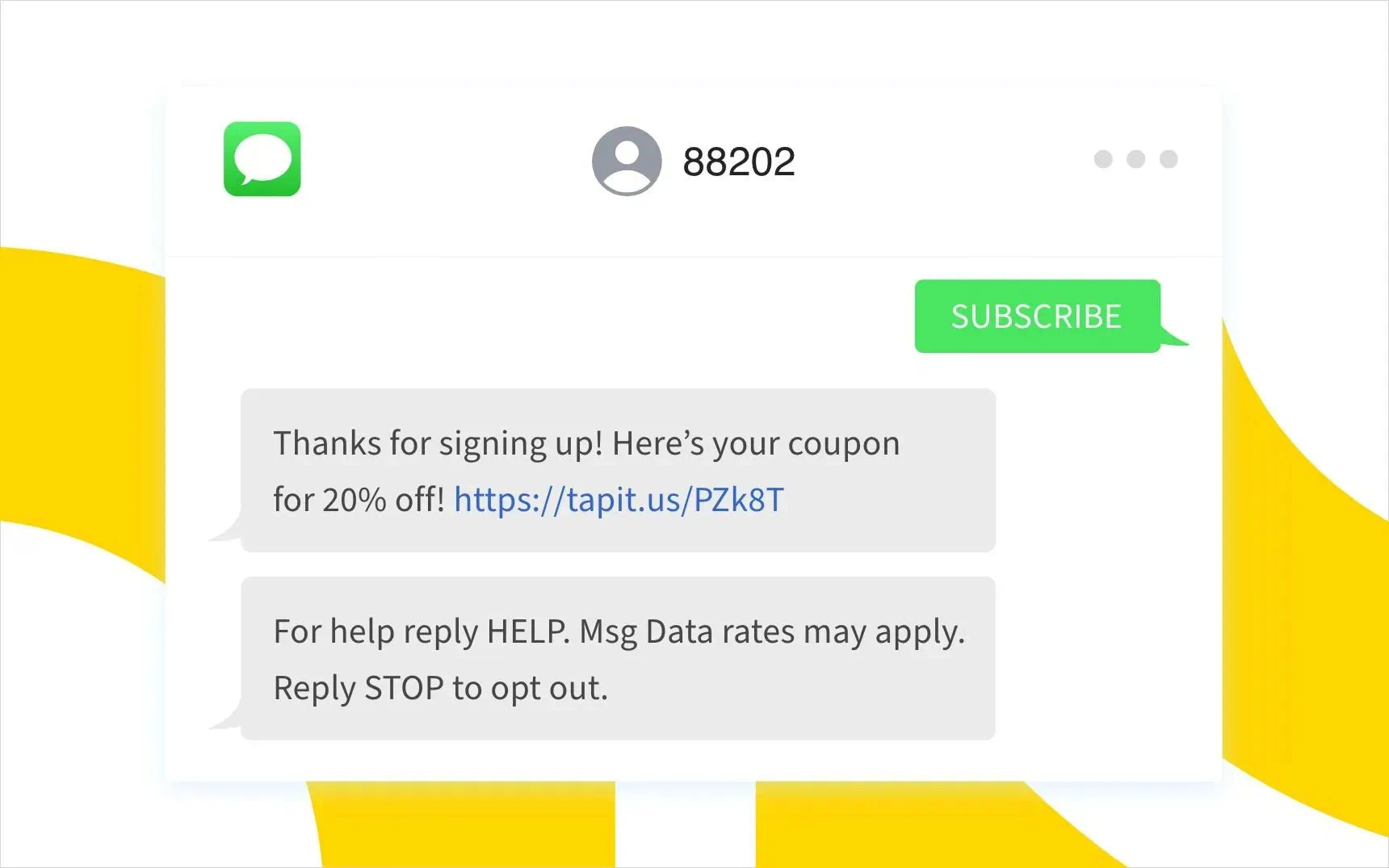
The TCPA requires that customers can easily opt out of your SMS marketing program. The accepted method of unsubscribing is to respond to a text with “STOP.”
Since April 2025, FCC rules require businesses to accept opt-out requests through any reasonable method, not just keyword replies. This includes email, phone calls, website forms, chatbots, or even in-person requests. Businesses must process opt-out requests within 10 business days and may send a single confirmation message (within 5 minutes, with no promotional content) to clarify which types of messages the consumer wants to stop receiving.
The rule also covers wording. A reply of “stop,” “quit,” “end,” “revoke,” “opt out,” “cancel,” or “unsubscribe” is always a valid opt-out. Any other reply counts too if a reasonable person would read it as a request to stop, so “please stop texting me” and “take me off your list” are opt-outs in law.
Keyword matching can miss those. In Bloomreach’s mobile messaging app, a keyword auto-response blocks the number and records the consent change the moment a message starts with a configured opt-out keyword. A reply that puts the keyword mid-sentence (“I want to STOP getting these”) needs a second layer. A scenario that scans incoming messages looks for opt-out phrases anywhere in the text, revokes consent, and sends the confirmation. Your legal team decides which phrases count; the platform enforces the list you give it.
It’s good practice to have easily accessible terms and conditions and periodically remind recipients of how to opt out so they aren’t frustrated or confused by the process.
Bloomreach solution: Consent management and keyword opt-outs
Send Time Restrictions (Silent Hours)
The TCPA stipulates that text messages may not be sent before 8 a.m. or after 9 p.m. in the recipient’s time zone. Certain states are more restrictive:
|
Jurisdiction |
Permitted window (recipient’s local time)
|
|---|---|
|
Federal (TCPA) |
8 a.m. to 9 p.m. |
|
8 a.m. to 8 p.m. |
|
|
8 a.m. to 8 p.m. |
|
|
8 a.m. to 8 p.m. |
|
|
8 a.m. to 8 p.m. |
|
|
9 a.m. to 9 p.m. Monday to Saturday, noon to 9 p.m. Sunday |
Oklahoma and Maryland also cap solicitations at three per 24 hours on the same subject. Texas SB 140, which took effect in September 2025, extended the state’s telemarketing rules to text messages.
To avoid risk, send texts between 9 a.m. and 8 p.m. and ensure time zones are respected.
Quiet hours are also where much of the recent litigation sits. Since early 2025, plaintiffs have filed class actions over marketing texts sent outside 8 a.m. to 9 p.m. to people who had opted in. An industry group asked the FCC in March 2025 to rule that the window doesn’t apply to consented texts, and that petition is still open. One federal district court agreed with the defense in April 2026, but that ruling binds no one else. Until the FCC or an appeals court settles it, apply the window to every marketing text, consented or not.
Bloomreach solution: Silent hours
Identification Requirements
The TCPA requires the sender to provide their name, the name of the company they’re communicating on behalf of, and a telephone number or address which can be used to contact them again. This information should appear in your first message to new subscribers.
Bloomreach solution: Brand name
Message Frequency Guidelines
The TCPA does not set strict limits on SMS frequency, but excessive messaging can be perceived as harassment and increases compliance risk. Most brands follow a general guideline of 1-2 promotional messages per week. Carrier policies, which are guidelines rather than law, add further restrictions:
- Abandoned cart messages should be limited to one message per unique cart event
- Abandoned cart messages should be sent within 48 hours of the event
Offering subscribers the ability to customize their message frequency (weekly, monthly, or promotional-only) reduces opt-outs and builds trust.
Bloomreach solution: Frequency policy
Record-Keeping Requirements
Maintaining detailed records of consent is your strongest defense in a TCPA complaint or lawsuit. Businesses should track:
- When and how consent was obtained (exact date, time, and method)
- The exact language of the consent agreement shown to the consumer
- The contact details of the recipient (phone number tied to consent)
- Opt-out requests and processing dates
Retain these records for at least five years. Courts and regulators expect businesses to produce documented proof of consent when challenged.
Internal Do Not Call (DNC) List
The TCPA requires callers and senders to maintain an internal do-not-call database of consumers who have asked not to be called or texted.
Bloomreach solution: Consent management and keyword opt-outs
National Do Not Call Registry
Marketers are required by the TCPA to suppress phone numbers on the National Do Not Call Registry. Some states maintain their own DNC lists as well, separate from the federal list.
Bloomreach solution: TCPA list validation
What Are the Penalties for Violating TCPA Regulations?
TCPA violations carry serious financial consequences:
- $500 per violation for standard infractions
- $1,500 per willful violation (treble damages)
Do Not Call violations can also draw civil penalties from the Federal Trade Commission of up to $53,088 per violation under its Telemarketing Sales Rule.
There is no cap on statutory damages, so repeat violations can result in millions of dollars in penalties. TCPA violations are frequently pursued as class-action lawsuits, which compound the cost quickly.
Recent TCPA SMS Settlements
Recent settlements illustrate the financial stakes of non-compliance:
- Clover Network (2024): up to $15 million for marketing texts sent to numbers on the National Do Not Call Registry
- Zales Jewelers (2025): $7.5 million for marketing texts to Do Not Call registrants who had never given Zales their number
- DSW / Designer Brands (2025): $4.43 million for continuing to send marketing texts after consumers replied STOP
- Cash App (2025): $12.5 million for referral texts sent to Washington residents without clear consent, brought under Washington’s Commercial Electronic Mail Act rather than the TCPA
The pattern across these cases is clear: the largest settlements involve either sending texts without any consent at all or continuing to text after opt-out requests. Both scenarios are preventable with proper compliance infrastructure. The Cash App case adds a second lesson: state laws carry their own damages, so federal compliance alone does not close the risk.
What Are the Biggest TCPA Risks?
Reassigned Numbers
Nearly 100,000 numbers are reassigned each day. Since consent is associated with the called party and not the phone number, contacting reassigned numbers carries significant TCPA risk.
The FCC’s Reassigned Numbers Database (RND) mitigates this risk. Operational since November 2021, the RND holds carrier reports of permanently disconnected numbers. Businesses can query the RND before sending messages to check whether a number has been disconnected since consent was obtained. A “No” response provides an FCC-recognized safe harbor if the database turns out to be wrong. Carriers must wait at least 45 days before reassigning a disconnected number, so checking at least that often keeps your list inside the window.
The RND is administered by SomosGov and available via subscription.
Bloomreach solution: Our TCPA list validation feature checks for deactivated and reassigned numbers daily and opts them out automatically. It also excludes known TCPA litigators and flags numbers on national and state DNC lists for you to review against your consent records.
Private Right of Action
TCPA allows individuals to sue brands directly for violations and statutory damages. While individuals can initiate legal action, TCPA violations are often pursued as class-action lawsuits, which compound costs rapidly.
Personal Liability
In certain situations, executives and compliance officers are being targeted personally for litigation stemming from TCPA penalties.
DNC Violations
Following the Supreme Court’s decision in Facebook v. Duguid, TCPA litigators have turned their focus to alleging DNC violations by organizations. There are different DNC lists (federal, state, and internal), and DNC compliance is taking on renewed importance. Failure to scrub against all applicable lists before sending is one of the most common triggers for TCPA litigation.
That theory now has a limit in part of the country. In July 2026, the Seventh Circuit held in Steidinger v. Blackstone Medical Services that a text message is not a “telephone call” under the TCPA provision that lets consumers sue over Do Not Call violations. The ruling binds only Illinois, Indiana, and Wisconsin. It leaves the FCC’s Do Not Call rules for texts, the TCPA’s consent rules, and state laws in place, so keep scrubbing.
TCPA Exemptions
Certain types of messages are exempt from full TCPA consent requirements:
Emergency messages are fully exempt. Severe weather alerts, public safety warnings, school lockdown notifications, and medical emergencies can be sent without prior consent.
Healthcare messages under HIPAA may be sent with prior express consent (not written). This includes appointment confirmations, prescription notifications, pre-operative instructions, and lab result notifications. These messages cannot contain marketing content.
Non-commercial messages from nonprofits, political organizations, and charitable entities often fall outside TCPA marketing rules. However, if the message contains any commercial promotion, standard TCPA rules apply.
Informational/transactional messages require prior express consent (not written) when they are purely informational. Order confirmations, shipping updates, and account alerts fall into this category, as long as they contain no promotional content.
If you believe your messages may qualify for an exemption, consult your legal team. Exemptions are nuanced, and misclassifying a promotional message as informational can result in violations.
What Is the CTIA?
The CTIA (Cellular Telecommunications Industry Association) is a trade association that represents all sectors of wireless communications. The CTIA has established messaging guidelines to help companies stay compliant with local and federal SMS regulations.
Unlike the TCPA, the CTIA messaging guidelines are principles and best practices that rely on voluntary compliance, not legal enforcement. You won’t be fined for failing to follow them. However, carriers reserve the right to shut down short codes and block senders that violate these guidelines. While not legal requirements, they should not be treated as suggestions.
SHAFT Content Restrictions
The CTIA’s SHAFT guidelines specify what type of content is restricted in marketing text messages. SHAFT stands for Sex, Hate, Alcohol, Firearms, and Tobacco (including CBD).
- Content regarding controlled substances and adult content must be age-gated
- Depictions or endorsements of violence or hate are prohibited
- No inappropriate or sexual content
- Profanity or hate speech is not allowed
- Endorsements of illegal or illicit drugs are forbidden
Products that are federally legal (such as alcohol) can be marketed via SMS as long as age-gating is in place, requiring recipients to confirm they are at least 21 years old before receiving messages.
What Changed: TCPA Updates for 2025-2026
The TCPA regulatory landscape has shifted significantly since mid-2024. If your SMS compliance practices haven’t been updated recently, review these developments with your legal team.
January 2025: One-to-One Consent Rule Vacated
In December 2023, the FCC adopted a rule requiring that consent be specific to a single identified seller (closing the “lead generator loophole”). On January 24, 2025, days before it was due to take effect, the 11th Circuit Court of Appeals vacated the rule in Insurance Marketing Coalition v. FCC, finding that the FCC’s one-to-one and topic restrictions conflicted with the TCPA’s statutory text. The FCC formally removed it from its rules in August 2025.
Current status: The one-to-one consent rule is no longer in effect. Businesses follow the pre-2023 TCPA definition of prior express written consent, which does not mandate seller-specific approvals. Lead generators can continue obtaining consent for multiple sellers via a single form, provided the consent is clear and the consumer understands what they are agreeing to.
April 2025: New FCC Opt-Out Rules
The FCC’s updated consent revocation rules took effect on April 11, 2025, with several key changes:
Expanded opt-out methods. Consumers can now revoke consent through any reasonable method, not just keyword replies. Businesses must accept opt-outs via text (“STOP,” “quit,” “end,” “revoke,” “opt out,” “cancel,” “unsubscribe”), email, phone calls, website forms, chatbots, or in-person requests. Consumers may also respond in the language in which they received the communication.
10-business-day processing window. Businesses must honor opt-out requests within 10 business days, down from the previous 30-day standard.
Single clarification message. You may send one clarification text within 5 minutes of receiving a revocation request to confirm which message types the consumer wants to stop. This message cannot contain any promotional content. If the consumer doesn’t respond, the opt-out applies to all automated messages from your brand.
A related “revoke-all” provision, which would make an opt-out from one type of message apply to every automated call and text from the sender on unrelated matters, has not taken effect. The FCC delayed it to April 2026 and then, in January 2026, to January 31, 2027.
June 2025: Courts No Longer Bound by the FCC’s Reading
In McLaughlin Chiropractic v. McKesson (June 20, 2025), the Supreme Court held that federal district courts do not have to follow the FCC’s interpretation of the TCPA in private lawsuits. Judges now read the statute themselves. Combined with the Supreme Court’s 2024 Loper Bright ruling, which ended judicial deference to agency interpretations, this is why courts have started to split on questions the FCC had settled, including the two rulings below.
September 2025: Texas SB 140
Texas Senate Bill 140 imposed additional requirements on automated text messages sent to Texas residents, including stricter quiet-hour restrictions (9 a.m. to 9 p.m. local time, noon to 9 p.m. on Sundays) and enhanced penalties for violations. A November 2025 settlement clarified that businesses running genuine opt-in SMS programs are effectively exempt from Chapter 302’s telemarketing registration and bonding requirements. Read our detailed breakdown of Texas SB 140 for full compliance guidance.
February 2026: Fifth Circuit Decision on Written Consent
In Bradford v. Sovereign Pest Control (February 25, 2026), the Fifth Circuit Court of Appeals ruled that the TCPA requires only “prior express consent” for automated telemarketing calls, not “prior express written consent” as the FCC’s regulations require. The court found that the FCC’s regulation adding the “written” requirement exceeded the statutory text. The case involved prerecorded calls, not texts.
What this means for marketers: In the Fifth Circuit (Texas, Louisiana, Mississippi), oral consent may now suffice for TCPA compliance. However, this only applies in those three states, and the court did not rule on text messages specifically. Other circuits and the FCC’s own rules still mandate written consent. Oral consent is also significantly harder to document and prove in litigation.
Our recommendation: Continue obtaining written consent for all SMS marketing nationwide. Written consent remains the safest practice and provides the strongest legal defense regardless of jurisdiction.
July 2026: Seventh Circuit on Texts and Do Not Call Claims
The Seventh Circuit’s Steidinger ruling (July 14, 2026) held that texts are not “telephone calls” for private Do Not Call lawsuits. It is the first federal appeals court to decide the question, it applies only in Illinois, Indiana, and Wisconsin, and it does not touch the consent rules that govern marketing texts nationwide.
September 2026: FCC Updates the Opt-Out Rules
On September 30, 2026, the FCC adopted a Report and Order updating its TCPA consent-revocation rules. The order was released October 1.
The FCC made two key changes:
- Informational opt-outs can be category-specific. A consumer can opt out of a particular category of informational calls or texts — such as payment reminders — without automatically opting out of other communications they still want. This change is aimed at informational messages; it should not be read as permission to continue marketing texts after a consumer has opted out of marketing.
- Senders can designate an exclusive opt-out method. A sender may designate one or more of these methods, as long as it clearly and conspicuously discloses them in the call or text:
- An automated, interactive voice or key-press opt-out mechanism
- A reply to an incoming text using standardized opt-out words
- A website or telephone number the sender provides for opt-out requests
For text messages, a disclosed reply-text method does not mean a brand can honor only the word “STOP.” The FCC’s order says senders must still recognize the standardized opt-out words covered by the rules — not just one chosen keyword.
The changes will take effect 30 days after publication in the Federal Register. As of October 2, the FCC had adopted and released the order, but the final effective date had not yet been announced.
For marketers, the practical takeaway is straightforward: keep honoring standard reply-text opt-outs, make your designated opt-out method clear in every relevant message, and maintain a process for separating informational preferences from marketing opt-outs. Review the final implementation approach with your legal team before changing an existing opt-out flow.
Mobile OS Changes Affecting SMS Delivery
While not regulatory changes, recent updates from Apple and Google affect how SMS marketing messages are delivered and received:
- Apple iOS 26 introduces expanded message filtering that can send messages from unknown senders to a separate folder, potentially reducing visibility of welcome and confirmation texts.
- Android Google Messages updates add link warnings, inbox filters, and in-thread unsubscribe buttons that make opting out easier.
These changes reinforce the importance of clear opt-in flows, branded sender IDs, and high-value message content. Encourage subscribers to save your number as a contact during onboarding.
How To Stay TCPA and CTIA Compliant With Bloomreach
Compliance starts with the decisions your brand makes: how you collect consent, which messages count as marketing, and how you handle opt-outs. Under the TCPA, those decisions belong to the brand that sends the message.
The right platform makes those rules much easier to follow. Bloomreach’s mobile messaging app applies your compliance rules automatically for every send, ensuring your messaging program:
- Validates consent before each message goes out
- Holds sends that would land outside the silent hours you configure
- Applies your opt-out keywords as soon as a reply arrives
- Records every consent change with a timestamp, so you have documentation if you’re ever challenged
Here’s what every SMS marketer should do to stay compliant, and how Bloomreach helps at each step:
Capture Consent With Compliant Sign-Up Units
There are multiple ways your customers can join your SMS marketing program. Some sign up via on-site pop-ups while others give consent during checkout.
Regardless of the method, your opt-in process must properly inform customers that their phone number will be used for marketing purposes, that they can opt out at any time, and that you’ll never share their information. You should also provide links to your terms of service and privacy policy.
Bloomreach guides marketers through the setup of these compliance requirements. You can build the ideal sign-up forms for your SMS marketing initiatives and include all the necessary information to maintain compliance.
If you want to collect both email and SMS consent simultaneously, you must capture clear and unambiguous consent for each program as a separate opt-in. Subscribers cannot enter both phone and email information on the same screen with a single submission button, as SMS consent may be misinterpreted as forced. Separate consent categories also mean an email unsubscribe doesn’t switch off SMS, or the other way round. With Bloomreach, you can implement our multi-step sign-up units to grow both your email and SMS lists quickly and compliantly.
Consent Language Examples
Your opt-in language must be specific and transparent. Here are examples of compliant consent language for different scenarios:
Web form opt-in:
“[By checking this box/By submitting this form] and providing your phone number, you agree to receive recurring automated marketing messages, including cart reminders, at the phone number provided, even if that number is on a state or national do not call registry. Consent is not a condition of purchase. Reply STOP to unsubscribe. Reply HELP for help. Message frequency varies. Msg & data rates may apply. View our Privacy Policy and Terms of Service.”

Double opt-in confirmation:
“[Brand Name]: Reply YES to receive automated marketing messages and cart reminders. Msg frequency varies. Msg & data rates may apply. Reply HELP for help. Reply STOP to unsubscribe.”
In-store or text-to-join:
“Text JOIN to [short code] to receive exclusive offers from [Brand Name]. By texting JOIN, you consent to receive automated marketing texts. Consent is not required for purchase. Msg & data rates may apply. Reply STOP to opt out.”
Build Your Lists Quickly and Compliantly With Keywords
Keywords are a great way to increase your subscriber count through external sources such as social networks (Instagram stories, Facebook ads) or posters in brick-and-mortar shops (text to join). Be sure to use the required compliance language and provide a link to your terms of service and privacy policy.
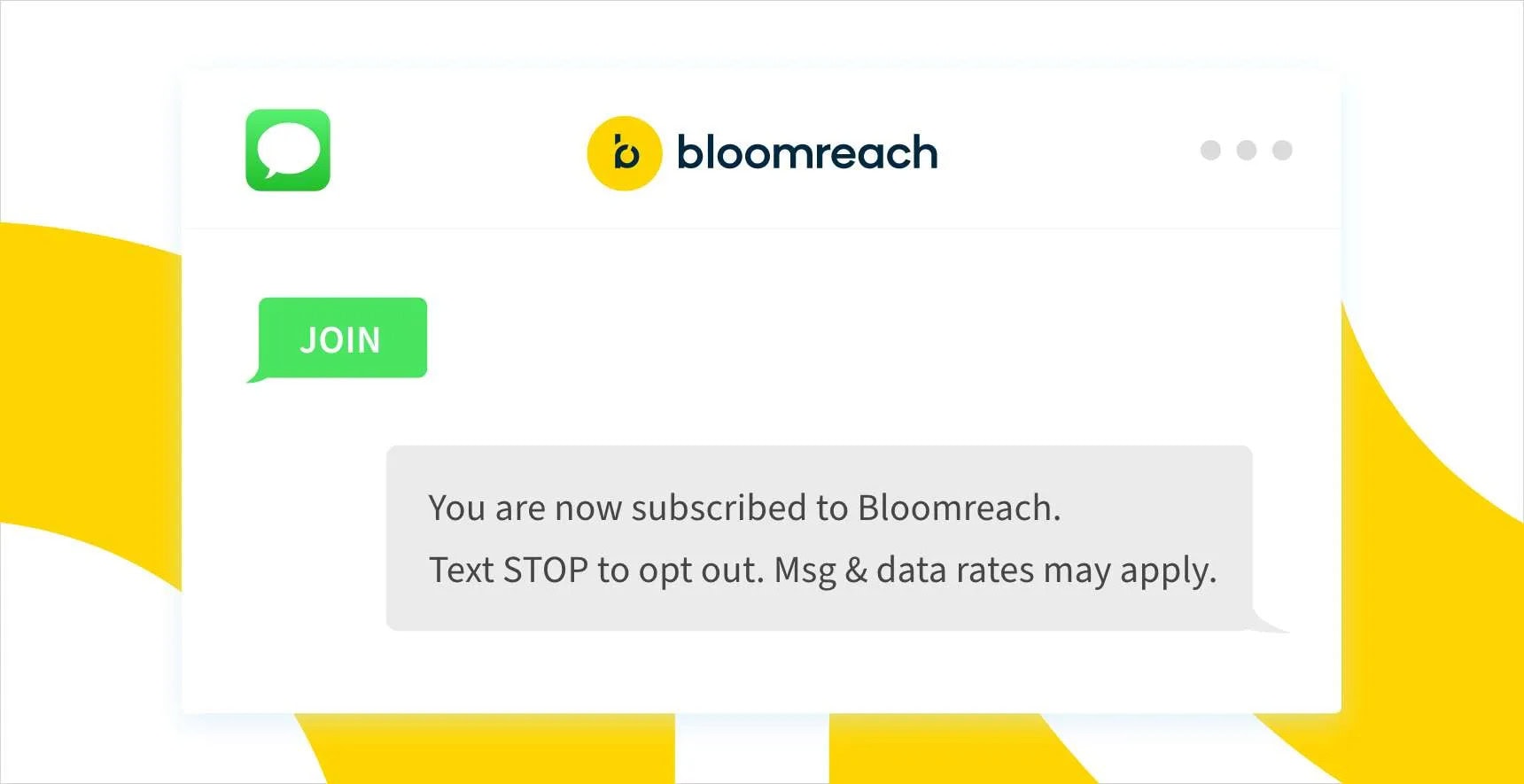
Bloomreach collects phone numbers by combining consent management and weblayers. We provide templates drafted with TCPA and CTIA regulations in mind. You can find these templates in the platform with the prefix TCPA_CTIA.
Remove Customers Who Have Opted Out
Under the April 2025 opt-out rules, you must honor opt-out requests from any reasonable channel within 10 business days. When a customer replies with “STOP” or a similar keyword, your brand needs to respond immediately.
When a reply starts with one of your configured opt-out keywords, Bloomreach blocks the number from further messages straight away, records the consent rejection on the matching customer profiles, and sends your confirmation. You can set up multiple keywords to revoke consent (up to 100 per configuration) and add a scenario that catches opt-out phrases elsewhere in a message, so subscribers can leave in their own words.
Meet CTIA Guidelines for Long Codes and Short Codes
The TCPA doesn’t regulate the provisioning of short codes, long codes, or toll-free numbers, although how these numbers are used must comply with TCPA requirements.
The CTIA reserves the right to shut down phone numbers for violations of the TCPA or CTIA messaging principles and best practices. All numbers must be registered, and each sender’s phone number collection processes must be vetted for compliance.
For standard 10-digit long codes, that registration is 10DLC: you register your brand and each messaging campaign with The Campaign Registry, and since February 1, 2025, US carriers have blocked unregistered 10DLC traffic. Toll-free numbers go through a separate verification. Carriers review your opt-in flow and sample messages as part of approval, so the consent work above is also what gets you approved.
Bloomreach partners with leading SMS providers like Sinch and Infobip to manage this process and help you get the green light before you start sending.
Short codes (five-to-six-digit numbers that texts are sent from) are considered the “gold standard” for SMS senders. While they come with a cost (around $500 per month), the rigorous approval process ensures you meet the highest compliance standards. Short-code senders are given higher messaging throughput and are prioritized by carriers for better deliverability.
Disclose Data Rates and Carrier Fees
According to the CTIA guidelines, you must make customers aware that data rates and carrier fees may apply. It’s usually as simple as including “Msg & data rates may apply” in your opt-in language.
See an example of the default opt-in message flow:
- CUSTOMER: [Enters phone number via a TCPA-compliant sign-up unit]
- BRAND: {{brand_name}}: Reply YES to receive automated marketing messages and cart reminders.
- CUSTOMER: YES
- BRAND: {{brand_name}}: Confirmed! Msg frequency varies. Msg & data rates may apply. Reply HELP for help. Reply STOP to unsubscribe.
Respect Send Time Restrictions (Quiet Hours)
Marketers should only send messages during TCPA-compliant timeframes, taking into account state-specific restrictions and local time zones. For nationwide campaigns, adjust for time zone differences: a text sent at 9 a.m. Eastern Time may still fall within quiet hours for recipients on the West Coast.
Bloomreach gives you the ability to define and control silent hours to pause campaigns until it is safe to send again. Silent hours can follow each customer’s own time zone, with a default zone as the fallback when a profile has none. Bloomreach also supports AI-powered optimal send times that maximize engagement while staying within compliant windows.
Send Relevant Content
Make sure that the content you send is relevant, aligned with your brand, and delivers on the promises you made when convincing customers to subscribe. Always provide value and do not send messages just for the sake of sending them.
Remove Deactivated Numbers
Consent is tied to the owner of a phone number, not the phone number itself. Prior written consent becomes invalid if the customer who gave you consent no longer uses that phone number because it was deactivated or swapped.
When a person terminates their cellular plan, gets a new phone number, or changes carriers, they need to be removed from your SMS marketing program. Ignoring this process leads to spam complaints, carrier filtering, and legal action.
Use the FCC’s Reassigned Numbers Database to check whether numbers in your list have been reassigned. Bloomreach helps you automatically identify and remove deactivated numbers using our TCPA list validation feature, which runs the reassigned-number check daily and also suppresses known TCPA litigators.

Any abandoned cart messages (e.g., shopping cart reminders) should:
- Be limited to only one message per unique abandoned cart event
- Be sent within 48 hours of the unique abandoned cart
You can easily control the frequency of your SMS campaigns using the frequency policy feature.
boohooMAN Drives 25x ROI With Compliant SMS
Compliance doesn’t mean sacrificing performance. UK fashion brand boohooMAN used Bloomreach to move SMS from one-off, unsegmented blasts to personalized campaigns built on compliantly collected customer data.
The results: a 5x overall ROI from SMS and a 25x ROI from an SMS birthday flow sent to customers who weren’t opted in to email — proving that consented, well-targeted SMS drives real revenue.
SMS Compliance Quick-Reference Checklist
Use this checklist to verify your SMS program meets TCPA and CTIA requirements:
- [ ] Consent captured: Prior express written consent obtained for all marketing messages
- [ ] Consent documented: Records include timestamp, method, and exact language shown
- [ ] Messages classified: Each automated text sorted as transactional or promotional, with no promotional content in transactional texts
- [ ] Opt-out available: “STOP” keyword and multiple opt-out channels supported
- [ ] Plain-language opt-outs caught: Replies like “please stop texting me” detected, not just keywords at the start
- [ ] Opt-outs processed promptly: Within 10 business days (aim for real-time)
- [ ] Silent hours respected: Messages sent between 9 a.m. and 8 p.m. local time (a conservative window; the federal rule is 8 a.m. to 9 p.m.)
- [ ] Sender identified: Business name included in every message
- [ ] DNC lists scrubbed: Federal, state, and internal DNC lists checked before sending
- [ ] Reassigned numbers checked: RND queried at least every 45 days
- [ ] Numbers registered: 10DLC brand and campaign registration or toll-free verification complete
- [ ] Frequency controlled: No excessive messaging; abandoned cart limited to 1 per event within 48 hours
- [ ] Data rates disclosed: “Msg & data rates may apply” included in opt-in language
- [ ] SHAFT compliant: No restricted content; age-gating for applicable products
- [ ] Records retained: Consent records kept for at least 5 years
- [ ] State laws reviewed: Texas SB 140, Florida, Oklahoma, Washington, and California requirements addressed
Stay Compliant With Bloomreach
TCPA compliance is non-negotiable, and the rules keep changing. Bloomreach gives you the controls and the audit trail in one place: TCPA list validation screens for deactivated numbers, reassigned numbers, and known litigators and flags DNC registrants, while consent management, silent hours, frequency policies, and opt-out keywords apply your rules to every send.
See how Bloomreach’s mobile messaging app keeps your SMS marketing compliant and high-performing.
Frequently Asked Questions
Does the TCPA apply to text messages?
Yes. The TCPA applies to all telephone solicitations, including SMS and MMS messages. Any marketing text message sent using an automatic dialing system or to a mobile phone number requires prior express written consent from the recipient.
What are the penalties for TCPA violations?
Standard TCPA violations carry a penalty of $500 per message. Willful violations can result in $1,500 per message (treble damages). DNC violations can reach up to $43,792 per violation. There is no cap on total damages, meaning large-scale SMS campaigns that violate the TCPA can result in multi-million dollar settlements.
Do transactional messages require consent?
Transactional messages (order confirmations, shipping updates, appointment reminders) require prior express consent, which can be oral or written. This is a lower standard than the prior express written consent required for promotional messages. However, if a transactional message includes any promotional content, it may be reclassified as promotional, requiring the higher consent standard.
How quickly must opt-out requests be processed?
Under the FCC’s April 2025 rules, businesses must process opt-out requests within 10 business days. Best practice is to process them in real time. After receiving an opt-out, you may send a single confirmation message within 5 minutes (with no promotional content), but no further marketing messages.
What is the difference between TCPA and CTIA?
The TCPA is a federal law enforced by the FCC with legally binding requirements and penalties. The CTIA is a wireless industry trade association that publishes voluntary best-practice guidelines. While CTIA guidelines are not legally enforceable, carriers can shut down short codes and block senders that violate them. Following both TCPA rules and CTIA guidelines provides the strongest compliance posture.
What is the CTIA’s SHAFT policy?
SHAFT stands for Sex, Hate, Alcohol, Firearms, and Tobacco (including CBD). The CTIA restricts these content categories in SMS marketing. Content involving federally legal products (like alcohol) may be permitted with age-gating that confirms recipients are at least 21 years old.