
Matching the right customers with the perfect products is an essential task for any ecommerce business, which is why product recommendations are so important for success.
But recommending items online isn’t a simple job. While customers can get tailored recommendations from a sales rep in brick-and-mortar stores, ecommerce brands need to build recommendation systems that determine which popular products are right for their particular audience.
According to Salesforce research, visits where shoppers click a product recommendation make up just 7% of all traffic — but those visits generate 26% of revenue. That kind of asymmetric return is why recommendation engines have become one of the highest-value investments in any serious ecommerce program.
With so much riding on the success of your ecommerce site’s recommendations, it’s worth diving into the hows and whys behind product recommendation engines. Keep reading to learn what a product recommendation engine is, how modern AI approaches like real-time personalization and neural networks have raised the bar for personalization, and where to deploy recommendations at every stage of the customer journey.
What Are Product Recommendations in Ecommerce?
Ecommerce product recommendations are products that online brands offer their customers, drawing on data about views, sales, and reviews to choose products their customers will likely enjoy.
These recommendations mirror the tailored in-store experience that shoppers would have with a salesperson, who can learn about the customer’s interests, intents, and needs through live conversation. They can make a real connection with a consumer and then make recommendations from that interaction.
Ecommerce product recommendations provide your business with the opportunity to have these types of interactions with your customers throughout their online shopping journey.
Using the digital touchpoints your audience has with your brand , like your ecommerce store, your mobile app, or an email campaign , you can provide relevant suggestions for products and inspire customers to make additional purchases.
What Is an Ecommerce Product Recommendation Engine?
An ecommerce product recommendation engine is an algorithm that determines which products to recommend to customers by filtering and sorting your online store’s items based on a set of rules. This process uses data about your products, such as the number of views, sales, or even reviews, to present the right items to the right audience.
While straightforward recommendations can be created using predetermined recommendation models (like “frequently purchased,” “best selling products,” and “past purchases”), modern personalization engines utilize advanced AI technologies, including natural language processing and machine learning algorithms, to personalize recommendations to each individual customer across multiple touchpoints in the customer experience. Today’s most advanced engines go further still, using real-time behavioral signals and deep learning architectures to generate recommendations in milliseconds , before a shopper has even finished browsing.
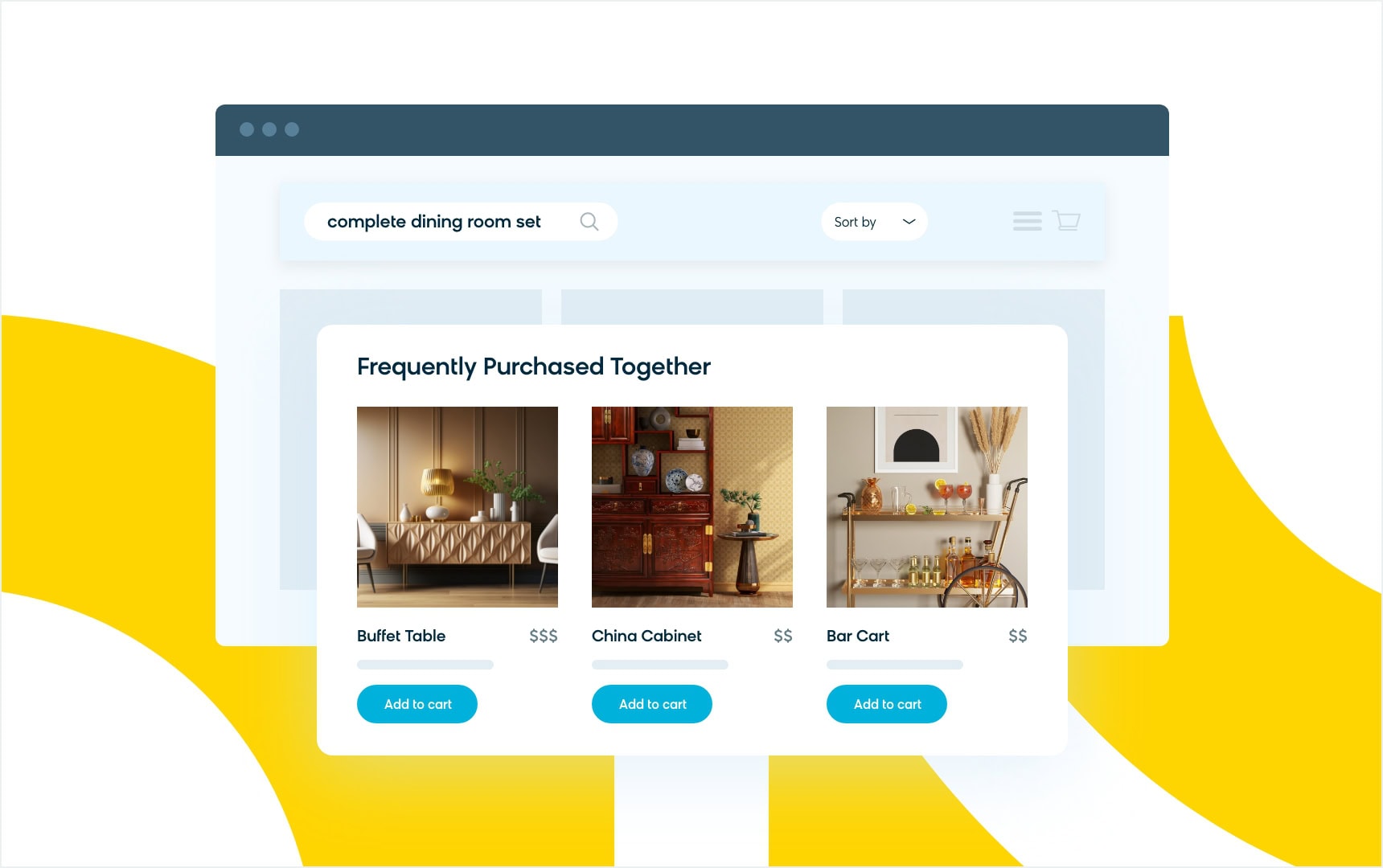
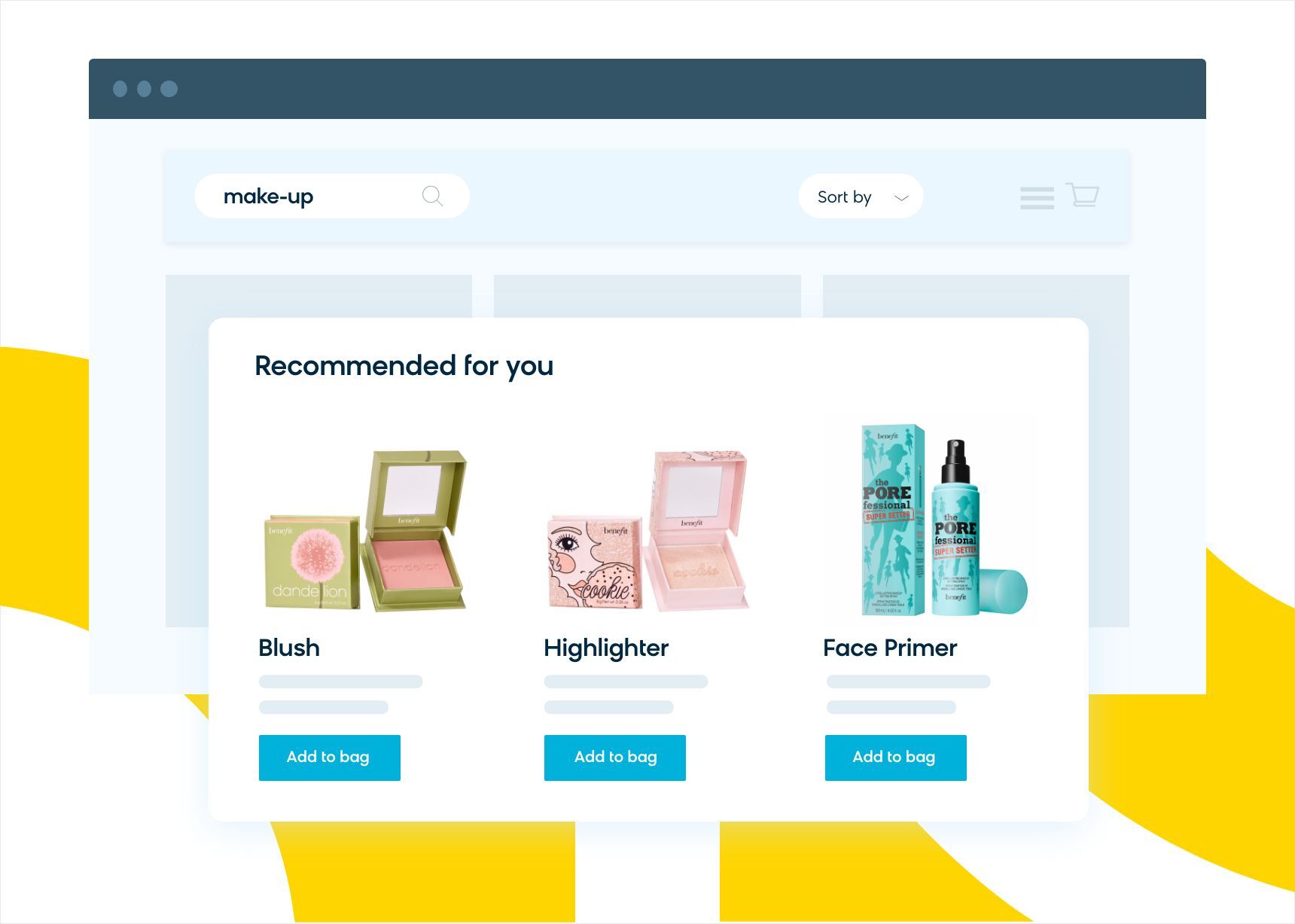
The presentation of these results can be as simple as a product highlight in a social ad or email campaign, or you can use them to order products that appear on your ecommerce website’s homepage or category pages. You can use them to influence buyers at every stage of the customer journey.
Types of Recommendation Engines
There are several types of recommendation engines, each employing different methodologies to generate relevant recommendations:
Collaborative Filtering
Collaborative filtering is one of the most popular methods used in recommendation engines. It operates by finding patterns in user behavior and suggesting products that similar users have liked.
This method is particularly effective because it draws on the collective wisdom of the crowd to make suggestions based on the preferences of users with similar tastes. For instance, if two users have purchased similar items in the past, the system might recommend a product liked by one user to the other.
Content-Based Filtering
Unlike collaborative filtering, content-based filtering focuses on the attributes of the products themselves. This method analyzes a customer’s past interactions with products to identify common features or characteristics they prefer. The system then recommends products that match these identified traits.
Content-based filtering is beneficial for users with unique tastes, as it tailors suggestions based on individual preferences rather than relying on the behavior of others.
Hybrid Models
Hybrid models combine collaborative and content-based filtering to provide more comprehensive recommendations.
By integrating multiple data sources and methodologies, hybrid models can overcome the limitations of individual approaches, resulting in more accurate and personalized suggestions. This synergy of techniques offers a balanced approach, maximizing the strengths of each method to improve the quality of recommendations.
For a deeper technical look at how these approaches compare, Google’s machine learning documentation offers a useful overview of recommendation system types.
For more on how trending product signals feed into these models, see Bloomreach’s guide to trending product recommendations.
How Modern AI Product Recommendation Engines Work
The recommendation engines described above (collaborative filtering, content-based filtering, and hybrid models) represent the foundational layer of how personalization works. But the gap between a basic recommendation engine and a modern AI-powered one is significant, and understanding that gap matters when you’re evaluating tools or trying to explain a budget request internally.
From Batch Processing to Real Time
Traditional recommendation engines ran on a batch processing model. The system would ingest data once a day (or once a week), retrain or update its models overnight, and serve recommendations based on what customers did yesterday. That’s a bit like briefing a salesperson using last week’s call notes and hoping those notes still apply to the customer walking in right now.
Modern engines process behavioral signals continuously. A customer clicks on a pair of trail running shoes, spends 45 seconds on the product page, adds a second pair to their cart for comparison, then navigates back to the category page. A real-time recommendation engine picks up each of those signals as they happen and updates what it shows that customer within milliseconds. By the time they land on the category page, the recommendations already reflect their demonstrated interest, not their purchase history from three months ago. The shift from batch to real-time processing is typically the most significant factor in AI recommendation performance. For more, see why ecommerce businesses need AI recommendations.
How Neural Networks Power Modern Recommendations
Under the hood, many modern recommendation engines use deep learning architectures to solve a problem that simpler models struggle with: what do you recommend to a customer you’ve never seen before?
One widely used approach is the two-tower model. The architecture creates two separate mathematical representations: one for the user (incorporating session behavior, device context, and any available history) and one for each product in the catalog (incorporating attributes, purchase patterns, and content signals). The engine then finds the closest matches between them in a shared mathematical space, surfacing products that fit the customer’s current context even when purchase history is thin or nonexistent. Bloomreach’s overview of two-tower neural networks covers the technical mechanics in more detail if you want to go deeper.
Recommendations Across Every Channel
The other meaningful shift in modern recommendation engines is where they operate. A legacy on-site widget shows recommendations on your product pages. A modern engine feeds the same real-time behavioral data into recommendations across your website, email campaigns, push notifications, SMS, and in-app messages simultaneously. A shopper who browsed camping gear on mobile on Tuesday gets a targeted product recommendation in Wednesday morning’s email, because the engine tracks context across all channels, including sessions that never touched the website.
This cross-channel capability is what distinguishes a recommendation engine from a simple on-site widget. For a closer look at how this plays out in practice, Bloomreach’s content on experience-driven recommendations covers the channel-by-channel deployment in detail.
The Benefits of Personalized Product Recommendations
Recommendation engines benefit both sides of the transaction: customers find products worth buying faster, and retailers see higher conversion rates, larger order values, and stronger retention. Here are the main benefits you’ll see when your business utilizes an ecommerce product recommendation engine:
- Higher conversion rates: When customers are presented with products that align with their interests and needs, they’re more likely to make a purchase. This relevance boosts conversion rates as shoppers find exactly what they’re looking for with less effort.
- Increased average order value (AOV): By recommending complementary or higher-value items, product recommendation engines can encourage customers to spend more per transaction. This increase in AOV directly impacts your bottom line, making each sale more profitable.
- Increased customer retention: Personalized recommendations make customers feel understood and valued, fostering loyalty. When shoppers have positive experiences and receive relevant suggestions, they’re more likely to return, increasing customer retention rates.
In practice: Yves Rocher, the global beauty brand, implemented Bloomreach’s real-time product recommendation engine and saw 17.5x more clicks on recommended items and an 11x higher purchase rate compared to generic top-seller placements. Recommendations were delivered in under 0.1 seconds. Read the Yves Rocher case study to see what that looks like at scale.
How To Use Ecommerce Product Recommendations To Gain and Retain Your Customers
With the right product recommendations, you can speak directly to your audience’s wants and needs. All you need to do is determine which type of recommendations to employ and where to plug them into your customer journey.
A/B testing various recommendation models (each using a different combination of input parameters: views, purchases, time spent on a page, clicks, add-to-cart events, and so on) will help you identify which model will drive sales most effectively.
When bimago, a European home décor retailer, replaced standard A/B testing with contextual personalization to determine which product recommendations to show each customer, they saw a 44% increase in conversion rate. The lesson: testing your recommendation models matters, but the right AI-driven approach can outperform manual experimentation.
Here are some recommendation types to consider and test in your customer journey:
Top Seller Recommendations
Customers crave shopping experiences that let them encounter relevant products without needing to search high and low to find them. Personalized, AI-powered recommendations achieve this by continuously identifying best-selling items and curating them for shoppers new to your brand.

With an AI-powered recommendation engine and marketing automation, you can showcase the best your brand has to offer, nudging your audience closer to conversion.
The Pareto principle suggests that roughly 20% of your products are likely driving 80% of your sales, which is why top-seller recommendations tend to resonate strongly with new visitors. These top 20% of your products will most likely speak to (and drive brand affinity for) new customers.

Rating-Based Recommendations
Nothing says “trustworthy” like a glowing 5-star review from a satisfied customer.
Humans are social creatures, and when customers share their experiences with previous purchases, they can play a huge role in the buying journey. That’s why peer-generated recommendations are some of the best ways to convince your new customers of your positive brand reputation, solid customer experience, and product quality.
Putting your top customer reviews to work in product recommendations brings your offerings to life, addressing potential concerns and answering key questions that new customers might have. Detailed reviews, in particular, significantly boost sales and reduce returns, as studies from Boston University show.

These reviews can be used across the commerce experience to inspire customers to convert. They can also be added to a variety of touchpoints, including:
- Abandoned cart emails: Include positive reviews to remind customers why they were interested in the first place and convince them to complete their purchase.
- Product pages: Highlight star ratings and snippets of rave reviews in “You Might Also Love” sections to entice further exploration.
- Search results: Prioritize highly rated products that align with the customer’s needs, making it easier for them to find quality items.
Cross-Sell Recommendations
Cross-selling is all about enhancing the shopping experience by offering items that complement a customer’s purchase objectives.
Think of it as the digital equivalent of a helpful salesperson suggesting the perfect pair of socks to go with your new shoes or a stylish hat to complete your winter outfit.

Incorporating personalized cross-sell recommendations into your marketing strategy is a strong move. Here’s how you can integrate them across various channels:
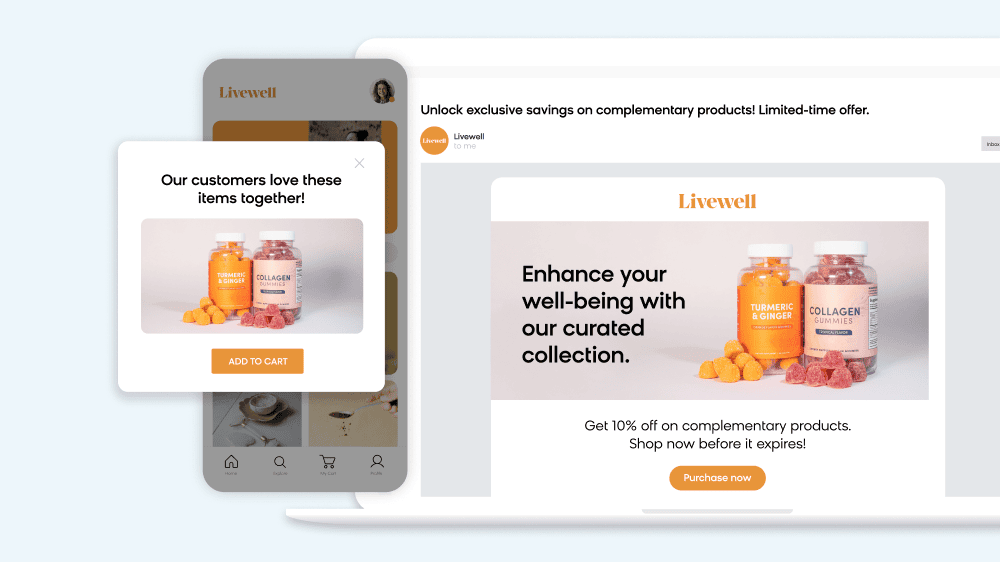
- Social media: Use platforms like Instagram and Facebook to showcase complementary products. If a customer recently viewed a fitness tracker, you could highlight sports gear or water bottles in your social media ads. This keeps your brand top-of-mind and encourages exploration of related items.
- On-site marketing: Make the most of your website by presenting cross-sell banners during the shopping journey. Display relevant items based on the contents of their cart, their brand preferences, or recently viewed products. For example, suggest a matching wallet when a customer is looking at handbags.
Customer Data Recommendations
Top-seller and rating-based recommendations draw on aggregated product data: what’s popular across your whole customer base. Customer data recommendations flip that logic: they build a profile of each individual shopper and surface products based on what that specific person has done.
In practice, this means a returning customer who bought hiking boots last season lands on your homepage and sees trail running shoes and outdoor gear based on their purchase history rather than your bestseller list. Or a shopper who’s spent 15 minutes browsing cameras gets shown lenses, memory cards, and cases before they’ve even added anything to their cart.
The engine tracks what each customer views, clicks, and purchases (plus how long they linger on a product page) and continuously refines their preference profile as each session adds new signals. The more data it collects, the sharper the recommendations get. This is also where hybrid models earn their value: combining each customer’s own history with patterns from similar shoppers lets the engine surface products the customer hasn’t seen yet but is genuinely likely to want.
Remarketing Recommendations
Today’s budget-conscious and savvy shoppers know the value of exploring multiple sites and options before making a purchase decision. Remarketing is an essential strategy for capturing their attention and presenting your offers and recommendations at key moments in their shopping journey.
The type of recommendation you employ in remarketing depends entirely on the product category. High-value products, such as electronics, benefit from display advertisements that motivate customers to spend more of their consideration process on your website. These advertisements may present products that reflect an awareness of their search intent and make it possible to make comparisons within a product range.
Other categories, such as food and groceries, would benefit from a different recommendation approach. Shoppers are more likely to use their shopping cart as a collection basket and check out once they’re finished with their collection process. Suitable display advertisements present a combination of cart items, product recommendations, and complementary products.
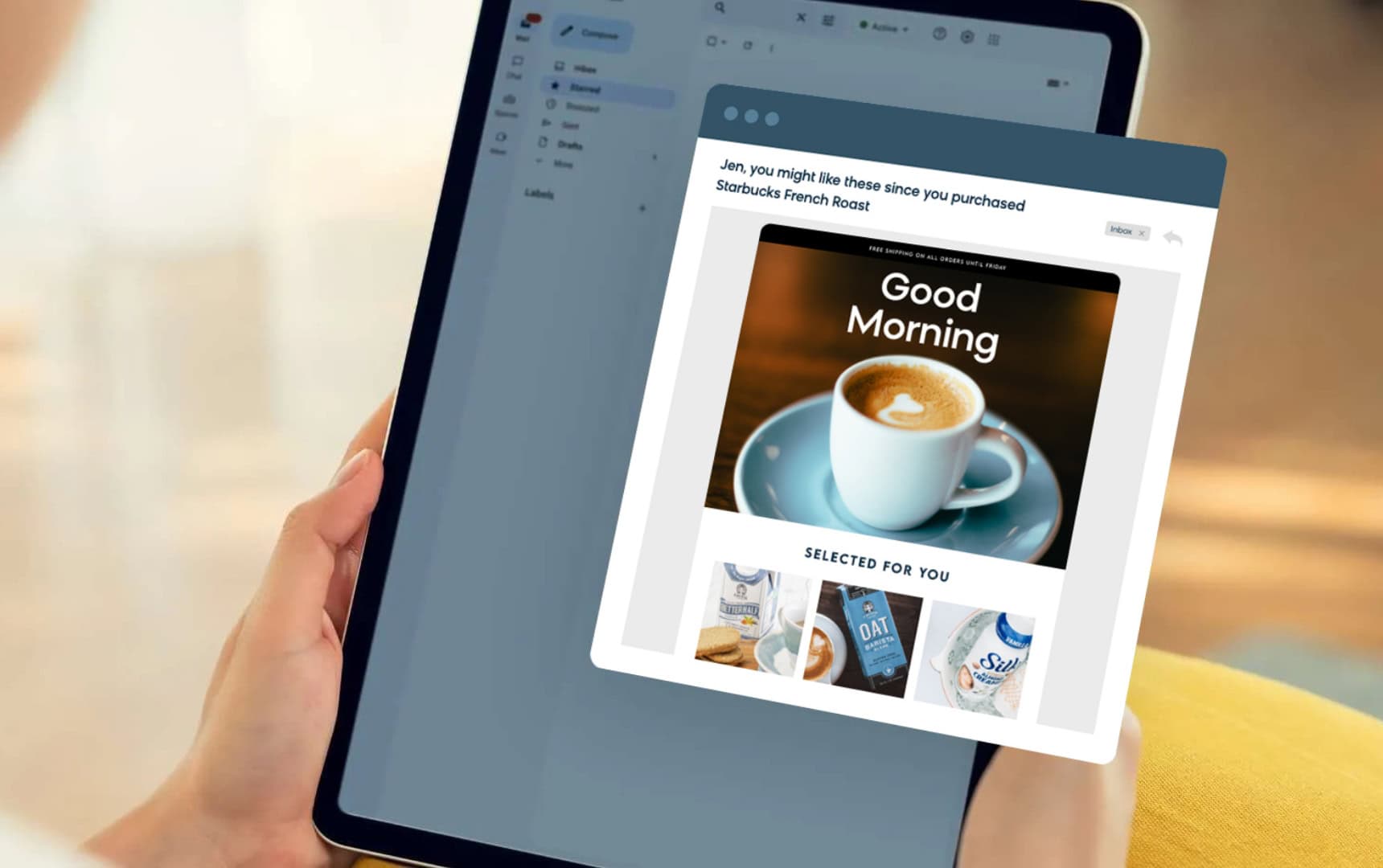
Personalized Email Marketing Recommendations
Personalized emails convey to your customers that they’re understood and valued, resulting in a significant increase in click-through rates.
Emails with personalized subject lines consistently outperform generic ones on open rates, while personalized product recommendations tend to deliver meaningfully higher click-through rates.
There are several great recommendation models that work well within emails.
Whether you want to use customer data (such as most frequented categories, purchase history, or interests) or product data (such as popularity and reviews) depends on the type of email marketing campaign.
Is your email campaign news-centered, such as the introduction of a new fashion season, the latest product releases from a brand, or a Black Friday sale? In that case, your recommendation strategy may benefit from reviews, user stories, and the popularity of your offers. These recommendations are eye-catching and informative, and they’ll also keep your customers engaged.
On the other hand, weekly deals and seasonal offers are ideally suited for personalized recommendations. Customer behavior, such as purchase history and interests, are good sources for weekly deal recommendations, while their previous season’s activities will help you align your offers with their seasonal interests.
Tips for Using Cart and Checkout Product Recommendations
Cart pages are arguably the most important touchpoints for your site visitors. When a customer navigates to their cart, they’re demonstrating a strong purchase intent and are ready to buy.
Incorporating product recommendations at this stage can significantly impact your sales strategy. These recommendations can effectively upsell, increase average order values, and reengage your customers.
Here are some tips to help you optimize your checkout page with recommendations:
Recommending Accessories and Complementary Products
Customers often focus on a specific item they need to purchase, such as a dress or suit for an event. By recommending accessories like shoes or an evening bag during the checkout process, you not only help customers complete their look but also increase your average order value and boost customer satisfaction.
These recommendation models require careful annotations of your product data, which means you have to answer the question: “What products are compatible?”
And let’s be real — your team might not have the time to go into that much detail. Having reviews and links to commonly bought accessories on product pages, abandoned cart emails, and more can serve as a valuable alternative to maintaining detailed records about your products.
Implementing “Frequently Bought Together” Recommendations
Package deals help customers purchase faster by informing them of the items they might need to complement their main purchase. It’s a successful form of cross-selling that takes place within the checkout process.
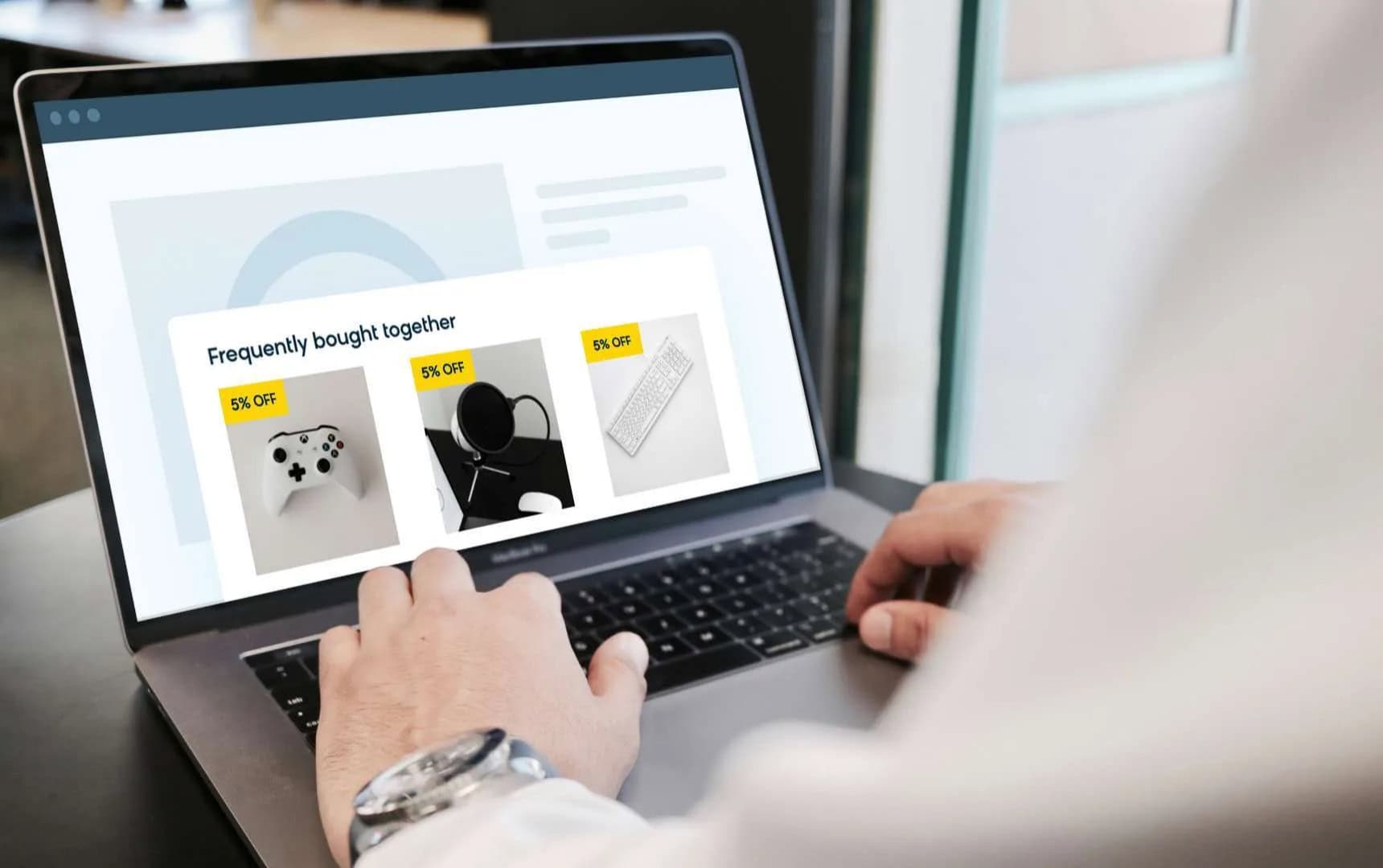
Effective recommendation models can also present alternatives to the items in the customer’s cart, such as different colors, styles, or product combinations. By showcasing reviews and user stories related to these package deals, you create compelling and trustworthy options for your customers.
These recommendations not only drive higher AOV but also motivate customers to trust your brand as a source of complementary products, which can yield a higher gross margin.
Timing and Placement of Recommendations
Strategically placing recommendations at the right moments in the cart and checkout process can significantly impact consumer behavior and maximize your sales potential.
Effective placements include the cart summary page (where customers review their selections before proceeding) and just before the final checkout step. At these stages, customers are already in a purchasing mindset, making them more open to adding complementary items to their cart.
Timing is crucial. Recommendations presented too early may be overlooked, while those introduced at the right moment can seamlessly enhance the shopping experience.
Effective recommendation models can also present alternatives to the items in the customer’s cart, such as different colors, styles, or product combinations. By showcasing reviews and user stories related to these package deals, you create compelling and trustworthy options for your customers.
These recommendations not only drive higher AOV but also motivate customers to trust your brand as a source of complementary products, which can yield a higher gross margin.
Timing and Placement of Recommendations
Strategically placing recommendations at the right moments in the cart and checkout process can significantly impact consumer behavior and maximize your sales potential.
Effective placements include the cart summary page (where customers review their selections before proceeding) and just before the final checkout step. At these stages, customers are already in a purchasing mindset, making them more open to adding complementary items to their cart.
Timing is crucial. Recommendations presented too early may be overlooked, while those introduced at the right moment can enhance the shopping experience.
How Bloomreach Powers Product Recommendation Engines With Loomi
Personalized product recommendations not only make shopping more enjoyable but also contribute to customer loyalty. By offering relevant and timely product suggestions, businesses can show their customers that they understand and value their unique preferences.
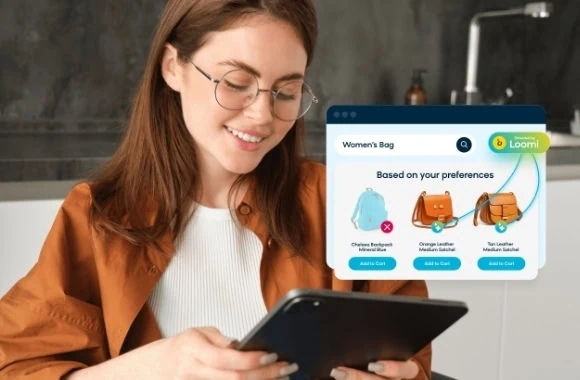
Loomi powers a product recommendation engine that processes real-time behavioral data (clicks, browsing sessions, cart events) to surface the right product for each customer across every channel. Unlike static recommendation widgets, Loomi continuously learns from customer behavior and updates recommendations in milliseconds. It can also personalize for first-time and anonymous visitors: as soon as someone views a product, Loomi begins building a behavioral profile and immediately tailors that session’s experience. When that anonymous visitor later creates an account, their entire history carries forward so future emails, SMS, and in-app messages are personalized from day one.
Bloomreach powers personalized search and personalized marketing experiences for over 1,400 brands worldwide. Request a demo to see what our recommendation engine can do for your business.
Frequently Asked Questions
What is a product recommendation engine?
A product recommendation engine is an AI-powered algorithm that analyzes customer behavior, product attributes, and purchase history to automatically suggest relevant products to shoppers. Modern engines process this data in real time, delivering personalized recommendations across your website, email campaigns, mobile app, and other channels.
How does a product recommendation engine work?
Recommendation engines collect data from customer interactions (page views, clicks, purchases, and time spent on product pages) and use that data to identify patterns. Depending on the engine’s approach (collaborative filtering, content-based filtering, or a hybrid model, as covered above), it matches those patterns to your product catalog and surfaces the items most likely to result in a purchase for each individual shopper.
What are the main types of recommendation engines?
The three primary types are: collaborative filtering (recommendations based on what similar users liked), content-based filtering (recommendations based on a product’s attributes and the customer’s past preferences), and hybrid models (a combination of both). Modern AI-powered engines typically use hybrid approaches enhanced by deep learning to improve accuracy, especially for new customers with limited purchase history.
How do you choose a product recommendation engine?
Evaluate engines on four criteria: (1) real-time personalization capability: can it update recommendations within the same session? (2) channel support: does it power recommendations across email, web, and mobile? (3) model flexibility: can you A/B test different recommendation strategies? (4) catalog scale: can it handle your product volume without degrading performance? Brands with large catalogs and cross-channel programs typically benefit most from AI-native engines built for real-time personalization at scale.