
The term single customer view (SCV) has been bandied about in marketing circles for over a decade. It’s something that is often referenced and is vital for a business’ marketing and sales efforts.
But mentioning a term isn’t the same as understanding it fully, which many have trouble doing with a SCV. Obtaining a complete view of the customer calls for an immense amount of data collected and organized in the right way, which isn’t an easy thing to do. And with a host of variables that can go into the process (how the data is sourced, identity resolution, the speed of profile updates, etc.) it’s hard to lock down a universal definition that sums it up in a short, simple way.
That’s why we’re diving deep into what a unified customer view is, how your business can use it, how to build one, and where the projects that fail usually go wrong.
- An SCV is a database with customer profiles (containing accurate data points like their purchase history, site activity, product recommendations, etc.) for every individual person who interacts with your business.
- Single customer view data is used to manage customer segmentation and marketing automation campaigns. If the profile is out of date, the message is wrong.
- Building one is an identity decision before it is a data-plumbing exercise. The system that stores all your data is not a single customer view until every record hangs off one stable identifier, anonymous browsing is stitched to the known person, and a marketer can act on the profile the moment it changes.
- Your SCV allows you to optimize the customer journey and understand how to personalize marketing communications for customers.
What Is a Single Customer View?
In the age of digital commerce, there’s never been more information for marketers to use to create effective campaigns. But there’s also never been more important data points to keep track of.
With customers shopping and purchasing from multiple different devices and the universal move toward omnichannel communication, a method of cataloging all that data is required for ecommerce businesses.
At its simplest, a single customer view solves this problem: A single customer view is a database with customer profiles (containing accurate data points like their purchase history, site activity, product recommendations, etc.) for every individual person who interacts with your business. The profile is the unit. One person, one record, whatever device or channel they arrive through.
But not all single customer views are created equal. A true single customer view is more than a customer database that can store customer data. It needs to be scalable, flexible, and updated in real time so your marketing team can offer the best possible customer experience.
That last point is a crucial difference. SCV data is used to enable segmentation and marketing automation. If the system is out of date, your customers could be seeing the wrong messages. Despite this, many companies that claim to offer a single customer view still manage their data with a rigid framework and time-delayed updates, which can be detrimental to marketing efforts.
To fully understand the need for a unified source of data, let’s break down the different types of data needed to make SCVs work. Then we’ll walk through the biggest benefits businesses get from a holistic view of the customer journey, how to build a single customer view, and the mistakes that sink most SCV projects.
Collecting Customer Data for a Unified Customer View
To create a holistic, unified view of your customers, you need to be able to collect data from a range of sources, including:
- Behavioral data: All the relevant interactions like clicks, preferences and filters picked, and time spent on page that a customer has with your brand. You need data on the categories and products they favor, the products they’ve added to a basket, and the searches they’ve abandoned.
- Customer relationship and offline data sources: This includes all the pertinent personal information, including any data that you might need to complete a purchase or reach your customer through marketing channels. This includes data such as a postal address, telephone number, email address, social media channels, etc.
- Transactional data: This encompasses all the purchases that your customer has made with your business, like products purchased, the volume of each purchase, order values, product returns, and so on.
- Consent data: Which channels each person has agreed to hear from you on, with the source and timestamp of every grant and withdrawal. Keeping consent on the profile itself, rather than in a system that syncs overnight, is what makes a suppression hold on the very next send. It is also what keeps your brand GDPR-compliant.
Two of these sources cause most of the trouble. Offline data arrives without a digital identity attached, so a store receipt or a kiosk order has nothing to join to. And behavioral data starts anonymous: a cookie on a phone and a cookie on a laptop are two strangers until the person does something that identifies them on both. How the platform handles those two problems decides whether you have a single customer view or a large, well-organized pile of records.
Optimizing the Customer Journey With a Single Customer View
With so many different data sets and customer profiles to manage, maintaining a single customer view can be a real challenge for businesses. But there are several benefits to collecting data in a SCV.
A Centralized Place for All Your Data
First, a unified customer view ensures data quality by providing a centralized data repository. Each customer’s data points are directed towards a single, interconnected profile, which makes sure you don’t have siloed data getting lost in the cracks between different marketing channels, touchpoints, and customer interactions.
This can be helpful for businesses that rely on data from multiple sources, especially with multiple channels as well as online and offline data to organize.
A Holistic View of Every Customer
A SCV offers a complete, 360-degree view of your relationship with your customers. This informs marketing decisions by providing a complete picture of who they are, what they want, and how their connections with your brand can grow with future interactions.
For modern businesses looking to personalize their marketing for their unique audience, a single customer view is crucial. It provides context and insights that let businesses tailor marketing messages to meet the exact needs of their customers. Without a SCV, personalized marketing is next to impossible.
Improved Customer Service
Finally, a SCV improves customer service by providing a more complete view of the customer’s interaction with the company. This lets businesses identify opportunities to improve the shopping experience and customer satisfaction.
Why Real-Time Data Is Vital for a Single Customer View
A single customer view is only as useful as it is current. If the profile updates on a delay, your marketing acts on a version of the customer that no longer exists.
Consider two everyday scenarios:
- A shopper abandons a cart at 9 a.m., then comes back and buys at lunch. If the profile hasn’t caught up, the recovery email still goes out at 4 p.m. — for something they already own.
- A customer unsubscribes from SMS. If the consent flag lives in a system that syncs overnight, they get one more text before the change takes effect.
Neither failure is about bad strategy. Both come down to how quickly the profile reflects reality.
Why Legacy Systems Struggle With This
The systems most companies built their customer records on were relational databases — designed to store fixed fields and answer SQL queries. They were never built to absorb a constant stream of clicks, views, and cart updates.
Non-relational (NoSQL) databases solved that problem. They handle large volumes of unstructured data, and they’re more flexible, scalable, and faster than SQL when dealing with big data. Unlike SQL, NoSQL systems can track any piece of data at any time, with no need to define the structure in advance.
But most legacy stacks couldn’t start over. The common workaround was to bolt a customer-shaped layer on top of the existing warehouse and point every data silo at it. The result looks like a single customer view — but it refreshes on the warehouse’s schedule, which for most teams means a nightly batch.

What “Real Time” Actually Means
That delay is the difference between a profile you can report on and a profile you can act on.
Real time means the profile changes the instant the event happens — and every downstream decision reads the changed profile. Not the version from last night’s export.
How To Build a Single Customer View
Connecting your data sources is the part vendors demo. It’s also the easy part.
What actually determines whether a single customer view is trustworthy happens before and after those connectors are in place: deciding who counts as one customer, which identifier proves it, how offline activity gets attached, and what happens when two records disagree.
These four decisions apply to any single customer view, whatever platform you build it on. The examples below come from how Bloomreach handles each one, because the specifics are where projects succeed or fail.
Choose the Identifier That Anchors the Profile
Every profile needs one identifier that proves a record belongs to a specific person.
In Bloomreach, that’s a hard ID — usually an email address or an internal customer ID from your commerce or loyalty system. Each hard ID holds exactly one value. Cookies, device IDs, and app installs are soft IDs, and a person can carry up to 64 of each type, one per device or browser. They all hang off the hard ID.
We recommend one hard ID per project, and email is not always the right choice. Households share an address, one person holds several, addresses change, and role-based inboxes aren’t people at all.
A stable customer or loyalty number is the safer anchor, with email demoted to an attribute on the profile.
Choose carefully, because the decision is permanent: in Bloomreach, an identifier can’t be deleted or renamed once it’s set, and a soft ID can’t later be promoted to a hard ID.
Decide What Merges and What Stays Separate
Two records become one person only when an identifying event connects them.
A visitor browsing on their phone and later on a laptop is two anonymous profiles — and they stay two profiles until that person logs in or buys on both devices. At that point the platform merges the profiles, carrying every historical event across and keeping the newer value wherever two properties conflict. A merge event is written to the surviving profile, so the join is auditable.
The rule that protects you is the one that refuses to guess. Bloomreach matches deterministically: no two profiles in a project can share a hard ID or a soft ID, and profiles with different hard IDs of the same type never merge.
That’s what keeps two people on a shared family tablet separate — as long as each has their own hard ID. Remove the hard ID from that picture and the second person gets absorbed into the first person’s profile. This is the wrong-merge scenario CRM teams fear most, and it’s why the identifier decision comes first.
Merging can’t be reversed, so settle your rules in a sandbox before production data touches them.
Give Offline Customers a Reason To Identify Themselves
A till receipt or kiosk order carries no identifier. No platform can stitch a transaction to someone who never said who they were.
The fix isn’t a smarter matching algorithm — it’s creating a capture moment at the point of sale.
Popeyes UK faced exactly this. About three quarters of its orders came through in-store kiosks with no way to know who placed them. The team built an in-restaurant game that gave guests a reason to identify themselves, then fed receipts, guest Wi-Fi sign-ins, and post-purchase surveys into Loomi.
Popeyes UK went from tying none of its in-restaurant purchase data to a customer to matching 20% of kiosk and till orders to loyalty profiles. Loyalty participants were then 3x more likely to return within 30 days.
Put the Profile Where the Marketer Works
A profile that lives in a warehouse and reaches marketing through a nightly export is a report, not a single customer view.
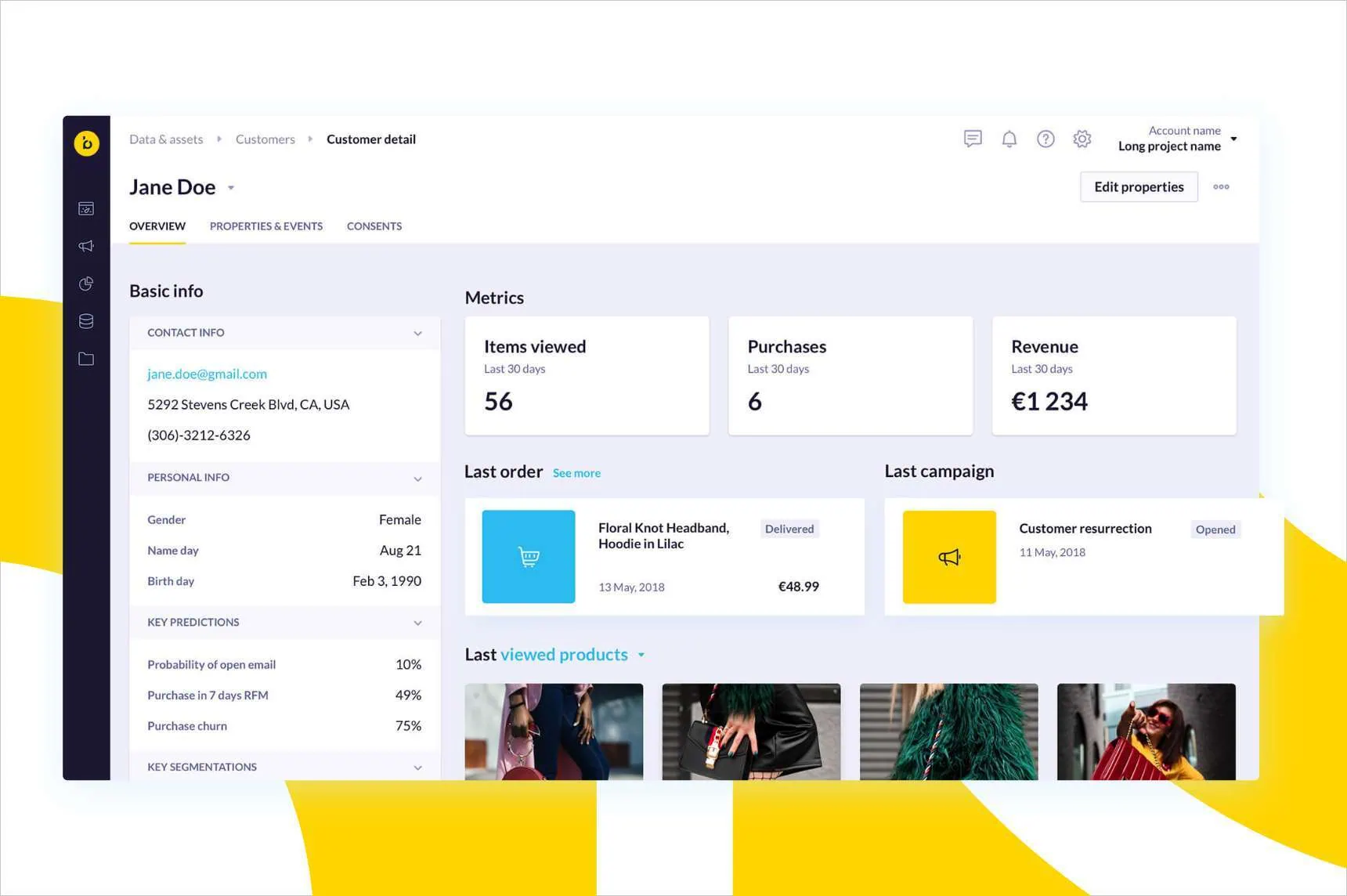
The test is whether the person building the campaign can open the profile and see the identifiers, the static attributes, and the full event history in one place. You should be able to use a segment or a prediction computed from that history without filing a ticket.
In Bloomreach, the customer profile shows exactly that. Aggregates, segmentations, and predictions appear on it as attributes, which recalculate as events arrive.
Where Single Customer View Projects Go Wrong
The four decisions above are what a successful SCV build looks like. These six assumptions are what derails one. Each sounds sensible in a planning meeting, and each one quietly adds months to the timeline.
“Our data warehouse already gives us a single customer view.” A warehouse is authoritative storage. It holds everything, and it answers questions through SQL and a data team. It can’t stitch anonymous sessions to known customers, it doesn’t carry a merge rule, and a marketer cannot trigger anything from it at the moment a shopper acts. The warehouse is the source the single customer view is fed from. The view itself has to live where campaigns are built.
“Our CRM is our customer 360.” A CRM holds contacts and transactions. But it’s missing the anonymous browsing, the web and app events, the campaign history, and the cross-channel stitching that make a profile predictive rather than descriptive.
“Real time means the event is available the instant it happens.” Two latencies are in play, and a platform can only claim one of them. Bloomreach processes tracked events in 5 milliseconds to 2 seconds depending on the tracking type. A store transaction that reaches the platform through an overnight warehouse batch is still a day old when it arrives, however fast the platform processes it. Ask for latency per source, and expect the bottleneck to be the feed rather than the platform.
“Email is the universal customer key.” Email is the most available identifier and one of the least reliable. Two records that share an email address are not necessarily one person. And identifiers are case-sensitive in Bloomreach, as in many platforms: [email protected] and [email protected] create two profiles, and one customer who receives every campaign twice. Lowercase identifiers on the way in to prevent the most common source of duplicates.
“The platform will clean and dedupe our data for us.” Expect light normalization such as trimming and lowercasing. Do not expect fuzzy matching, typo repair, or fixes to the source system. Duplicates usually come from an identifier being tracked as a plain property rather than as an ID, and that is a tracking fix on your side.
“We need the complete 360 before we can activate anything.” This one costs the most, because it delays every use case while the data program grows. The teams that see returns pick one outcome (like a pre-churn intervention or an abandoned-browse journey), identify the three or four signals it needs, and build the profile out from there. Our financial services guide to the outcome-first approach covers how that works in a regulated industry.
How Bloomreach Approaches the Single Customer View
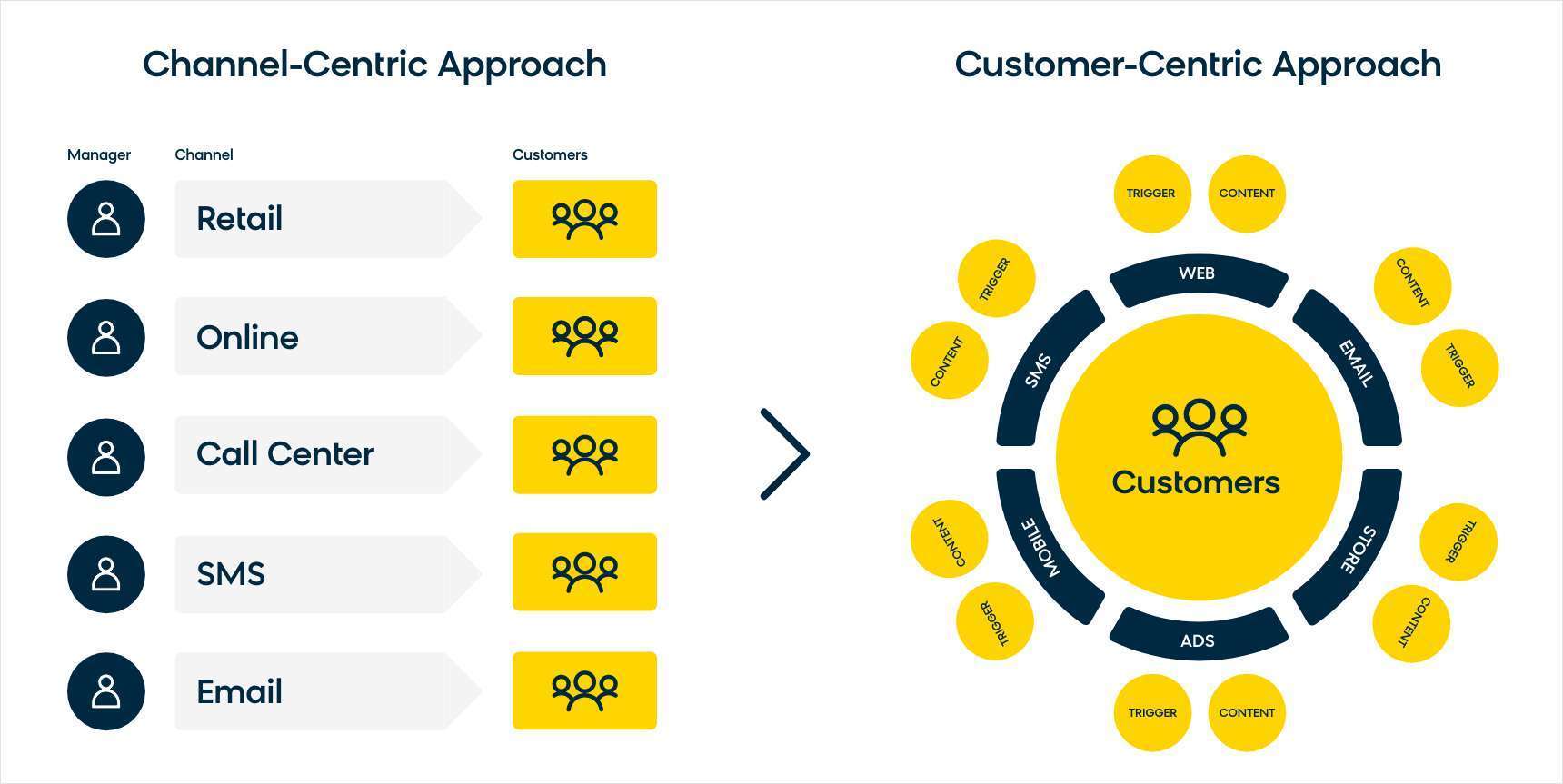
Bloomreach takes a customer-first approach to the single customer view. Instead of treating the customer profile as a data repository that feeds other tools, Loomi makes it the shared foundation for every interaction. That means every channel works from the same up-to-date understanding of the customer — so when someone browses, buys, or changes their preferences, your next message or experience can respond accordingly.
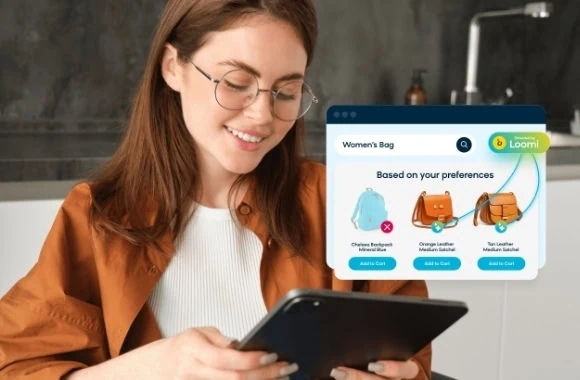
Loomi, our agentic personalization platform, connects real-time customer and product data from every source, including your website, CRM, data warehouse, and offline systems, into one profile per person. No matter what data point you gain, whether it’s on-site data, back-end data, offline data, calculated metrics, or predicted future data, your single customer view reflects customer behavior with your brand. It’s the key to utilizing customer insights, segments, and attributes in real time and creating personalized experiences at scale.
The same profile powers email, SMS, mobile app, web personalization, and ads from one place, so a segment built on this morning’s behavior is the segment every channel uses this afternoon. And the data that powers all your efforts is constantly updating, so fast that you can watch a customer profile update itself as the customer clicks around.
MandM, an off-price fashion retailer with more than 3 million active customers across seven localized sites, runs email, SMS, web push, and on-site personalization from one Bloomreach profile. Banners that reflect a shopper’s own behavior lifted purchase conversion by 66%, and personalized pop-ups built on the same profile raised revenue per visit by 2.6%. Jackie Barnett, MandM’s Head of CRM, describes the effect as “a unified place to build recommendations and segmentations that multiple teams can use to create personalized customer journeys.”
Understanding a Single Customer View
- In the simplest sense, a single customer view is a database of customer profiles (one for every user) composed of purchase history, site activity, product recommendations, etc.
- A true single customer view is a valuable resource, letting businesses utilize real-time data to enable personalized customer journeys, detailed segmentation, advanced predictive analytics, and more.
- The view is only as trustworthy as its identity rules: One stable hard ID per person, merges only on an identifying event, and no guessing when two records might be the same customer.
- NoSQL (non-relational) databases are superior to relational databases when dealing with large sets of detailed data (i.e., big data).
- Not all single customer views are equal. A profile assembled on top of a warehouse refreshes on the warehouse’s schedule, which is too slow for a cart-abandonment email or a consent check.
- Loomi’s single customer view updates in real time and feeds email, SMS, mobile, web, and ads from the same profile, so every channel personalizes from the same understanding of the customer.
With the power of a single customer view, your marketing efforts can offer the one-to-one personalization that today’s customers expect from their favorite businesses. See how Loomi stitches anonymous browsing to a known customer and updates the profile while they shop. Schedule a demo.