
Customer acquisition cost (CAC) is one of those metrics that every marketer knows is an essential statistic, but not everyone fully understands.
Despite it being an important barometer of your company’s success, it gets neglected in many businesses’ strategic planning and is often confused for cost per acquisition (CPA).
Considering how important these metrics are to the health of your company, mixing them up can result in an entirely preventable failure.
Here’s everything you need to know about customer acquisition cost — how to calculate it, how it differs from cost per acquisition, and how to improve your CAC to boost your business’ bottom line.
What Is Customer Acquisition Cost and How Do You Calculate It?
Customer acquisition costs measure the total cost of your sales and marketing efforts to earn a new customer in a specific time period.
The equation to find your CAC is a straightforward one: Divide all the costs spent on acquiring new customers (e.g., sales and marketing expenses) by the number of customers acquired in the same time period.
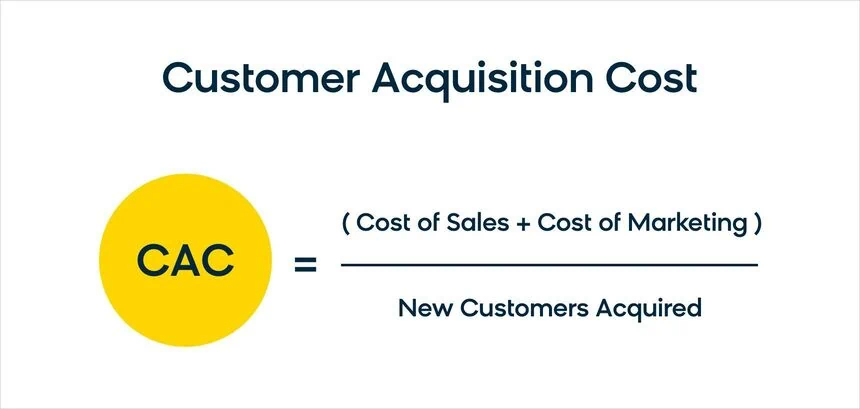
For example, if a company spent $1,000 on sales and marketing in a year and acquired 100 customers in the same year, their customer acquisition cost is $10.
What is a Good Customer Acquisition Cost?
A good customer acquisition cost can vary significantly depending on the industry, business model, and company size. Generally, a good CAC is one that is lower than the lifetime value of a customer, ensuring that the business is profitable over time.
Here are some general guidelines:
- Industry Standards: Different industries have different benchmarks. For example, SaaS companies might have a higher CAC due to the nature of their business, while ecommerce companies may have a lower CAC.
- LTV to CAC Ratio: A common rule of thumb is to aim for an LTV to CAC ratio of 3:1. This means that the lifetime value of a customer should be at least three times the cost of acquiring them.
- Efficiency: A lower CAC indicates more efficient marketing and sales processes. Companies should continuously optimize their strategies to reduce CAC while maintaining or increasing LTV.
- Growth Stage: Startups might have a higher CAC initially as they invest in brand awareness and market penetration, but this should decrease as the company grows and gains more organic traction.
Ultimately, a “good” CAC is one that aligns with your business goals, ensures profitability, and supports sustainable growth.
What is an Average CAC in Retail?
The average CAC in retail can vary based on the channel used. According to Shopify, here are some typical figures:
- SEO: Approximately $30.33
- Email Marketing: Around $15.92
- Influencer Partnerships: About $73.58
- Online Paid Ads: Roughly $59.17
These numbers can fluctuate depending on the specific retail sector and marketing strategies employed.
How Is Cost Per Acquisition Different from Customer Acquisition Cost in Marketing?
CAC and CPA are very similar and useful metrics, but there is one key difference: CAC measures the cost to acquire a paying customer, while CPA measures the cost to acquire a lead — for example, a registration, activated user, or a sign-up for a free trial.
Because customer acquisition cost measures the cost of converting a customer, it can encompass all types of marketing channels. It is a metric that can be applied to your business as a whole, giving you a big-picture view of your relationship with the average paying customer as opposed to a campaign-specific view.
But not all customer acquisitions are the same. Acquiring customers doesn’t begin and end with clicking a purchase button — some businesses have short paths to purchase while some lead times take months or years.
Different companies cater to different audiences, use different campaigns, and utilize different ways to guide customers through the customer lifecycle. To understand these nuances, metrics like cost per acquisition are incredibly helpful.
Read This Next: What Is Customer Lifecycle Marketing?
This is because cost per acquisition is more of a campaign-level metric. CPA looks at the cost to acquire a lead (not yet a paying customer) who took an action that you wanted them to take, like downloading an e-book, submitting a demo request,or any other submission of contact information with intent.
Since cost per acquisition measures conversion goals, which aren’t necessarily purchases and can vary from campaign to campaign, calculating one CPA for your overall business is a difficult task. There are very different factors and costs to converting Facebook ads, email campaigns, and SMS campaigns.
That’s why CPA is traditionally used to measure the specific cost/profit ratio of particular marketing channels, and the varying factors for each channel make each calculation its own unique equation.
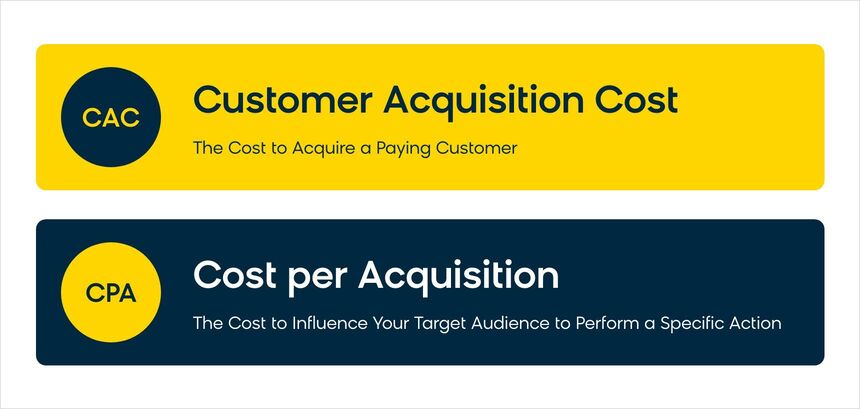
For context, here are some simple ways to understand the difference between CAC and CPA:
CAC vs. CPA Examples
- If you sign up for a free month of Netflix, you’re measured using CPA. Once you pay for the first month after your trial, you’re measured using CAC.
- If you’re a Facebook user, you’re measured using CPA. If you’re a Facebook advertiser, you’re measured using CAC.
- If you make an account on an ecommerce site without purchasing, you could be measured with CPA. Once you’ve made a purchase, you’re measured with CAC.
What is a Good Cost Per Acquisition Ratio?
A good cost per acquisition (CPA) ratio is typically determined by comparing it to the LTV of a customer. Here are some general guidelines:
- LTV to CPA Ratio: A common benchmark is to aim for an LTV to CPA ratio of at least 3:1. This means that the revenue generated from a customer over their lifetime should be at least three times the cost of acquiring them.
- Profitability: Ensure that the CPA is low enough to maintain profitability. If the CPA is too high, it can erode profit margins.
- Industry Standards: Different industries have different acceptable CPA levels. It’s important to compare your CPA with industry averages to gauge competitiveness.
- Business Goals: Align your CPA with your business objectives, whether it’s growth, market penetration, or maintaining a steady customer base.
Ultimately, a good CPA ratio supports sustainable growth and profitability while aligning with your business strategy.
Why Does Customer Acquisition Cost Matter?
If you run an ecommerce business, your customer acquisition cost is a crucial statistic. Calculating, understanding, and optimizing your CAC should be a top priority.
Cost per acquisition has its place and measuring each channel’s CPA can shed light on important aspects of your CAC, but your marketing strategy won’t get far without a strong grasp of your customer acquisition cost.
Calculating your CAC is similar to checking the pulse of your business. Measuring how much your business is spending to acquire customers can determine the vital next steps for your company, whether that means optimizing your customer lifetime value (LTV) or completely reassessing the cost/profit ratio of your business as a whole.
This is especially true in relation to your LTV, a measure of a customer’s monetary value to a company over a period of time.
The balance between your CAC to LTV is one of the most important relationships a business needs to keep under control — it’s no exaggeration that this relationship will tell you whether or not your business can succeed.
Read This Next: The Ultimate Guide to Customer Lifetime Value

Luckily, this correlation between CAC and LTV is easy to comprehend.
Simply put, if you want to know if your ecommerce business is in good shape, your customer acquisition cost needs to be lower than your customer lifetime value.

This ratio lets you know how much your business can spend to acquire enough customers without spending more than the value those customers will bring to your company.
Let’s take a look at how you can implement these ideas in your marketing tactics and how these calculations work in practice.
Examples of Customer Acquisition Cost Analysis
First, let’s see how customer lifetime value and customer acquisition cost work together to illustrate the health of your business.
Consider Company A, for example. Company A’s LTV is $40, and its CAC is $45.
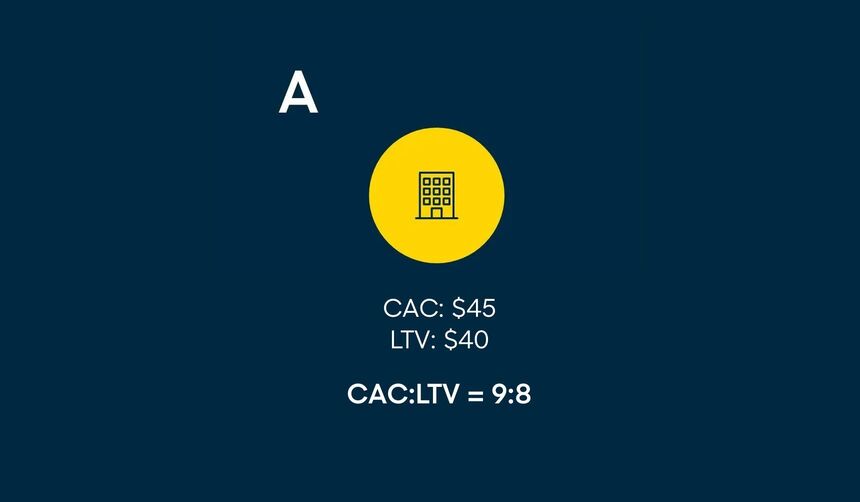
With a customer acquisition cost that is greater than its customer lifetime value, Company A is doomed to fail. Even if the company becomes one of the most popular brands in the world, it can’t sustain a business model where the cost to acquire a customer is greater than the value they offer.
This may seem obvious, but many ecommerce companies haven’t taken the time to calculate these metrics and understand the repercussions for their business. They may be paying more than they can possibly make back, without even knowing it.
It’s also important to know how much higher your LTV is than your CAC, as it will inform how quickly your company’s revenue will grow.
Let’s compare the metrics of two more example companies, Company B and Company C.
- Company B’s LTV is $40, while Company C’s LTV is $400
- Company B spends $10 to acquire a customer, while Company C spends $200
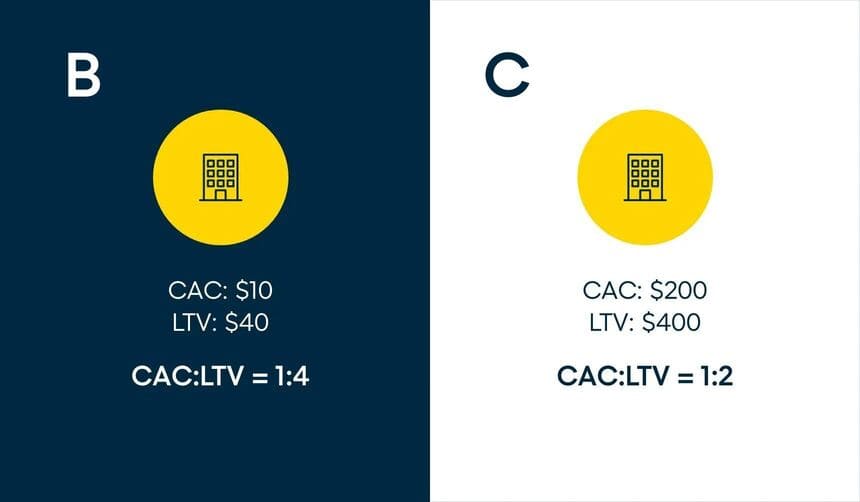
Even though Company C makes $200 per customer and Company B makes $30, the CAC to LTV ratio shows that Company B will be able to scale twice as quickly. It costs less per customer to get more value, making their business model much more sustainable with the ability to grow revenue faster.
You can also use this ratio to examine paying customers within individual channels and campaigns. If you calculate the customer acquisition cost for each of your separate marketing channels, you’ll know which of these bring you the more affordable customers. Combine that with your LTV, and you’ll know which channel brings you the most valuable customers overall.
How To Improve Customer Acquisition Cost
If you’re looking to lower your CAC, it can be hard to know where to start.
Is the cost of your marketing a problem? Are you paying too much to bring a visitor to your site? Or is the issue that you just aren’t converting enough of them?
Customer acquisition cost is a metric that deals with the full scope of your business, so drilling down on a few key areas and addressing these kinds of questions is the best way to make a big impact.
Here are a few key ideas to consider.
How To Lower Your Marketing Costs
If converting customers isn’t an issue for your business, but it’s costing too much to bring them to your site, here are a few ideas to bring your costs down:
Identify and Optimize Your Best Channels
Zeroing in on your best-performing channels and optimizing them for acquisitions can go a long way towards driving down your customer acquisition cost.
- Track the number of visitors coming in from each channel. You need to know how many customers are coming from each marketing channel to fully understand your efforts.
- Divide the marketing spend for each channel by the number of visitors gained. This tells you which channel brings the cheapest traffic and which is the most expensive.
- Focus your energy and budget on what works. With a ranking of your most costly and most affordable channels, you can start optimizing them and getting the most out of your spending.
The same logic applies to individual campaigns. Divide the cost of each campaign by the number of visitors gained to find your best acquisition campaigns, then replicate what works.
Know Your Audience and Sharpen Your Targeting
Truly knowing your customers is the best way to improve your targeting techniques. Understanding their behaviors, preferences, and segments streamlines your efforts and cuts wasted spend.
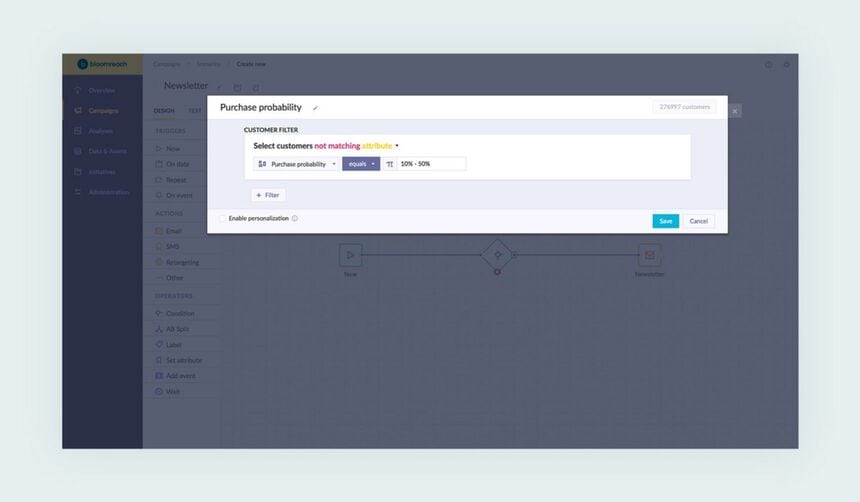
- Lean into lookalike audiences. Use the purchase predictions of your current users to create a Facebook or Google audience for a remarketing campaign.
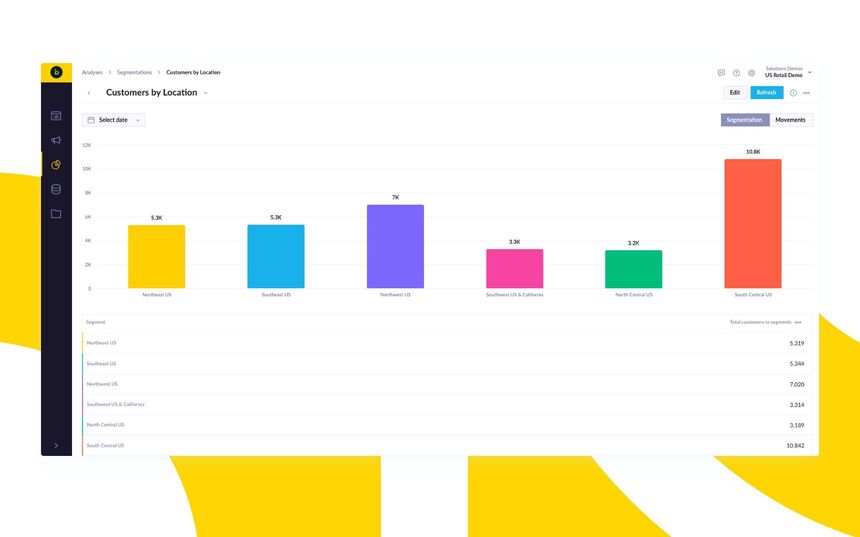
Segment your customers by their customer lifetime value. For your retention campaigns, make sure that targeted efforts for high-value customers have the most budget behind them, and that you aren’t spending too much to retain low-value segments.
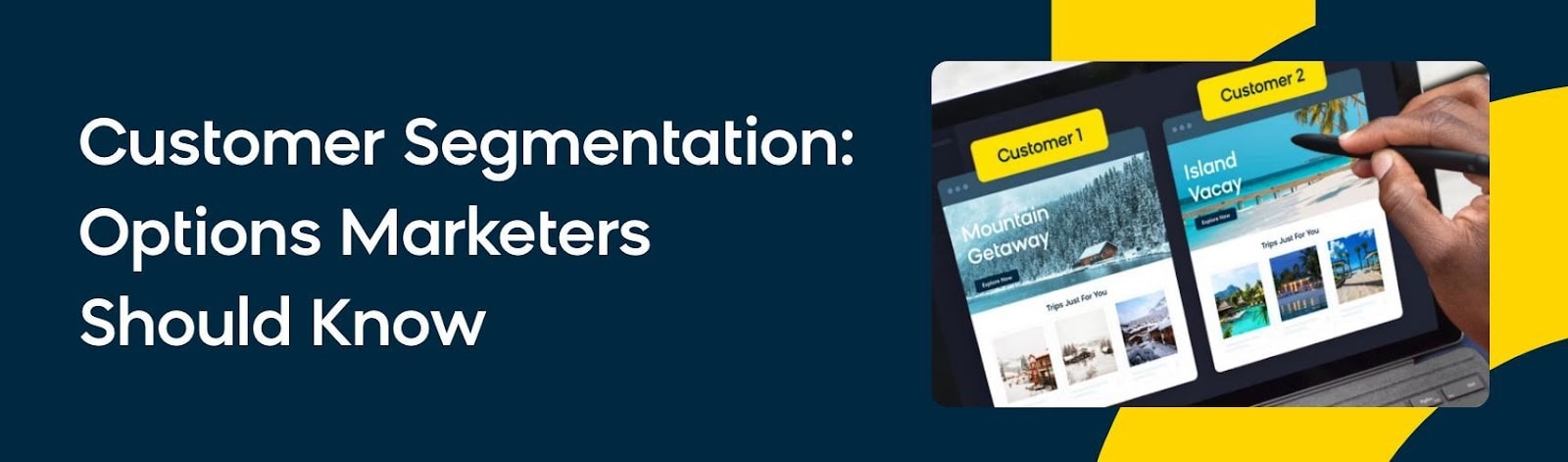
Read This Next: Customer Segmentation: Options Marketers Should Know
Optimize Your Ad Spending
Make sure your ad spending is always aimed at customer acquisition:
- Use negative audience segmentation to ensure no ads are wasted on an audience unlikely to convert.
- Set ad frequency caps to limit the number of times a visitor will be shown an ad.
Invest in organic channels. Attract organic traffic through SEO, unique product descriptions, and other ecommerce optimization strategies to reduce dependence on paid traffic.
Improve On-Site Conversion
If you’re getting a good amount of traffic but not enough of it is converting, these ideas can lower your conversion costs:
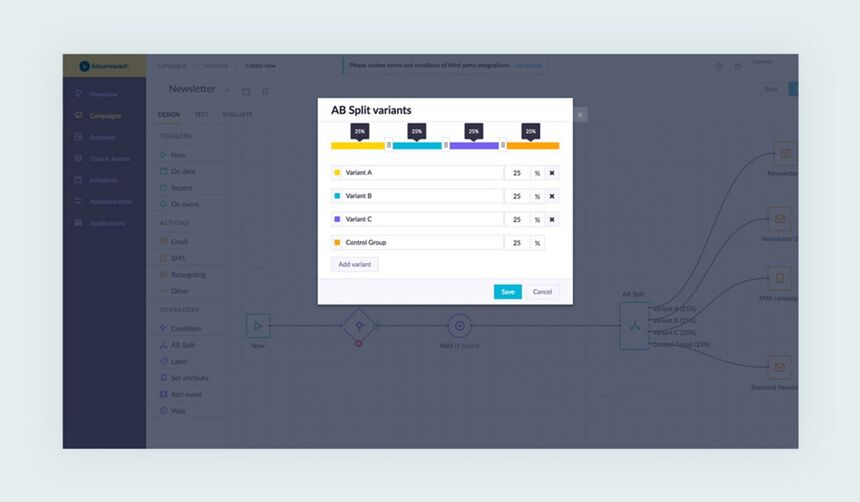
Optimize your customer journey. Analyze your traffic and campaigns to see where you’re losing customers. Which stages in the buying process see the most drop off? A/B test different variations of your customer experience based on your analysis. Once you know where you are leaking customers, you can orchestrate your ideal customer journey.
Cater to returning visitors. Personalize your site to include recommended content. Inspire users revisiting your site with recommendations based on previous browsing history.
- Deploy banners to returning visitors. Make your recommended products front and center in their site experience.
- Display reminders for abandoned carts. Remind visitors of the items in their cart and entice them to complete their purchase.
- Send personalized email offers based on browsing history. A personalized email marketing strategy can bring customers back onsite and inspire a purchase.
Optimize your site’s user experience. A/B test multiple variants of website modifications. You can test and refine every aspect of your site experience until you find what performs best, whether that means simplifying your homepage or testing the difference between a red, blue, or green CTA button.
Minimize distractions around your point of sale. Don’t let a busy UX stand in the way of conversions. Your product pages should essentially be landing pages leading to the completion of a transaction.
Use Personalization To Lower CAC at Scale
According to McKinsey, personalization can reduce customer acquisition costs by as much as 50%, lift revenues by 5-15%, and increase marketing spend efficiency by 10-30%. Companies that grow faster derive 40% more of their revenue from personalization than their slower-growing counterparts.
Here’s how personalization directly impacts CAC:
- Better targeting means less wasted spend. When you use customer data to build precise audience segments, your ads and campaigns reach people who are actually likely to convert. That means fewer dollars spent reaching people who will never buy.
- Higher conversion rates bring CAC down. Even if your traffic costs stay flat, converting more visitors into customers lowers your per-customer cost. Personalized product recommendations, tailored email campaigns, and dynamic on-site content all drive conversion.
- Retention compounds the value of acquisition. Acquiring new customers costs 5-25x more than retaining existing ones, according to research from Bain & Company. When personalized experiences keep customers coming back, the effective CAC drops over time because each customer generates more lifetime value.
BCG’s Personalization Index found that businesses leading in personalization achieve compound annual growth rates 10% higher than laggards, with only 10% of companies qualifying as leaders. That means there’s a significant competitive advantage available to businesses willing to invest in personalization.
Retain More Customers To Lower Effective CAC
One of the fastest ways to improve your CAC economics isn’t to spend less on acquisition. It’s to get more out of the customers you already have.
A 5% improvement in customer retention produces 25-95% profit increases, according to Bain & Company research. When customers stay longer and buy more, the return on every acquisition dollar multiplies.
Effective retention marketing strategies include:
- Personalized lifecycle campaigns that adapt to where each customer is in their journey
- Win-back emails triggered when engagement drops, based on each customer’s behavior patterns
- Cross-sell and upsell recommendations powered by purchase history and browsing data
- Loyalty programs that reward repeat purchases and long-term engagement
The most efficient businesses balance acquisition and retention spending rather than pouring all their budget into new customer acquisition. When your retention strategy is strong, you can afford a higher CAC because each customer delivers more value over time.
How Bloomreach Customers Reduce Acquisition Costs
Reducing customer acquisition costs isn’t just theoretical. Here are examples of how brands use Bloomreach to improve their acquisition economics.
hmv: Smarter Ad Targeting With AI-Powered Segments
British music and entertainment retailer hmv needed a better way to use their customer data for ad targeting. Their CRM and ads teams operated in silos, meaning valuable first-party data wasn’t informing their paid campaigns.
Using autosegments powered by Loomi AI, hmv built more precise audience segments that connected CRM data to Google Ads campaigns. The result: a 14% revenue lift and a 425% increase in landing page views from targeted campaigns. By letting its customer data work harder, hmv cut wasted ad spend and acquired higher-quality customers.
BrewDog: Personalized Email Campaigns That Convert
Craft beer brand BrewDog used Loomi AI to personalize email campaigns based on individual customer behavior and preferences.
Compared to generic blasts, customers who received personalized emails clicked 15.6% more often, had an 11.5% conversion rate, and generated 13.8% more revenue. Higher conversion rates from the same email list means a lower effective CAC, because the cost of sending a personalized email is nearly identical to sending a generic one.
On The Beach: Real-Time Re-Engagement That Drives Conversions
Travel company On The Beach used Loomi AI to trigger personalized outreach based on real-time customer signals, like price drops on packages customers had previously browsed.
The result was dramatic: +362% revenue per visitor and +587% conversion rate uplift. By connecting customer intent data with real-time triggers across email and web, On The Beach converted more visitors without increasing acquisition budget.
Reduce Your Customer Acquisition Cost With Bloomreach
To optimize your customer acquisition cost and set your business up for sustainable growth, you need the right data and tools working together. That means real-time customer data, intelligent segmentation, and the ability to personalize every touchpoint.
That’s what marketing automation powered by Loomi AI delivers. It combines a customer data foundation with AI that understands every customer in context, then personalizes their experience in real time across email, web, mobile, ads, and more.
With Loomi AI, you can:
- Build precise audience segments using AI that identifies high-value prospects and suppresses low-converting audiences
- Personalize campaigns across 13+ channels so every touchpoint reinforces the same message
- Trigger real-time outreach based on customer behavior, not just schedules
- Measure the full journey from first touch to purchase, so you know exactly where your acquisition spend delivers returns
If you’re ready to get started, try our CAC and LTV Calculator to see where your business stands today.
Frequently Asked Questions
How do you calculate customer acquisition cost?
Divide your total sales and marketing expenses by the number of new customers acquired in the same time period. For example, if you spent $50,000 on sales and marketing in Q1 and acquired 500 new customers, your CAC is $100. Include all relevant costs: ad spend, salaries, tools, creative production, and agency fees.
What is a good customer acquisition cost?
A good CAC depends on your industry and business model, but the most important measure is your LTV-to-CAC ratio. Aim for at least 3:1, meaning your customer lifetime value should be three times your acquisition cost. In ecommerce, CAC can range from $68 (B2C) to $84 (B2B), while B2B SaaS averages $702-$1,200 per customer.
What’s the difference between CAC and CPA?
CAC measures the cost to acquire a paying customer, while CPA (cost per acquisition) measures the cost to acquire a lead or conversion action, like a sign-up or demo request. CAC is a business-level metric that spans all channels. CPA is a campaign-level metric used to evaluate specific marketing efforts.
How can I reduce my customer acquisition cost?
Focus on four areas: optimize your best-performing channels and reallocate budget away from underperformers; improve on-site conversion rates through A/B testing and personalization; invest in retention to maximize the value of existing customers; and use customer data to sharpen targeting across paid and organic channels. McKinsey research shows that personalization alone can reduce CAC by up to 50%.
What is the CAC payback period?
The CAC payback period measures how many months it takes to recover the cost of acquiring a customer. Calculate it by dividing your CAC by the monthly revenue per customer multiplied by your gross margin percentage. Most healthy businesses aim for a payback period under 12 months.
Why is customer acquisition cost increasing?
CAC has risen roughly 60% over the past five years due to several factors: increasing digital ad costs (Google Ads CPL rose 5.13% in 2025), privacy regulations that reduce targeting precision, ad fatigue from market saturation, and longer sales cycles. These trends make efficiency optimization and retention strategies more important than ever.