
With marketing teams facing increasing pressure to demonstrate ROI in the face of higher customer expectations, traditional segmentation approaches simply can’t drive the growth modern companies need to succeed.
The problem is, many marketing teams build segments in one system, customer experience teams use different data in another, and product teams rely on completely separate insights. This disconnect creates friction, delays, and missed opportunities at every customer touchpoint.
Fortunately, segmentation has evolved from a marketing tactic into the operating layer of autonomous commerce. Intelligent segmentation systems now adapt in real time to every customer signal, powering personalized experiences across all channels simultaneously. Companies that master this shift transform segmentation from a support function into their primary competitive advantage.
Learn how your brand can adapt its segmentation strategy to operate with real-time insights and significant scale with the power of autonomous AI.
The Limits of Legacy Frameworks
Traditional segmentation tools create three critical barriers that prevent businesses from achieving their growth potential.
- Delayed segmentation represents the most significant limitation. Legacy systems provide valuable analytical insights but operate with substantial time lags between data collection and action. Most legacy platforms process in scheduled batch cycles with delays from hours to multiple days, making insights less relevant by the time they reach activation.
- Inflexible schemas force businesses to conform their customer understanding to rigid, predefined categories. Many legacy platforms lock segments into specific marketing use cases, preventing the cross-functional activation that drives real growth.
- Poor cross-channel orchestration means that insights generated in one channel rarely translate effectively to others. A segment performing well in email campaigns might not activate properly for web personalization or mobile app experiences, creating inconsistent customer experiences.
Advanced segmentation platforms address these limitations through real-time processing loops that identify customer signals, predict likely behaviors, activate appropriate experiences, and continuously refine their understanding. AI-powered segmentation based on behavioral patterns eliminates the lag time that makes traditional approaches less effective.
It’s crucial for brands to recognize that segmentation technology must match the speed of customer decision-making, not the pace of traditional data processing cycles.
Redefining Market Segmentation for 2025
Traditional market segmentation categories (demographic, geographic, psychographic, behavioral, and firmographic) served their purpose in a simpler digital landscape. However, these static frameworks fail to capture the fluid nature of modern customer behavior.
Legacy segmentation relies on historical data and fixed groupings. A customer classified as “high-value” based on past purchases might be actively researching competitors, while someone labeled “price-sensitive” could be ready to upgrade to premium products. Static segments miss these critical moments of behavioral shift.

Modern segmentation strategies blend historical identity data with real-time engagement signals and predictive AI modeling. Instead of placing customers into fixed categories, advanced systems create fluid micro-intent models that evolve with each interaction. A customer browsing premium products immediately triggers different personalization logic than their historical “budget-conscious” segment would suggest.
The most effective segmentation platforms bridge the gap between past behavior and live intent, capturing the moment when customers reveal their true current needs and preferences.
Taking a Unified Approach to Segmentation
Modern unified platforms combine customer data platform capabilities, AI processing power, and omnichannel activation engines in composable architectures that integrate naturally with existing business systems. There’s a reason why over 70% of organizations now prefer or are migrating to cloud-based marketing automation for performance and flexibility advantages over legacy batch-based solutions.
Native integrations enable rapid prediction, routing, and activation without custom development work. This architectural approach enables marketing-led orchestration instead of holding teams up with system limitations and technical dependencies. Teams can focus on strategy and optimization rather than worrying about data synchronization and technical implementation challenges.
The shift toward unified platforms reflects broader industry recognition that customer experience quality depends on system architecture decisions made by technology and marketing leaders working together.
Platform Comparison: Modern vs. Legacy Segmentation
| Capability | Modern Platforms | Legacy Tools | Analytics Only |
|---|---|---|---|
| Real-time updates | Sub-second to seconds | Limited batch processing | Delayed reporting |
| AI predictive engine | Advanced machine learning | Basic automation | Manual analysis |
| Omnichannel activation | Email, SMS, web, search, push, and more | Email-focused | Analytics only |
| Unified customer view | Single source of truth | Partial connectivity | Standalone system |
Why AI Alone Fails Without Activation
One major challenge many organizations face is investing heavily in AI-powered analytics but failing to achieve proportional business results. The main issue lies in the gap between generating insights and acting on those insights — AI recommendations trapped in dashboards aren’t particularly useful unless they affect real customer experiences.
Traditional approaches create bottlenecks where marketing teams must translate AI insights into campaign logic, request technical implementation, and wait for development cycles to complete activation. This delay reduces the relevance of time-sensitive insights and frustrates teams who see opportunities but can’t act quickly.
Unlocking the Power of Autonomous Segmentation
Advanced platforms eliminate these bottlenecks by empowering marketers to use AI to significantly streamline their processes. Instead of having to jump through hoops to make any changes (resulting in delays), marketers can launch campaigns quickly with agentic AI.
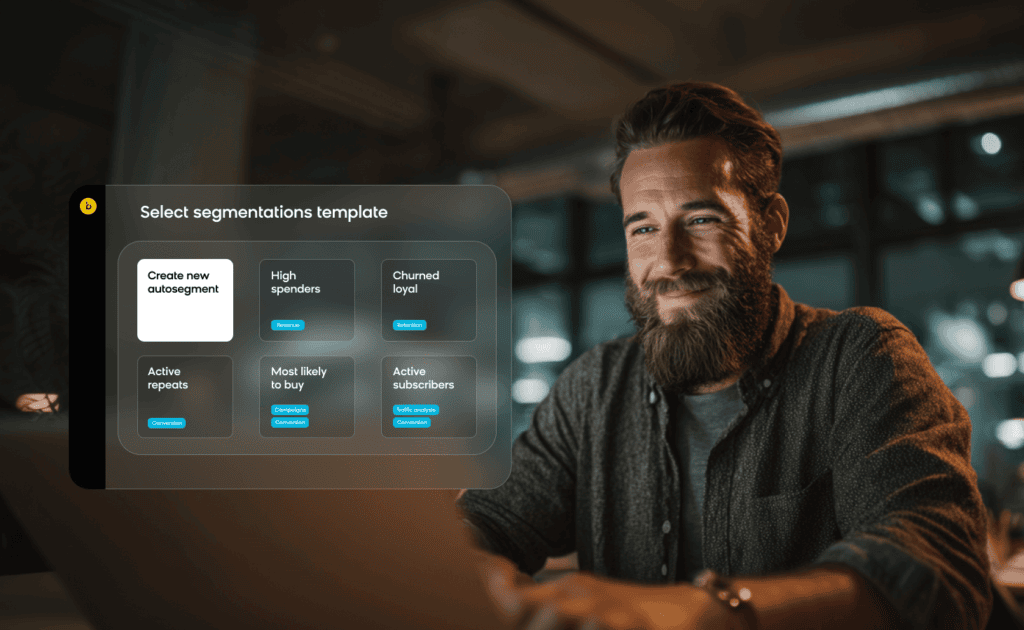
Here’s what marketers can unlock with AI agents:
- Automatic segments. With features like Bloomreach’s AutoSegments, you can automatically generate relevant customer segments without needing manual setup or ongoing maintenance. Machine learning algorithms identify meaningful patterns in customer behavior and create actionable segments rapidly, and then marketers can review and refine as needed before targeting them with campaigns.
- Predictions for a customer’s next best actions. AI can use predictive logic to understand churn risk, customer lifetime value, and product affinity with impressive accuracy. Rather than waiting for customers to demonstrate behaviors, predictive systems anticipate needs and trigger appropriate experiences proactively.
- Activation across every channel at scale. Autonomous agents can enable omnichannel orchestration at a scale that isn’t possible for humans to achieve. These segment insights can be activated simultaneously across every channel (email, SMS, web, product discovery, mobile app, and more), allowing you to effectively reach your audience segments with cohesive messaging.
- Continuous improvement. AI systems can adapt segment definitions based on real-time customer behavior, adjusting personalization as necessary to meet immediate intent signals.
The foundation of effective autonomous segmentation relies on marketing intelligence and AI systems that process customer data in real time and generate actionable insights immediately.
How To Build a 2026-Ready Segmentation Strategy
Modern segmentation strategies require a fundamental shift in approach and methodology. Organizations must design segments for specific business outcomes rather than demographic convenience, focusing on behaviors that predict future value rather than past characteristics.
- Work cross-functionally. If you want to drive meaningful growth across the business, you need to get your teams aligned and coordinated. So, merchandisers can use real-time segmentation data to promote products based on actual demand signals rather than static buyer personas, reducing their guesswork. Then, customer experience teams can create personalized journey flows across all touchpoints — a customer identified as “at-risk for churn” receives different support experiences and proactive outreach, for example. And, data and IT teams can operate with a single source of truth instead of trying to wrangle disparate segmentation systems.
- Maintain velocity. Static segments quickly lose relevance in fast-moving markets. Successful segmentation strategies incorporate automated refresh mechanisms that update customer classifications based on real-time behavior changes. Stale segments directly translate to lost revenue through irrelevant messaging and missed opportunities.
- Implement predictive filters. Use the technology to anticipate customer needs before they become explicit (and before it becomes too late!). AI-powered segmentation identifies early indicators of customer intent, enabling proactive engagement that feels helpful rather than intrusive.
- Don’t go too niche. Be careful not to over-fragment your customers. While you could technically generate hundreds of micro-segments, effective strategies balance precision with actionability, ensuring that segments remain large enough to drive meaningful business results.
Segmentation Success Stories From Big Brands
Thirdlove transformed its customer experience by implementing dynamic segmentation that continuously reshapes customer journeys based on quiz answers and purchase behavior. The brand’s segmentation strategy powers personalized campaigns that reach over 3.5 million customers, and this strategy drove over $256K in incremental revenue in just a few months. Thirdlove’s approach demonstrates how sophisticated audience targeting can scale personalized experiences without increasing operational complexity.
Lovall achieved exceptional growth through dynamic segmentation that automatically identifies high-value customer segments and triggers the right campaigns. With its unified data approach, Lovall was able to increase its CRM revenue by 50.85% and boost its automation flow revenue by an impressive 310.5%. Lovall’s personalized automation strategy showcases how behavioral segmentation can dramatically improve marketing performance.
HMV used AI-powered AutoSegments to optimize its PMAX campaigns. The AI was able to identify new customer segmentation opportunities that the brand wasn’t able to identify before, resulting in a 14% lift in campaign revenue and a 425% increase in landing page views. HMV’s use of AutoSegments highlights the power of an AI-driven segmentation strategy to boost conversions.
These success stories share common elements: real-time data processing, automated segment creation, and seamless activation across multiple channels. Companies that achieve similar results recognize segmentation as a strategic capability rather than a tactical tool.

Power Your Segmentation Strategy With Bloomreach
Segmentation has evolved from a tactical marketing exercise into the foundational layer of a customer-centric business strategy. Organizations that recognize this shift and invest in adaptive, AI-powered segmentation capabilities position themselves for a real competitive advantage.
To really set yourself apart, you need a platform like Bloomreach. The all-in-one platform allows you to personalize across every channel — in real time and at scale. Save time by autonomously generating audience segments, then activate these new segments with hyper-personalized experiences when it counts the most.
It’s time to modernize your segmentation strategy for the age of autonomous commerce. Learn how Bloomreach can help by scheduling a personalized demo.