
Your marketing team is managing more channels, more SKUs, and more audience complexity than ever, but your headcount hasn’t budged. Between building audience segments, writing personalized copy, scheduling sends, and pulling performance reports, your team is buried in production work.
This is where AI marketing agents can help. These autonomous systems handle the building, targeting, and optimizing so your team can focus on strategy, creativity, and outcomes instead of spreadsheets.
One scope note worth flagging upfront: this covers agents that help internal marketing teams run campaigns more effectively, not customer-facing AI agents like shopping assistants or chatbots. That’s a different product category with entirely different evaluation criteria.
What Are AI Marketing Agents?
An AI marketing agent is an autonomous software that perceives marketing data, makes decisions, takes action, and iterates without a human manually executing each step. The key word is autonomous. These aren’t AI assistants you have to prompt every time you need something done. They’re goal-directed systems that figure out how to achieve a marketing objective and then go execute it.
The contrast with traditional marketing automation makes this clearest. Conventional automation follows fixed if/then logic: if a customer abandons a cart, send email X after 24 hours. A human designed that workflow, and it runs the same way every time regardless of whether it’s working or who it’s targeting. AI marketing agents operate differently. You give the agent a goal (re-engage customers who browsed outerwear in the last 30 days) and it determines the audience, the content, the timing, and the channel. Then it evaluates what happened and improves the next cycle.
They’re also distinct from generative AI tools like ChatGPT. When you use a generative AI tool for copywriting, you’re still in the loop for every output: prompt, review, edit, use. An AI marketing agent takes multi-step action. It might generate a subject line, select an audience, schedule the send, monitor open rates, and suppress a non-performing variant, all without waiting for you to approve each step.
According to McKinsey’s research on agentic marketing workflows, the move from rule-based automation to agentic workflows represents a different operating model, not an incremental upgrade to existing tools.
Most mature platforms combine several agent types. The next section explains how the underlying mechanics work, and then we’ll walk through the six types that matter most for ecommerce and retail teams.
How AI Marketing Agents Work
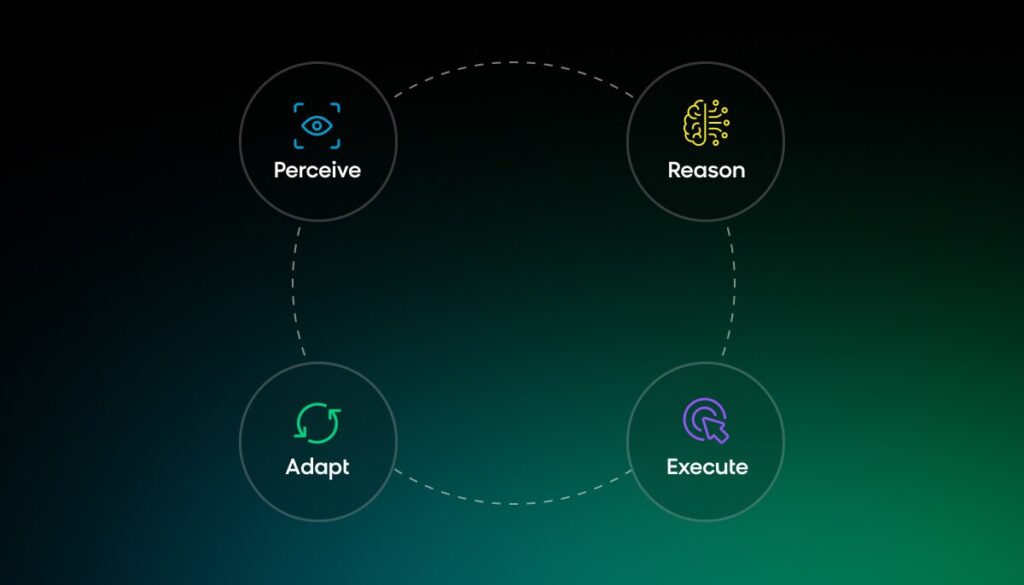
The mechanism that separates AI marketing agents from everything that came before it is a continuous loop. Here’s what each step actually means in practice.
Perceive
The agent reads real-time customer data: behavioral signals, purchase history, product catalog state, channel engagement, and consent status. This isn’t a batch process that runs overnight. The agent is continuously monitoring what customers are doing, which products are trending, and which segments are showing early intent signals.
Reason
Given the objective you’ve set (“re-engage lapsed buyers from Q1” or “maximize revenue from our new product drop”), the agent works out which customers to target, what message would be most relevant to each segment, which channel is most likely to drive a response, and how to structure the campaign. It’s not pulling from a pre-written playbook. It’s reasoning from the data in front of it.
Execute
The agent builds the campaign: audience segments, content, send timing, and deployment logic. Then it runs it. No human is mapping out the workflow in a drag-and-drop builder. No one is manually defining inclusion/exclusion criteria. The output is a live, running campaign.
Adapt
This is the step that most clearly separates agentic marketing from automation. After a campaign launches, the agent checks which subject lines are driving opens, identifies that a specific age cohort responds better to urgency framing, and shifts content weighting on the next send, automatically. It doesn’t wait for a human to review dashboards and queue up a new A/B test.
Google Cloud’s research on AI agent ROI makes a useful distinction here: standalone AI models generate outputs, but agents take action in pursuit of a goal. The difference is that an agent operates across multiple steps and systems, running beyond a single prompt-response interaction.
The data layer underneath all of this matters enormously. An agent working from a live, unified customer profile (one that updates as customers browse, buy, and engage) makes meaningfully better decisions than one working from a batch-synced snapshot that’s 24 hours old.
For complex campaigns, multiple agents can work in coordination. A content agent handles copy generation while a segmentation agent identifies the audience and an optimization agent monitors performance and adjusts sends in real time. This is what agentic orchestration enables: campaigns that execute and adapt with minimal human intervention at the workflow level. The marketer still sets the strategy, defines brand voice guardrails, and reviews directional decisions. Execution, however, becomes largely autonomous.
6 Types of AI Marketing Agents for Ecommerce and Retail Teams
AI marketing agents aren’t monolithic. Different agents specialize in different parts of the perceive-reason-act-learn loop described above: some focus on finding the right audience, others on building and executing campaigns, others on optimizing and reporting performance. Most mature platforms combine several of them. Here are the six types that matter most for ecommerce and retail teams.
1. Campaign Builder Agents
Campaign builder agents take a marketer’s goal or prompt and generate a complete campaign structure (audience definition, content, timing, and journey logic) without requiring manual assembly of each piece. The workflow shift is significant: instead of briefing a campaign, building it step by step, QAing each element, and handing it off for review, a marketer describes what they want to achieve and the agent handles the build.
This is particularly valuable for high-velocity teams managing multiple product drops or promotions each month. Every hour spent in campaign assembly is an hour not spent on creative strategy or customer insight.
Sideshow, a pop culture collectibles brand with a lean marketing team and frequent product launches, put this to the test. Using Bloomreach’s Loomi Marketing Agent, the team can input a business objective (promote a Star Wars collectibles drop this week) and the agent generates campaign scenarios, audience segments, and journey logic. The result: campaign launches in under 15 minutes. The team saw a 2x increase in value per email delivered and generated $10K from a single AI-built campaign, with 13.9% of total email revenue now attributed to Loomi Marketing Agent.
2. Audience Segmentation Agents
Manual segmentation has a built-in ceiling. A marketer can build segments based on rules (customers who bought in the last 90 days, or contacts who opened the last three emails) but those rules are static approximations of customer intent. They don’t account for behavioral signals, purchase affinity, or real-time intent.
Audience segmentation agents scan a customer database dynamically for each send, identifying the highest-propensity contacts based on behavioral and predictive signals rather than static criteria. The audience isn’t defined once and reused. It’s computed fresh, based on who is most likely to convert right now.
The practical outcome: fewer emails sent to disengaged contacts, better deliverability, fewer unsubscribes, and more revenue per send. 260 Sample Sale, a flash sale retailer with a 900K+ contact list, used Loomi Marketing Agent to do exactly this. Instead of blasting the entire database, the agent identified 36,000 highest-propensity buyers for each weekly Last Chance send. The outcome was 82% more efficient targeting (the same revenue, generated from 18% of the audience) and a 2.4x higher conversion rate compared to manual sends.
3. Content Generation Agents
Where campaign builder agents handle campaign structure and journey logic, content generation agents handle the copy layer: subject lines, body text, personalized product descriptions, and message variants at a volume no copywriting team can match manually.
For brands with large product catalogs or multiple audience segments, the problem isn’t creativity. It’s throughput. A single campaign might need a dozen subject line variants, different body copy angles for different customer segments, and localized versions across markets. Content generation agents handle this at scale.
These agents generate multiple variants simultaneously, making A/B and multivariate testing practical at a scale that’s operationally impossible to build by hand. Most teams skip testing not because they don’t want the data, but because producing the variants eats time they don’t have.
One important note: content agents accelerate production, but they don’t replace editorial judgment. Brand voice guidelines, approval workflows for sensitive messaging, and creative direction remain human responsibilities. The agent produces the volume; the marketer ensures it’s on brand.
Bloomreach’s AI content generation capability enables teams to save up to 70% of time on AI-generated campaigns, time that was previously spent on copy drafts, edits, and approval cycles.
4. Personalization Agents
If segmentation agents answer “who gets this campaign,” personalization agents answer “what exactly does each person receive.” Segment-level personalization means everyone in the “high-value customers” bucket gets the same message. That’s better than no personalization, but it still misses what makes each customer’s history and preferences distinct. Personalization agents operate at the individual level: different product recommendations, different messaging angles, different offers, tailored to each customer’s unique behavior and purchase history.
These agents work across channels, so the personalized experience is consistent whether a customer receives an email, an SMS, or a push notification. And they update continuously. If a customer’s purchase patterns shift (say, they were buying women’s apparel but recently started browsing men’s) the agent adjusts without waiting for a marketer to manually update segment rules.
The concept of agentic personalization captures what makes this distinct from conventional personalization engines: the agent actively decides what to personalize, when to serve it, and how to adjust based on ongoing response signals, rather than personalizing only on explicit instruction.
The revenue impact of this kind of individual-level personalization can be dramatic. Oliver Bonas, using Loomi AI-powered email flows and segmented campaigns, achieved +762% revenue growth, +161% conversion rate improvement, and +97% email click-through rate. Our reengagement with Loomi AI use case illustrates how these personalized reactivation campaigns operate at scale.
5. Send Time and Channel Optimization Agents
Batch-and-blast scheduling (send to everyone at 10 a.m. Tuesday) ignores the fact that different customers check email at different times, on different devices, with different channel preferences. Send time and channel optimization agents replace the scheduled blast with per-contact predictions: when is this specific customer most likely to engage, and on which channel?
The agent calculates an optimal delivery window for each contact based on their historical engagement patterns. Not an average for the segment, but an individual-level timing prediction. It extends the same logic to channel selection: if a specific customer consistently responds to SMS but rarely opens email, the agent routes the message accordingly.
This optimization runs continuously. Each campaign cycle adds more data on each customer’s engagement behavior, making the predictions sharper over time. Marketers don’t have to manually A/B test send times across segments. The agent runs that optimization automatically and at a level of granularity that manual testing can’t match.
Our AI-driven send time optimization describes this as “campaign agents that build, run, and optimize campaigns for you, learning and improving over time.” That learning loop is what distinguishes this from a one-time configuration. The agent gets better at customer timing preferences the longer it runs. For teams running omnichannel marketing across email, SMS, and push, this kind of contact-level channel routing is what makes cross-channel coordination practical.
6. Campaign Performance and Reporting Agents
Every marketer has spent too much time pulling data from dashboards, building performance reports, and cross-referencing results across campaigns. Performance and reporting agents handle this monitoring layer automatically, surfacing insights, flagging anomalies, and identifying winning variants without requiring manual investigation.
In more advanced implementations, these agents act on what they find. If a subject line variant is significantly underperforming, the agent suppresses it and expands the winning variant. If a specific audience subset is driving disproportionate revenue, the agent flags it for the marketer to explore.
The practical shift is from gathering insights to acting on them. When a marketer receives a plain-language summary (“subject line B is outperforming A by 22%, recommend expanding to full audience”) the value of their attention is directed toward the decision, not toward data extraction.
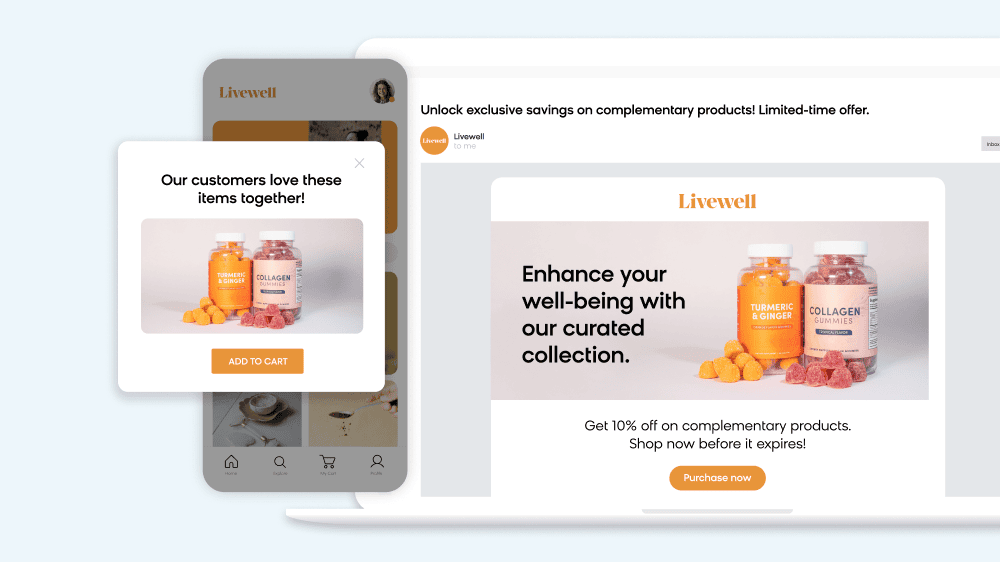
Bloomreach’s newsletter with automated product updates use case shows a related application: AI-driven personalization that automatically selects products, timing, and messaging based on individual customer preferences, adjusting content selection based on ongoing performance signals rather than requiring manual merchandising decisions for each send.
Benefits of AI Marketing Agents for Ecommerce Marketing Teams
The operational case for AI marketing agents comes down to five benefits that compound on each other.
Speed to launch. Campaigns that previously took days to assemble (briefing, building, QAing, approving) now take minutes. At Sideshow, the entire cycle from concept to live campaign runs in under 15 minutes. That speed doesn’t just save time; it unlocks campaign opportunities that previously weren’t worth pursuing because the build cost was too high.
Scale without additional headcount. AI agents let a team run more campaigns, more variants, and more personalized flows than would be physically possible with the same number of people. Revolution Beauty’s 5x revenue per email improvement happened with the same team size. Not because the brand hired more marketers, but because agents handled the production volume their team couldn’t. The evolution of marketing automation with AI is about this capacity shift.
Precision over volume. Sending to a smaller, more accurate audience generates better results than broadcasting to a large, imprecise one. 260 Sample Sale’s 82% targeting efficiency improvement is the clearest illustration: the same revenue from 18% of the list. That also means lower suppression risk, better sender reputation, and fewer unsubscribes. Precision-versus-volume is consistently one of the primary drivers of measurable ROI from agentic AI systems.
Compounding improvement over time. Unlike static automation workflows that run the same logic indefinitely, AI agents learn from every campaign cycle. Outcomes feed back into the model, making audience selection, content choices, and timing predictions sharper with each iteration. The system gets better at the same tasks over time without requiring human reconfiguration. McKinsey’s research on agentic marketing workflows describes this as a structural advantage over rule-based tools.
Recaptured strategic capacity. 260 Sample Sale’s marketing team was spending 35 hours per week on campaign production (copywriting, segmentation, assembly, scheduling). That’s not strategy, and it’s not creative work. It’s operational overhead. AI agents absorb that production burden and redirect human attention toward the decisions that actually require human judgment: positioning, messaging strategy, brand direction, and customer engagement goals. The $580K+ in AI-attributed revenue 260 Sample Sale generated serves as evidence that the recaptured capacity was directed somewhere more valuable.
What to Look for in an AI Marketing Agent Platform
Evaluating AI marketing agents and the platforms that power them isn’t straightforward. The category is new enough that marketing claims vary widely and “AI-powered” appears on everything. Here are the criteria that actually differentiate platforms capable of delivering the results above.
A live, unified customer data foundation. An agent is only as accurate as the data it works from. Platforms that maintain real-time, unified customer profiles (combining purchase history, browse behavior, email engagement, and RFM data) give agents far better inputs than those relying on batch-synced snapshots. A 24-hour-old data snapshot means the agent is working with yesterday’s customer. Agentic personalization at any meaningful level requires current behavioral signals, not stale snapshots.
Ecommerce-native logic. Generic AI platforms aren’t trained on ecommerce-specific patterns: product affinity, seasonal purchase cycles, abandoned cart behavior, repeat purchase signals, flash sale dynamics. A horizontal AI platform retrofitted for marketing will underperform a platform built specifically for retail and ecommerce. The agents should understand what it means that a customer browsed outerwear twice in a week, reading that behavioral signal as high purchase intent rather than treating it as two generic page visits. Strong personalization engines are built on this kind of domain-specific training.
Marketer-controlled guardrails. Autonomous doesn’t mean uncontrolled. The best platforms let marketing teams set brand voice parameters, messaging boundaries, and campaign rules so agents operate within defined constraints. The marketer owns strategy and brand direction; the agent owns execution within those boundaries. If a platform can’t accommodate human-defined guardrails, it’s not ready for enterprise use.
Multi-agent orchestration. A content generation agent in isolation has limited value. The compounding impact comes when campaign builder, segmentation, personalization, and optimization agents work in coordination, each informing the others. Evaluating platforms on single-agent capability misses how the full system performs.
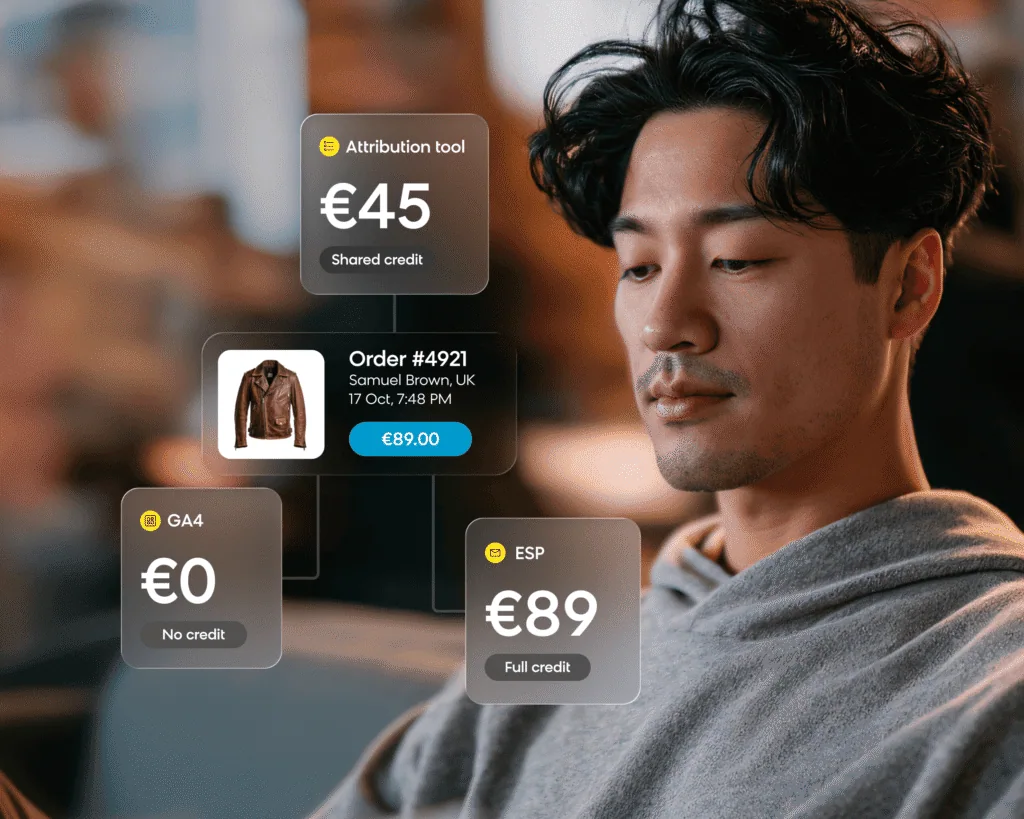
Campaign-level attribution. You need to know which revenue came from agent-generated campaigns specifically, separated from manually built campaigns. Without that, you can’t make the internal ROI case, you can’t optimize your use of agents, and you can’t identify where human-built campaigns are underperforming against agentic ones. Look for platforms that attribute at the campaign level, not at the channel level alone.
Integration with your existing stack. Agents need to work with your ESP, CRM, ecommerce platform (Shopify, commercetools, SAP), and data warehouse. Fragmented integration means the agent works from incomplete data, which undermines every other capability on this list.
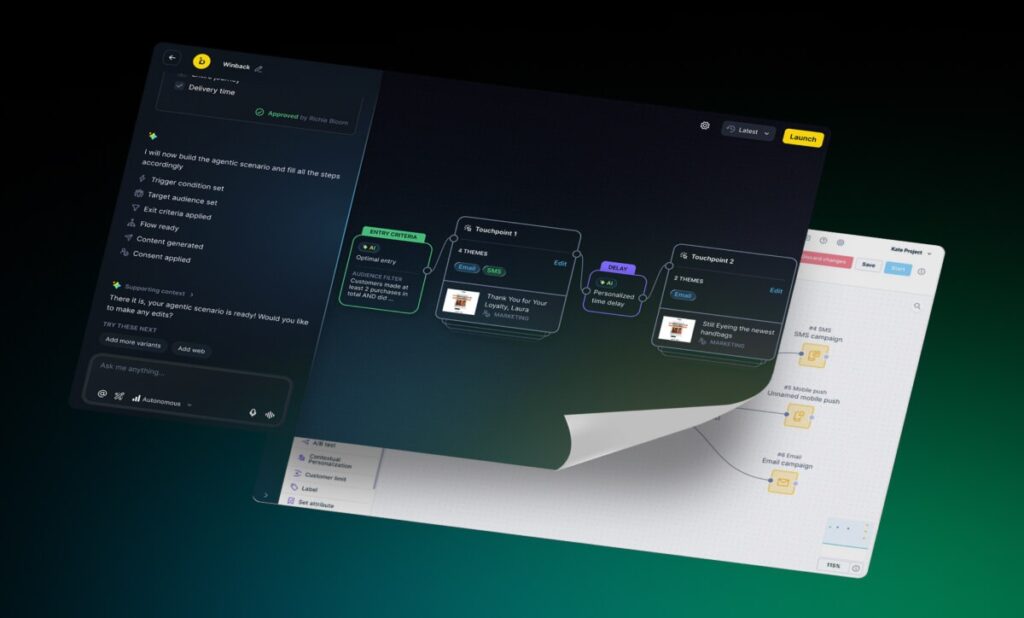
Bloomreach’s Loomi Marketing Agent was built specifically for ecommerce and retail teams, combining a live unified customer data layer with agents that handle campaign building, audience segmentation, content generation, personalization, and optimization. The results from Revolution Beauty, Sideshow, and 260 Sample Sale above all came from email-focused deployment of those capabilities, which is where Loomi’s current agent layer operates.
Start Using AI Marketing Agents
Strategy, creative direction, brand voice, and campaign positioning stay human. Building audience segments, assembling campaign elements, scheduling sends, and pulling performance reports become the work of AI marketing agents. That’s the shift.If your team is spending more time executing campaigns than thinking about them, Loomi Marketing Agent was built for exactly that situation. See how Loomi Marketing Agent works or learn how Bloomreach is changing marketing automation with AI.
Frequently Asked Questions
What is an AI marketing agent?
An AI marketing agent is software that autonomously plans, builds, and optimizes marketing campaigns. It makes decisions about audience segmentation, content, timing, and channel without requiring manual execution at each step. Unlike traditional marketing automation, which follows fixed rules a marketer programs, an AI marketing agent interprets a goal (“re-engage lapsed customers who browsed last month”) and determines how to achieve it. The result is a system that takes multi-step action rather than waiting for human instruction at each stage. For a broader definition of what an AI agent is, including how agents differ from models, that post covers the fundamentals.
How are AI marketing agents different from marketing automation?
Traditional marketing automation executes workflows that a human designs: if a customer abandons a cart, send email X after 24 hours. The rules are fixed, and the system runs them the same way indefinitely regardless of whether they’re working. AI marketing agents operate from a goal rather than a ruleset: they determine their own workflows, adapt based on real-time performance data, and improve with each campaign cycle. The practical distinction is between a system that executes instructions and one that makes decisions. Automation doesn’t get better at targeting customers over time; an AI agent does.
What tasks can AI marketing agents handle?
AI marketing agents can handle audience segmentation, content generation, send time optimization, campaign building, A/B testing, performance monitoring, and individual-level personalization. The specific scope depends on the platform and the combination of agent types deployed. As covered in the six types above, most enterprise platforms combine campaign builder, segmentation, content generation, personalization, optimization, and reporting agents that work in coordination, each handling a different part of the marketing workflow while sharing data and signals.
Do AI marketing agents replace human marketers?
No. AI marketing agents handle execution; they don’t handle strategy. Marketers still define campaign goals, set brand voice guidelines, make creative and positioning decisions, and interpret results in business context. The shift is that agents absorb the time-consuming production work (segment-building, campaign assembly, copy generation, performance monitoring) so marketing teams can direct their attention toward the decisions that actually require human judgment. The 35 hours per week 260 Sample Sale recaptured from production work didn’t eliminate marketing jobs; it redirected marketing capacity toward higher-value work.
How much does an AI marketing agent improve campaign performance?
Results vary by platform, use case, and the quality of underlying customer data, but verified results from ecommerce brands using Loomi Marketing Agent include: 2.4x higher conversion rate from AI-targeted sends versus manual segmentation (260 Sample Sale), 5x more revenue per email (Revolution Beauty), 2x increase in email value per send (Sideshow), and $580K+ in AI-attributed revenue from a single platform deployment. The performance gains typically come from two sources: precision targeting that reaches higher-intent audiences, and the ability to launch and test campaigns that wouldn’t have existed without agent-driven velocity.
What data does an AI marketing agent need to work effectively?
An AI marketing agent performs best with access to a unified customer profile that includes purchase history, browsing behavior, email engagement history, and real-time behavioral signals. The richer and more current the data, the more precisely the agent can identify high-propensity audiences, personalize content, and predict optimal send timing. Platforms that maintain a live data layer (updating in real time as customers browse, buy, and engage) give agents meaningfully better inputs than those relying on nightly batch syncs. This is why the data foundation is the first thing to evaluate when assessing any AI marketing agent platform.