Every Shopify store needs email marketing, and every merchant has too many platforms to choose from. The right pick depends less on features and more on where your store is today — and where it’s heading.
The best email marketing platform for a Shopify store depends on its size: brand-new stores should start with Shopify Email (a free tier already sits in your admin), growing stores get the most from Omnisend or Klaviyo, and mid-market brands that have outgrown both should look at Bloomreach. Email is still the revenue channel a Shopify store controls most directly, which makes this one of the highest-leverage platform decisions a merchant makes.
A note on how to read any “best of” list, including this one: they come with a bias. Review sites take affiliate commissions on most of the tools they rank, and we showcase our Loomi email platform in this blog. We’ve ordered our list by store stage rather than preference, and our Loomi ranking comes with a straight answer about who shouldn’t buy it.
Key takeaways:
- Just starting out? Use Shopify Email. It’s free for 10,000 emails/month and lives inside the Shopify admin.
- Growing store, small team? Omnisend and Seguno are built for ecommerce and easy to run alone, and both offer a free plan.
- Want to build your own segments and flows? Klaviyo is helpful for hands-on segmentation, and it fits teams with someone to own segment building week to week.
- Running lifecycle marketing at scale? Bloomreach’s Loomi platform is built for mid-market and enterprise stores, typically 20,000+ contacts, where segmentation and campaign building have turned into manual work.
- The hidden cost is the migration. Switching platforms means rebuilding automations and retraining your team, so choose based on where you’ll be in two years.
How To Choose Email Marketing for Shopify
Before comparing platforms, it helps to know what actually separates them. Most of the differences that matter show up in six areas — and depending on your store’s stage, you probably only need to weigh three.
- Integration depth comes first. Every tool on this list “integrates with Shopify,” but a nightly contact sync and a real-time feed of orders, browse behavior, and catalog changes are different products. One sends the cart reminder in minutes; the other sends it tomorrow.
- Automation range is next. Basic tools cover welcome emails and abandoned cart emails. Stronger ones trigger on price drops, back-in-stock events, and post-purchase behavior.
- Pricing model is the sleeper. Most platforms charge by contact count, so a plan that’s cheap at 500 contacts can cost an order of magnitude more at 50,000. Check what happens to your bill before you commit.
The other three are situational:
- AI capability. Most platforms on this list use AI for copy suggestions and send-time hints — useful, but still advisory. A few go further, making per-customer decisions about content, timing, and product recommendations without manual input. The comparison table below breaks down where each platform’s AI actually sits.
- Ease of use. If one person runs your email program, look for prebuilt flows you can edit rather than build from scratch. If you have a dedicated lifecycle team, the depth of the workflow builder matters more than the learning curve. Match the tool to the team you have today.
- Multichannel support. If SMS, push, or web personalization are on your roadmap, it’s cheaper to start on a platform that supports them natively than to bolt on separate tools later. Separate tools mean separate segment lists, separate analytics, and customers who get an email and a text about the same promotion five minutes apart.
If you take one rule from this section, take this one: prioritize integration depth over feature count. A basic feature on real-time data beats a sophisticated feature on stale data.
8 Best Email Marketing Platforms for Shopify
The platforms below are ordered by store stage, so start at your size and read forward — and if you’re not on Shopify, our wider roundup of ecommerce email platforms covers the same ground without the Shopify-native filter.
1. Shopify Email – Best for Beginners
Shopify Email is the answer to “do I even need another app?” For many new stores, it’s all the email tool you need in year one — built into the Shopify admin with zero configuration, a free monthly allowance of 10,000 emails, and revenue attribution right in your Shopify analytics. And Shopify Magic adds AI copy generation and send time optimization.
It fits the first year of a store’s life, when the list is small, sends are occasional, and everything you need is already in the admin. The natural moment to look at a dedicated tool is when email stops being occasional — when you want flows firing on more than abandoned checkout and welcome events, precise timing on promotions to a bigger list, or sends in more than one language for international customers.
Best for: new Shopify stores, and merchants testing email marketing before investing in a dedicated tool.
Pricing: free monthly sending allowance (10,000 emails), then a per-email fee that decreases at higher volumes.
2. Seguno – Best for Budget-Conscious Shopify Stores
Seguno is built specifically for Shopify, offering a native experience that lives entirely within the Shopify admin with real automation depth. For merchants wanting affordable email marketing without leaving their familiar environment, Seguno provides solid automation at competitive pricing.
Key features:
- Works entirely within Shopify admin
- Prebuilt automation for abandoned carts, welcome series, and more
- Automatic product recommendations, back-in-stock and price drop notifications
- Canva integration for design
Staying native is the main selling point, and it’s the right call for as long as the Shopify admin is where your marketing actually happens.
Best for: small to medium stores wanting a budget-friendly, Shopify-native tool with solid automation basics.
Pricing: free plan available; paid plans scale with subscriber count.
3. Mailchimp – Best for General-Purpose Email
Mailchimp is a platform your team is probably familiar with, and that familiarity is a real advantage for small teams. After reconnecting with Shopify (the two split for a few years before rebuilding the integration), it offers a straightforward option: an intuitive drag-and-drop builder, a large template library, basic automation and segmentation, plus landing pages and signup forms.
It’s built as a general-purpose email tool that connects to Shopify, which suits stores whose email program is mostly newsletters, announcements, and campaigns on a calendar rather than automation firing on store events.
Best for: small stores, beginners who value ease of use, and merchants already comfortable in the Mailchimp ecosystem.
Pricing: free plan available; paid plans scale with contact count.
Moving up from starter tools? The decision isn’t really about features — it’s about three questions. How much of your revenue is email responsible for now? Do your flows need to fire on what a shopper just did, rather than on a calendar? And are SMS or push joining the mix this year? If you’re answering yes to two of those, the next group of platforms is where to look.
4. Omnisend – Best for Ecommerce Workflows
Omnisend was built for ecommerce first, and it shows: abandoned cart, browse abandonment, welcome, and post-purchase flows come prebuilt, and email, SMS, and push live in one workflow builder.
Key features:
- Prebuilt ecommerce automation workflows
- Email, SMS, and push notifications in one platform
- Product recommendations based on browsing and purchase behavior
- A/B testing for campaigns and automation
This is the strongest fit where email, SMS, and push need to run from one workflow builder, and the team running them is small. The prebuilt ecommerce flows mean you can start by editing a working automation rather than building one from scratch.
Best for: small to medium Shopify stores wanting strong ecommerce automation with multichannel capabilities.
Pricing: free plan available (250 contacts); paid tiers scale with contact count, and the top tier offers unlimited emails.
5. Klaviyo – Best for DIY Segmentation
Klaviyo is the default upgrade path for growing Shopify stores. The platform centralizes data from a large integration library and lets you slice segments by purchase history, browsing behavior, and predictive metrics like lifetime value and churn risk.
Key features:
- Advanced segmentation with predictive analytics
- Prebuilt automation flows for common ecommerce scenarios
- Email, SMS, and WhatsApp in one platform
- Detailed revenue attribution and campaign analytics
- Strong Shopify data sync for real-time personalization
The thing to plan for is the operating model: Klaviyo is a hands-on platform, and that’s the point. Your team designs and maintains every segment, flow, and test, with full control over each step. So, the useful planning question is who on your team will live in the segment builder each week.
Best for: medium to large Shopify stores wanting detailed targeting and comprehensive analytics.
Pricing: free plan available (up to 250 contacts); paid plans scale with contact count.
Moving up from DIY? Owning your segmentation is a legitimate choice, and plenty of teams want that control. The question isn’t preference — it’s capacity. Count the hours going into hand-building segments, scheduling sends, and reading results each week. If that number is growing faster than your list, it’s worth asking which of those decisions you still want a person making, and which ones should happen automatically.
6. ActiveCampaign – Best for CRM Integration
ActiveCampaign is a good fit when email marketing is only half the job. It pairs a sophisticated visual automation builder with a built-in CRM, so stores that manage sales relationships (wholesale sides, high-touch products, B2B lines) can run pipelines and campaigns in one tool.
Key features:
- Advanced marketing automation with visual workflow builder
- Built-in CRM for contact and deal management
- Email, SMS, and WhatsApp personalization with Shopify data
- Lead scoring and sales automation
The workflow builder rewards a team that will invest time in it, so this is the right call where the built-in CRM will genuinely get used rather than just switched on.
Best for: Shopify stores needing CRM capabilities alongside email, and those wanting complex automation workflows.
Pricing: paid plans scale with contacts and feature tier. No free plan.
7. Drip – Best for Ecommerce Automation
Drip is an appealing tool for established Shopify stores ready to level up their automation game, with real-time segmentation that reacts to store and customer behavior as it happens. It carries Shopify’s “Built for Shopify” badge, which certifies that the app meets Shopify’s quality and integration requirements.
Key features:
- Prebuilt Shopify flows for price drop, back-in-stock, abandoned cart
- Real-time segmentation on store and customer data
- Visual workflow builder for complex automation
- List growth tools including quizzes, forms, and popups
Drip is aimed squarely at stores with an established list: the company itself suggests it fits stores with 2,500+ subscribers, which is a useful fit test to run before you trial it.
Best for: established ecommerce businesses wanting sophisticated automation and segmentation.
Pricing: paid plans scale with subscriber count. No free plan; free trial available.
8. Bloomreach – Best for Scaling Brands
Bloomreach’s Loomi platform is last on the list by stage, and deliberately so: this is the platform brands graduate to, and it’s ours. We flagged that bias at the top, so hold this entry to the same integration test we applied to everything above.
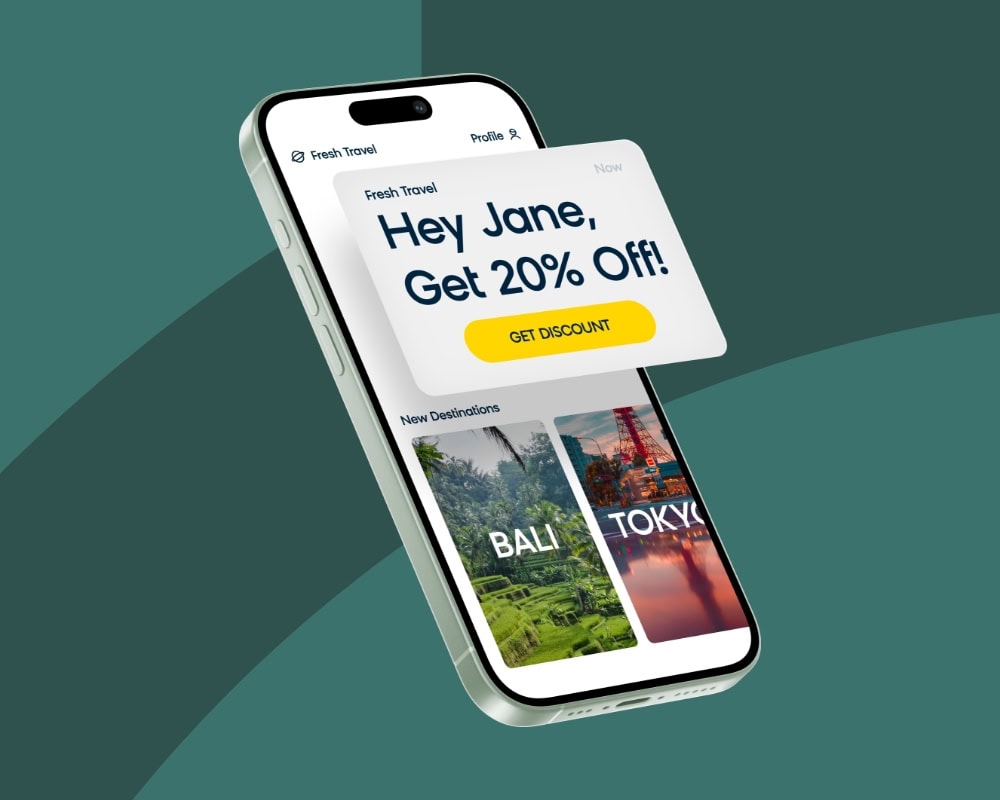
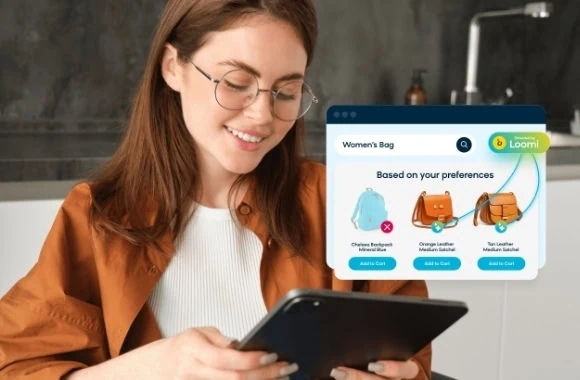
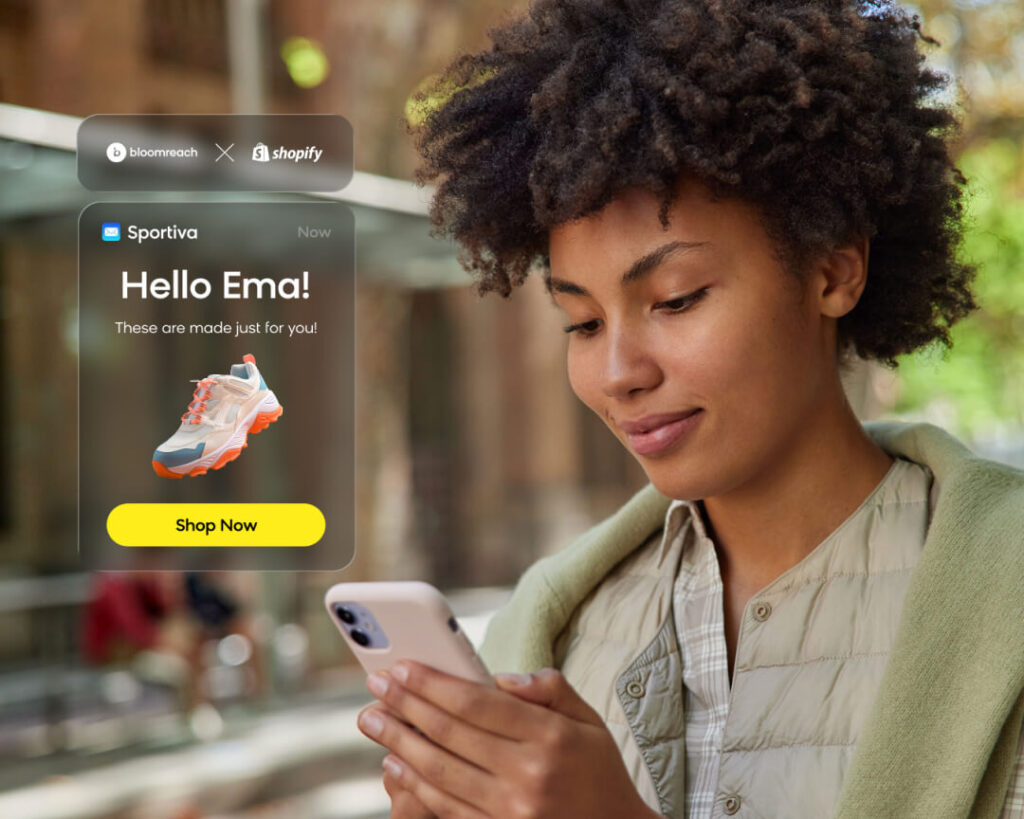
Loomi email is designed to personalize the entire customer experience. For Shopify merchants ready to move beyond basic email marketing, Loomi offers AI-native capabilities that continuously optimize campaigns without manual intervention — adapting content, timing, and product recommendations for each individual customer, in real time.
Most platforms on this list are email-first tools that have added SMS or push as secondary channels. Loomi weaves your email campaigns into the full customer journey — it orchestrates across 13+ channels from a single customer view, so a shopper’s email, SMS, web, and app experience are coordinated together rather than managed in silos. Our native Shopify app connects it all through a single install, syncing your catalog, consent status, product translations, and Shopify Markets variants right from the start.
Key Shopify capabilities:
- Real-time personalization: Loomi learns from each customer interaction to optimize email content, product recommendations, and send times per individual
- Unified customer view: first-party Shopify data combined with browsing behavior, engagement history, and predictive insights
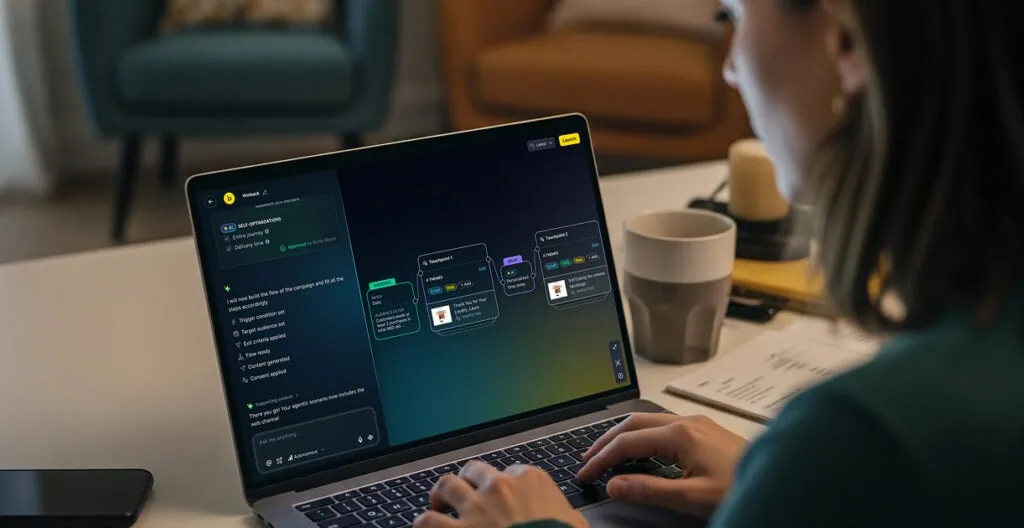
- Loomi marketing agent: describe a campaign and our marketing agent builds it, then keeps testing new variants
- Omnichannel orchestration: email coordinated with SMS, push, web personalization, and ads from one place
Results from Shopify brands:
BrewDog sent a personalized campaign against a control of 40,000 customers who all received the same non-personalized email. The personalized group clicked 15.6% more often and generated 13.8% more revenue.
UK womenswear brand Lovall came to us running campaigns largely by hand. It got 10+ hours a week back and grew overall CRM revenue 50.85% year over year. Automated email revenue rose 310.5%, though that one is measured from a near-manual base, where the first automations always produce a big multiple; and a year-over-year figure carries whatever else changed that year.
Who shouldn’t buy it: Stores under roughly 20,000 contacts, teams of one, and anyone whose email program is a weekly newsletter. A useful self-test — if you’re running fewer than a handful of automation flows today, you won’t feel the ceilings Bloomreach is built to remove.
We build and price for brands running lifecycle marketing at scale. If that’s not you yet, Shopify Email or Omnisend will serve you better today, and we’d rather earn your business in two years than lose it in six months.
Best for: mid-market to enterprise Shopify brands ready to scale beyond basic automation, wanting AI-powered personalization across channels.
Pricing: contact for pricing based on your requirements.
Quick Comparison Table
| Platform | Best For | Where the AI sits | Pricing model | Free Plan |
|---|---|---|---|---|
| Shopify Email | Beginners | Copy generation, send-time suggestions (Shopify Magic) | Free allowance, then per email sent | Yes |
| Seguno | Budget-conscious | Automatic product recommendations | Subscriber-based tiers | Yes |
| Mailchimp | General-purpose email, ease of use | Segmentation and send-time basics | Contact-based tiers | Yes |
| Omnisend | Ecommerce workflows | Product recommendations, A/B testing | Contact-based tiers | Yes |
| Klaviyo | DIY segmentation | Predictive analytics (lifetime value, churn risk) | Contact-based tiers | Yes (250 contacts) |
| ActiveCampaign | CRM integration | Lead scoring, journey automation | Contact + feature tiers | No |
| Drip | Ecommerce automation | Real-time behavioral segmentation | Subscriber-based tiers | No |
| Bloomreach | Scaling brands, AI personalization | Per-customer send time, content, and product recommendation optimization | Custom / enterprise | No |
The Real Cost of Choosing Wrong Is the Migration
The most expensive part of choosing the wrong email platform isn’t the subscription — it’s the switch. Migrating means rebuilding every automation, relearning a new workflow builder, and often re-warming your sending reputation. For a lean team, that’s weeks of work on top of the new subscription cost, which is why so many stores stay on a tool that’s “good enough for now” a year longer than they should.
But there’s two migration fears that are often overblown:
- You don’t lose your store history. Shopify itself is the source of truth for orders and customers, so a platform with a deep integration re-imports your full purchase history on day one. (Email engagement history is the one thing that lives in your old platform, and it moves by export.)
- IP warming is a gradual ramp rather than a blackout. You keep sending from your current platform until the new one is fully live. The real cost is the rebuild effort, so weigh that honestly and plan to do it exactly once.
The takeaway: plan to migrate exactly once. Buy for the store you’re building, not the one you have today — and know the graduation signals when they arrive:
Personalization has become the job, not part of it. Count the hours going into exporting data, hand-building segments, and picking send times. When that work fills a week, the question worth asking is which of those decisions you still want a person making — and which should happen per customer, continuously.
Your channels are managed in silos. When email, SMS, push, and analytics each live in their own tool, each keeps its own segment lists and its own view of the customer. Bringing them together is what makes coordinated journeys possible — and it changes how you compare cost. Price an enterprise platform against everything it would replace (your ESP plus the SMS tool plus the personalization and analytics add-ons), not against your email bill alone.
Your list grows but revenue doesn’t. Rule out the usual suspects first — acquisition quality, offer-market fit, and deliverability — because most of them aren’t platform problems. If those check out and revenue still isn’t tracking list growth, it’s usually a sign that sending the same thing to everyone has gone as far as it goes.
Which Platform Should You Actually Pick?
The honest answer is that it depends on where your store is today and where it’s heading.
- Start free, and only pay for capability you’ll use this quarter.
- If you’re launching, use Shopify Email and revisit this decision at 5,000 subscribers.
- If you’re growing and email is becoming a real revenue channel, Omnisend or Klaviyo will carry you a long way.
And if you’re a mid-market brand whose team spends its week hand-building what should be automatic, see how Loomi can help you move beyond constraints and scale your business.
Frequently Asked Questions: Email Marketing for Shopify
What is the best email marketing for Shopify?
There’s no single winner: match the platform to your stage. Merchant reviews back the stage-based approach, with Omnisend, Seguno, and Mailchimp among the best-reviewed email apps in the Shopify App Store. Klaviyo is a common step up for teams that want to build their own segments and flows, and Bloomreach is the platform brands graduate to once they need AI personalization beyond email alone.
Does Shopify have built-in email marketing?
Yes. Shopify Email is built directly into the Shopify admin, with a free monthly sending allowance, templates, basic automation, and revenue tracking. It works well for beginners; brands needing sophisticated segmentation, multilingual sends, or complex automation will outgrow it. See our full comparison of Shopify Email vs. dedicated platforms.
How much does email marketing cost for Shopify?
Shopify Email’s free allowance covers most new stores, with a small per-email fee beyond it. Entry tiers on the other apps in this list are modest, and most of them offer a free plan to start on (see the comparison table above); Bloomreach uses custom enterprise pricing. Because most platforms charge by contact count, the number that matters is not the entry price but the cost at your projected list size in 12 months, so check each vendor’s current rates against that figure.
Does the AI build the whole campaign, or just make suggestions?
It depends on the platform’s AI maturity. Most tools on this list use AI for copy suggestions and send-time hints. On Bloomreach, Loomi marketing agent goes further: describe the campaign you want and it builds it, drafts variants, and keeps testing new ones. Nothing launches without your approval.
Can I still edit everything the AI builds?
Yes, and you should expect this from any platform. On Bloomreach, every AI-generated campaign, subject line, and product recommendation block is fully editable before it sends. The AI does the heavy lifting; your team keeps final say.
Is Klaviyo the only email platform with a real Shopify integration?
No, though it’s a common assumption. Several platforms maintain deep native Shopify connectors. Bloomreach’s, for example, syncs orders, customers, and catalog changes in near real time through webhooks and delta imports, and its native app adds consent status, Shopify Markets variants, and product translations. When comparing integrations, ask each vendor what syncs in real time versus on a schedule, and whether edge cases like metafields and subscription data are covered.
Can I use multiple email marketing apps with Shopify?
Technically yes, but don’t. Beyond the usual data-silo problems, both apps will claim the same Shopify customer and order events, so your revenue attribution stops being trustworthy, and a customer who unsubscribes in one tool can keep receiving email from the other. Pick one platform that fits your size and consolidate.
What’s the difference between Klaviyo and Bloomreach?
Klaviyo is strong on DIY segmentation and analytics. Both platforms do per-customer optimization, so this isn’t one having AI and the other not: Klaviyo has predictive features including Smart Send Time. The real difference is operating model and scope. In Klaviyo you own the segments and flows and decide where automation applies, which is what teams who want that control are buying. In Bloomreach the decisioning runs across the 13+ channels you’ve connected, so one customer’s email, SMS, web, and app experience is decided together. If your program lives mostly in email, that breadth isn’t worth paying for.