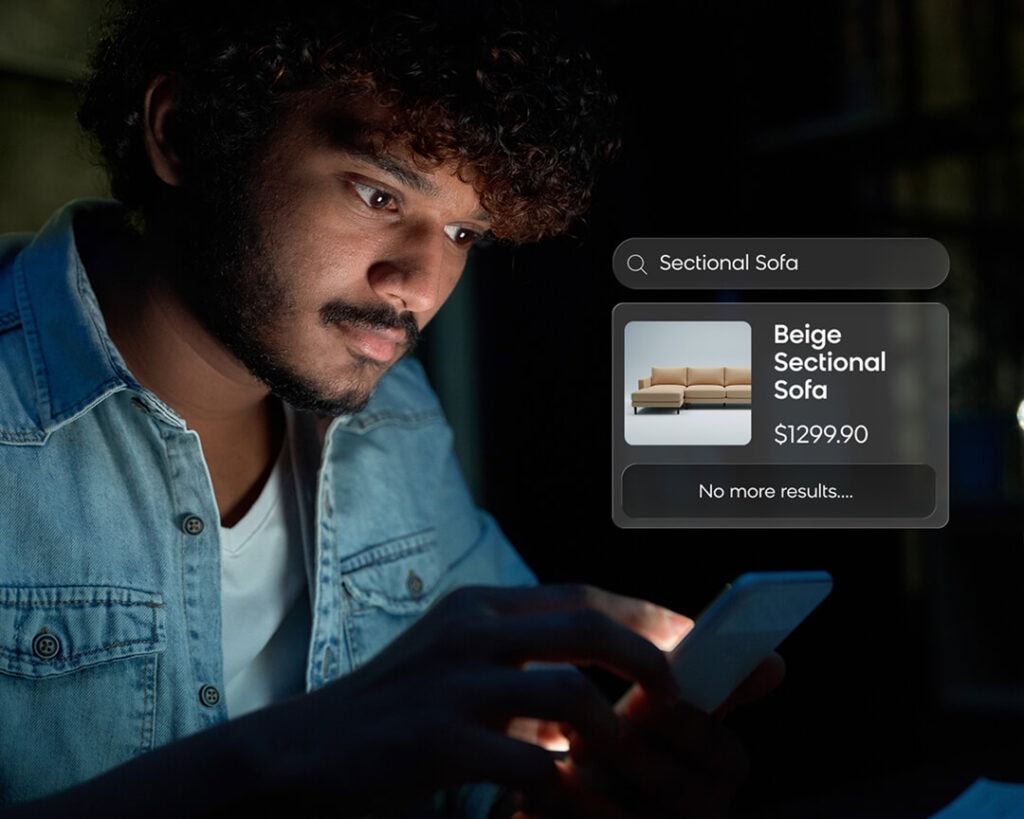

There’s a particular kind of stuck that’s hard to diagnose – because on the surface, everything looks fine.
Your platform is running. Your campaigns are going out. Your team is busy. But look a little closer and the picture shifts: engineers are patching instead of building, your personalization is powered by data that’s already too old, and your competitors are launching new experiences in weeks while your roadmap stretches into next year.
This is a technology problem. Far too many enterprise commerce teams are tied to an inflexible platform that can’t adapt to modern standards and pace. This status quo has quietly become the single biggest obstacle to growth.
The Hidden Cost of Staying Put
Legacy commerce platforms were built for a different era. The promise was scalability and control. The reality has been something closer to complexity debt: rigid infrastructure, fragmented data, and multi-year upgrade cycles that eat budget without delivering meaningful innovation.
A company that retires legacy marketing solutions and processes could see an ROI of 251%. And 43% of CIOs say they expect to decrease their investment in legacy infrastructure. The question is no longer whether to modernize – it’s how to do it without blowing up everything you’ve already built.
The Maze Group, the enterprise digital consultancy behind some of the most ambitious replatforming projects in retail, has seen this pattern play out repeatedly. The insight Maze brings from the front lines: the cost of staying is almost always higher than the cost of moving. Whether measured in total cost of ownership, speed to market, or the organizational toll of managing fragile systems – inertia is expensive.
What “Getting Unstuck” Looks Like
Getting unstuck isn’t about ripping out your stack and starting over. It’s about removing the layers of complexity that are slowing your team down and replacing them with an agentic-enabled platform designed for how commerce actually works today.
“Most personalization is still transactional: ‘you liked X, so here’s Y.’ The brands that stand out go deeper. They understand their product, their customer, and what drives loyalty and they have the technology to turn that insight into real experiences.” Mat Feuer, Head of Retention at Maze
For marketing and commerce teams, that means confronting a set of challenges that tend to compound quietly over time:
- Generic customer experiences – without real-time unified data, personalization breaks down and every shopper gets the same treatment
- Fragmented customer data – insights scattered across Shopify, marketing tools, loyalty apps, and support platforms lead to incomplete attribution, poor forecasting, and missed opportunities
- Disconnected customer journeys – experiences reset from channel to channel because data and execution are not unified
- Costly, complex tech stacks – stitching together point solutions creates ongoing maintenance overhead and rising costs as you scale
- Operational inefficiencies – teams spend more time fixing integrations and chasing data than driving strategy and growth
Sound familiar? You’re not alone and there’s a clear path out.
The Modern Commerce Stack: Shopify + Loomi AI
Getting unstuck requires two things working in concert: commerce infrastructure that moves at your speed, and personalization intelligence that keeps pace with every shopper.
Commerce infrastructure that moves at your speed. Shopify’s enterprise capabilities have matured significantly, and Maze has built a proven framework for migrating from legacy platforms — with fixed timelines, fixed fees, and a focus on continuity. Maze clients have seen over 30% total cost of ownership savings and more than 60% faster time-to-market. One global media and entertainment company that made the move with Maze cut annual expenses by 25%.
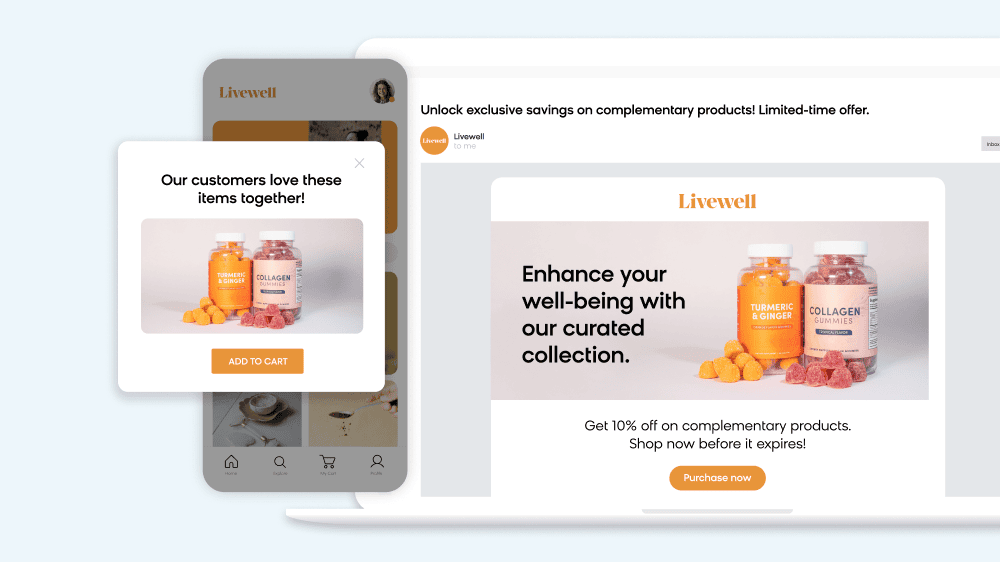
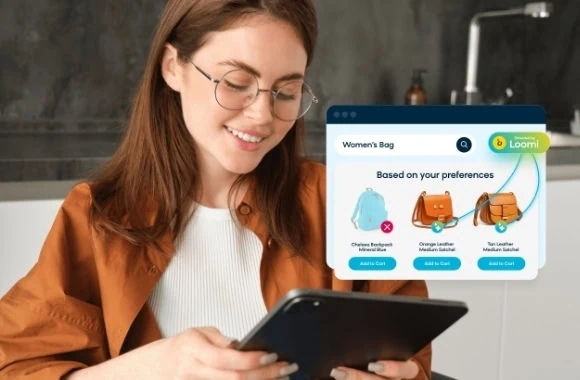
Personalization that runs on real-time intelligence — not yesterday’s data. Loomi AI for Shopify is a native integration between Shopify and Bloomreach that unifies customer data, product data, and commerce data so you can personalize every interaction — from search results to an email to an in-store moment — with the same real-time intelligence.
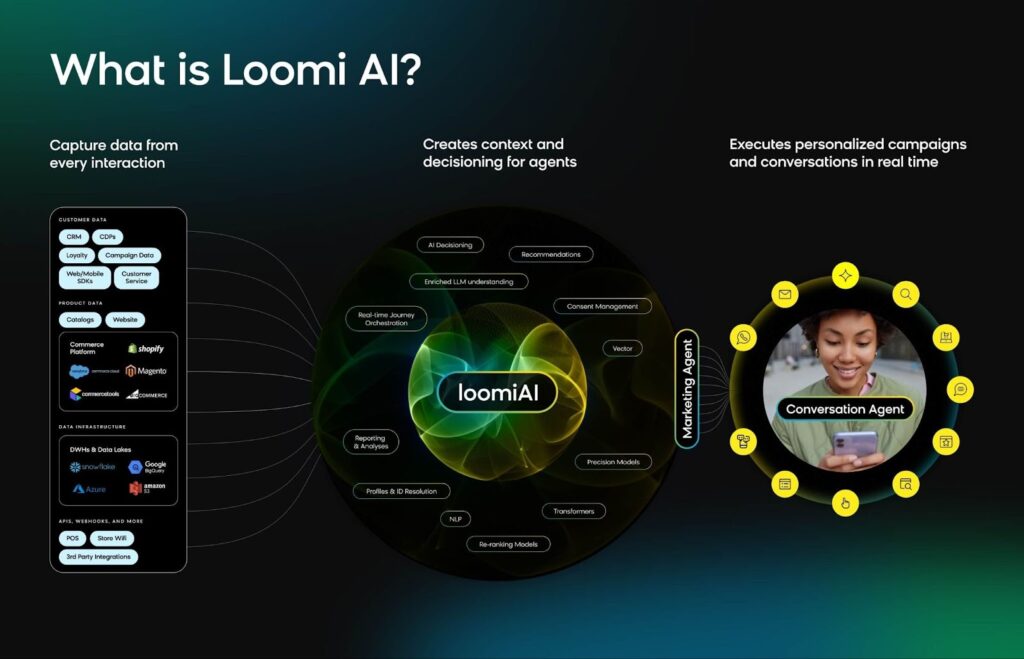
Unlike point solutions that force you to stitch together data, models, activation, and optimization, Loomi AI brings these critical components together with your Shopify commerce data in a single platform. The result: one place to create unique, seamless experiences for every shopper — including anonymous visitors.
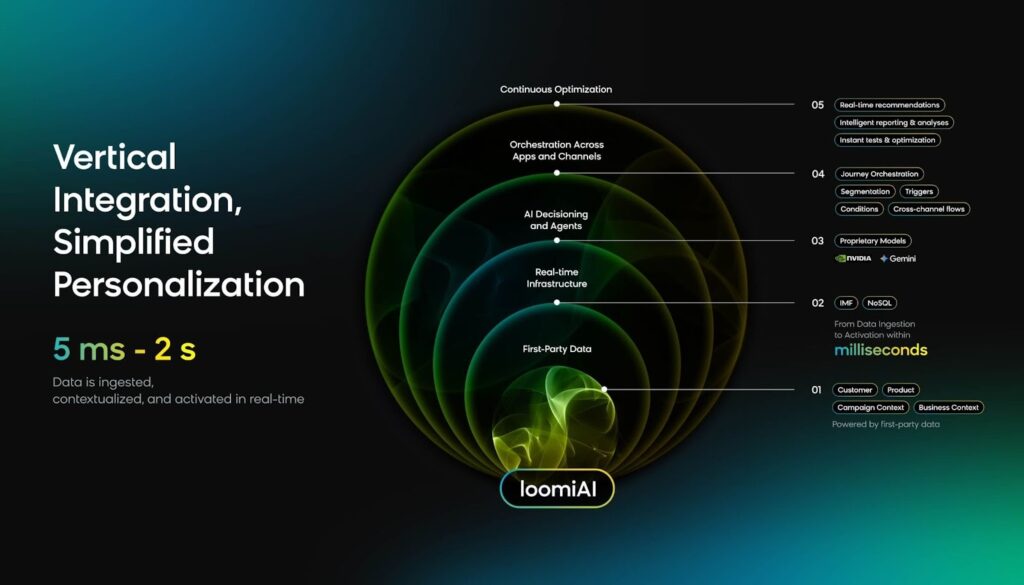
Under the hood, Loomi AI solves the fragmentation problem through five interconnected capabilities:
- First-party context – deep integration with Shopify’s transactional data, combined with full behavioral event capture (browse, search, cart, intent signals), builds a complete real-time customer profile that reflects not only what shoppers bought, but also what they browsed on site, what campaigns they engaged with, and what they searched and clicked.
- Real-time infrastructure – data ingestion to activation in 5ms–2s, so your storefront, triggered campaigns, and recommendations are always acting on current shopper intent.
- AI decisioning and agents – proprietary models and purpose-built agents determine the next best experience for each shopper automatically, turning intent into the right message, product, or offer.
- Scalability and orchestration – because personalization logic, customer data, and activation are unified in one platform, turning on a new channel is as simple as flipping a switch. Whether you’re expanding to in-store, shopping agents, or paid ads, there’s no rebuilding integrations, no re-training models, and no re-syncing data — your intelligence travels with the shopper across every touchpoint automatically.
- Continuous optimization – the system learns from every interaction, so your marketing performance and storefront get smarter over time without manual intervention.
The Personalization Imperative
The business case for getting unstuck is directly tied to revenue. Around 75% of customers are more likely to purchase from brands that deliver personalized experiences, and $2 trillion in revenue is projected to shift toward companies that master personalized commerce and communications.
Companies with a cohesive ecommerce strategy see up to 30% higher revenue growth – and those delivering seamless digital experiences report a 25% increase in customer satisfaction alongside a 20% boost in repeat purchases.
For marketing teams, personalization at scale requires a data and infrastructure foundation that most legacy stacks weren’t built to support. Brands that make the move now – to modern commerce infrastructure combined with a unified AI personalization platform – will be operating with a structural advantage that compounds over time.
The most common thing we hear from ecommerce and marketing leaders who’ve been through the migration journey is that they wish they’d started sooner. Operating on a modern, unified stack fundamentally changes what their team can do.
If your engineers are spending more time keeping the lights on than innovating, if your segmentation is still based on static lists, or if launching a new personalization experience requires a cross-functional project plan – it may be time to ask what “stable” is actually costing you.
Maze and Bloomreach help enterprise brands answer that question and build a path forward. Get “unstuck” with Maze and Bloomreach today.