Most marketing teams aren’t understaffed. They’re just spending too much time on work that shouldn’t require them.
Rebuilding the same campaign structures. Manually defining segments that will be stale by next week. Waiting on A/B results before making changes that could’ve been made automatically. It’s execution overhead that compounds, and it comes directly at the expense of strategic thinking.
Agentic marketing moves that execution layer to AI. You set the goal. The agent identifies the audience, builds the campaign, and adapts it mid-flight. Here’s what’s actually happening under the hood.
Agentic Marketing, Defined
Agentic marketing is what happens when you give an AI system a goal instead of a script.
Traditional marketing automation executes the logic you built: if this event happens, send this email. The marketer still does the thinking. Agentic marketing inverts that. You define the outcome you want, and the system figures out how to get there (which customers to reach, on which channels, with what message, at what time).
The AI agents doing this work aren’t chatbots or content generators. They’re goal-directed systems that perceive their environment (your customer data, catalog, and behavioral signals), reason through options, take action, and adjust based on what happens. MIT Sloan describes agentic AI as AI that “pursues goals across sequences of decisions”, which is exactly what distinguishes it from single-task AI tools.
What agentic marketing is not: it’s not a smarter email template builder. It’s not trigger-based automation with an AI subject line suggestion. It’s not a rules engine with a GPT wrapper. Those tools still depend on humans to define the strategy. Agentic marketing moves the strategy layer into the AI itself.
How Agentic Marketing Works: The Four-Step Loop
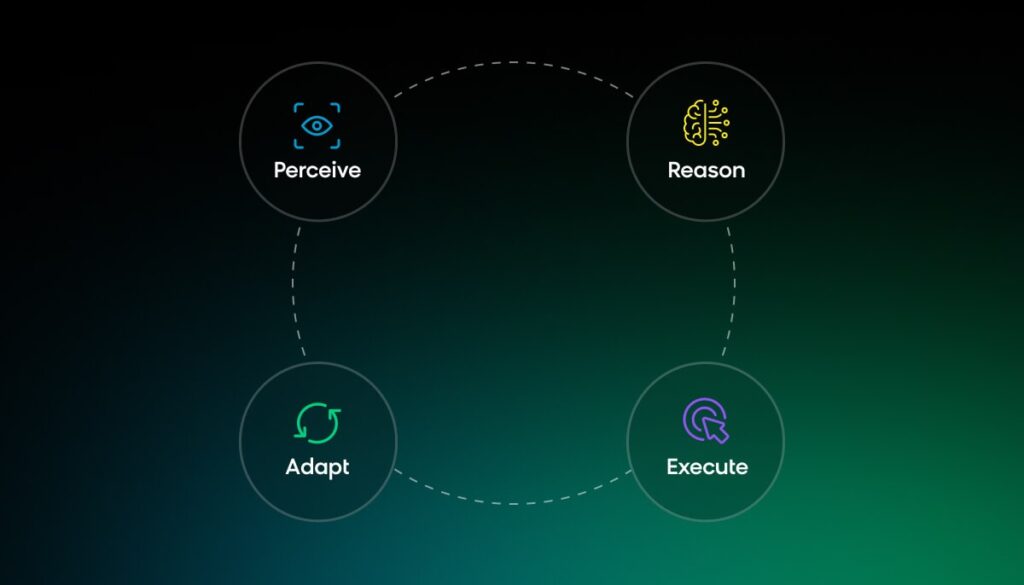
The mechanism that separates agentic marketing from everything that came before it is a continuous loop. Here’s what each step actually means in practice.
Perceive
The agent reads real-time customer data: behavioral signals, purchase history, product catalog state, channel engagement, and consent status. This isn’t a batch process that runs overnight. The agent is continuously monitoring what customers are doing, which products are trending, and which segments are showing early intent signals.
Reason
Given the objective you’ve set (“re-engage lapsed buyers from Q1” or “maximize revenue from our new product drop”), the agent works out which customers to target, what message would be most relevant to each segment, which channel is most likely to drive a response, and how to structure the campaign. It’s not pulling from a pre-written playbook. It’s reasoning from the data in front of it.
Execute
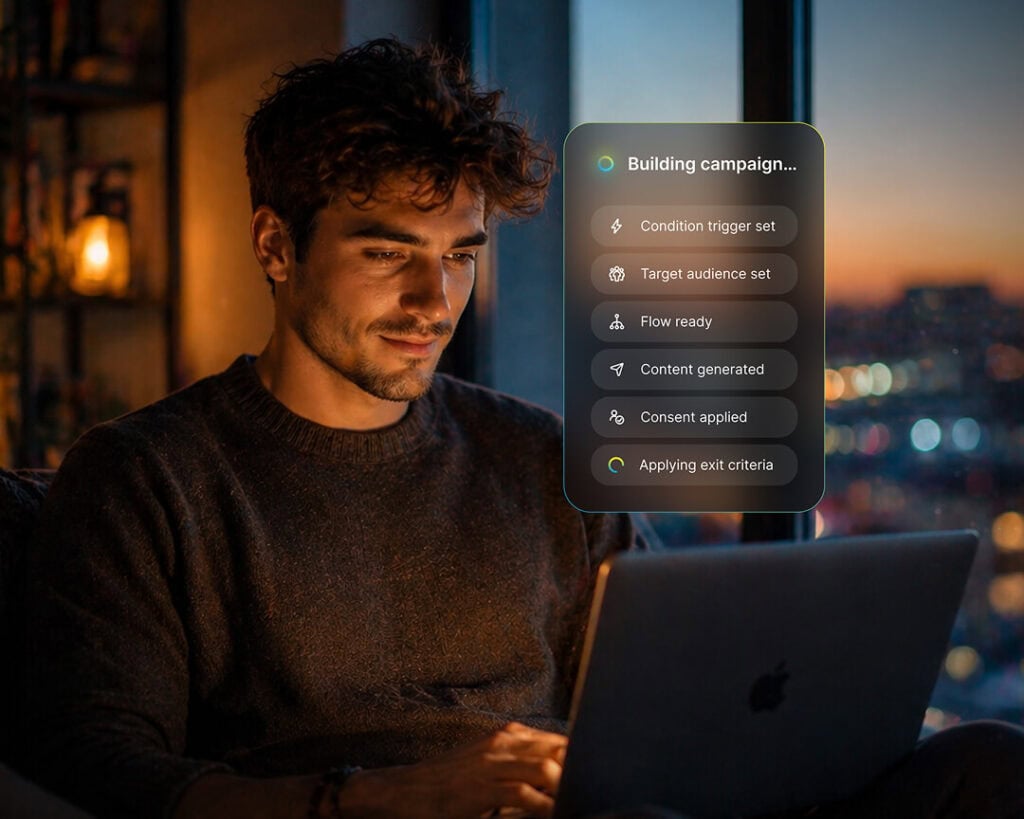
The agent builds the campaign: audience segments, content, send timing, and deployment logic. Then it runs it. No human is mapping out the workflow in a drag-and-drop builder. No one is manually defining inclusion/exclusion criteria. The output is a live, running campaign.
Adapt
This is the step that most clearly separates agentic marketing from automation. After a campaign launches, the agent checks which subject lines are driving opens, identifies that a specific age cohort responds better to urgency framing, and shifts content weighting on the next send, automatically. It doesn’t wait for a human to review dashboards and queue up a new A/B test.
McKinsey’s research on agentic marketing workflows highlights that this kind of multi-step, self-adjusting execution is what distinguishes agentic AI from the single-task AI tools that have dominated martech for the past decade.
The four-step loop: Perceive → Reason → Execute → Adapt Each cycle feeds the next. The agent gets more accurate with every campaign it runs because it carries forward what it learned about what worked.
For a deeper look at how this loop changes actual marketing workflows, the implications go well beyond campaign speed.
Agentic Marketing vs. Marketing Automation: What’s Actually Different
The core distinction is simple: marketing automation follows rules you wrote; agentic marketing pursues goals you set.
When you build a marketing automation workflow, you’re essentially writing a decision tree. If a customer abandons a cart, wait two hours, then send email A. If they don’t open in 24 hours, send email B. You’ve done the thinking. The automation executes your logic faithfully, at scale.
Agentic marketing removes you from that decision tree entirely. You tell the system what you’re trying to achieve, and the agent determines the path. HBR’s research on redesigning marketing organizations for the agentic age frames this as a fundamental shift in where cognitive work lives, moving it from the marketer to the AI.
Here’s what that looks like across five practical dimensions:
| Dimension | Marketing Automation | Agentic Marketing |
|---|---|---|
| Campaign initiation | Triggered by an event or rule you pre-defined | Initiated by an objective or prompt you provide |
| Audience targeting | Targets a segment you manually defined | Agent identifies the highest-propensity audience dynamically from the full customer base |
| Content | Template with variable substitution (e.g., first name, product name) | Agent builds content logic matched to individual context and behavioral signals |
| Optimization | A/B testing requires human setup, monitoring, and follow-up action | Agent self-optimizes mid-campaign within guardrails you’ve defined |
| Scaling | More campaigns mean more human configuration time | Campaigns scale without adding configuration effort from the team |
A note on framing: marketing automation isn’t broken. It was the right tool for what teams could do before agentic platforms existed, and it still handles plenty of use cases well. The shift is additive. You’re not ripping out automation infrastructure; you’re adding a layer that handles the high-effort, high-volume campaign work your team currently does by hand.
What changes is where your marketers spend their time. Teams using automation are still doing most of the strategic thinking for every campaign. Agentic marketing transfers that cognitive load to the AI, which means your team can think at a higher level: setting goals, defining guardrails, evaluating results, and making creative calls that require human judgment.
What Agentic Marketing Platforms Actually Do
If you’re building a shortlist of platforms, “AI-powered” on a vendor website tells you almost nothing. The five capabilities below are what to actually evaluate, but they don’t carry equal weight. Goal-driven campaign creation and real-time adaptation are the baseline; any platform making agentic claims should have both. Where platforms genuinely diverge is multi-agent orchestration, cross-channel execution, and the depth of first-party data access underlying everything else.
Goal-Driven Campaign Creation
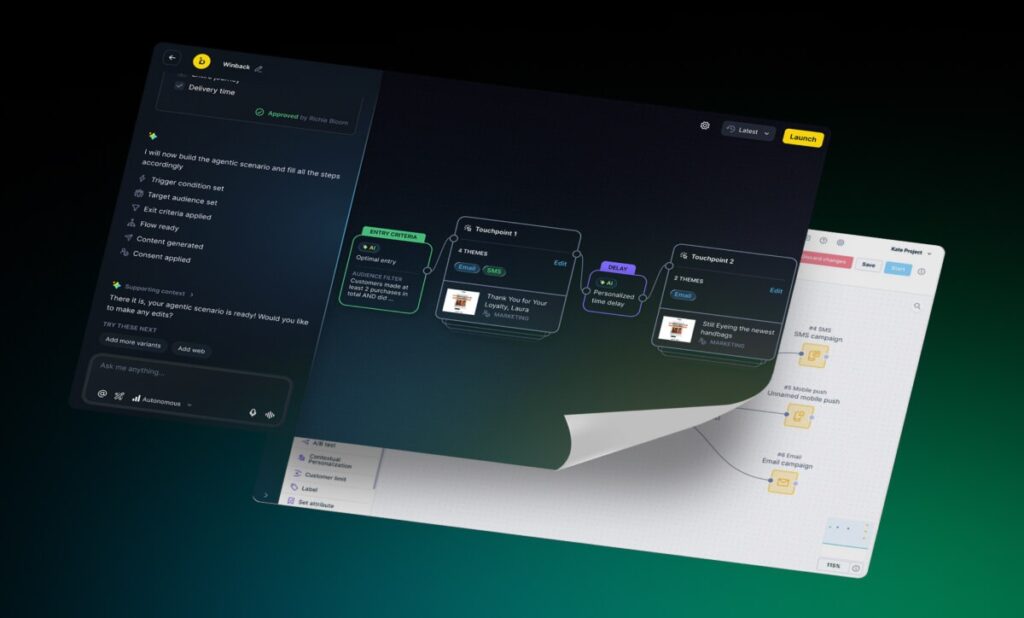
You input a business objective. “Re-engage customers who bought in Q4 but haven’t returned.” “Drive first purchase from email subscribers acquired in the last 90 days.” The agent handles audience identification, message construction, and deployment without requiring you to configure each step manually. Our Loomi Marketing Agent is built around this model, with a prompt in and a live campaign out.
Autonomous Audience Segmentation
Rather than targeting a segment you’ve manually defined, the agent analyzes the full customer database and identifies high-propensity subsets in real time. This matters because static segments age quickly. An agent that dynamically identifies the right audience at the moment of campaign creation captures intent that a manually built segment would miss.
Multi-Agent Orchestration
Enterprise-scale agentic marketing doesn’t run on a single agent. Multiple agents work in parallel, one managing email, one handling SMS, one adjusting web personalization, all coordinated toward the same business goal. MIT Sloan’s research on the emerging agentic enterprise identifies this kind of coordinated multi-agent architecture as the differentiating pattern in organizations that are getting meaningful business results from AI, versus those running isolated pilots.
Real-Time Adaptation
An agent that can only optimize after you review a report is closer to automation than true agentic behavior. The capability that matters is mid-campaign adjustment: the agent monitors performance as it runs and changes send timing, content weighting, or audience criteria based on what’s working, without waiting for a human to act. Timing is one dimension — the agent applies the same real-time adjustment to content weighting and audience criteria within the same running campaign, beyond the send clock.
Cross-Channel Execution
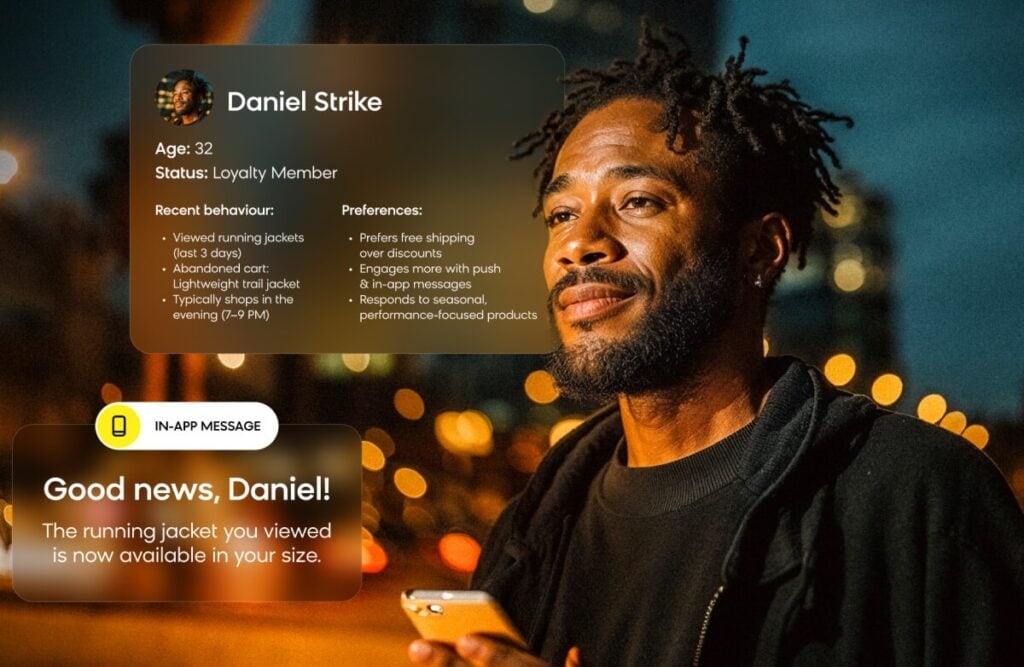
The agent deploys across email, SMS, push notifications, and on-site without requiring you to build a separate workflow for each channel. This is where agentic personalization becomes meaningful at scale: the agent selects the channel most likely to drive a response from each individual customer, drawing on that person’s own behavioral signals rather than segment-level averages.
The distinction worth holding onto: on a genuine agentic platform, the output isn’t a draft for a marketer to review. The output is a live, running campaign.
Agentic Marketing in Practice: What Early Adopters Are Seeing
These aren’t case studies from early pilots. The brands below are running agentic marketing at scale right now.
Revolution Beauty: 5x Revenue Per Email
Revolution Beauty spans 13 brands with a fast-moving product calendar and a lean marketing team. The challenge was familiar: too many campaigns to build, not enough time to build them properly. Long campaign cycles couldn’t keep pace with new product launches and promotions, and the team had no bandwidth to experiment with new formats.
The brand used Loomi Marketing Agent to change the ratio. Instead of team members configuring each campaign from scratch, they told the agent which campaigns they wanted to build and let the AI handle audience segmentation, targeting logic, and email execution.
The results moved fast. Revolution Beauty 5x more revenue per email, and over 5% of total email revenue is being produced by autonomous AI-created campaigns built and run without manual campaign configuration.
Sideshow: Campaign Idea to Launch in Under 15 Minutes
Sideshow is a global pop culture collectibles retailer managing dozens of product drops per month with a small team. The previous process, manual campaign builds for each new drop, couldn’t scale without adding headcount.
After adopting Loomi Marketing Agent, Sideshow moved from multi-day manual builds to prompt-driven campaign creation. The results include going from campaign idea to live launch in under 15 minutes, a 2x increase in value per email delivered, and 13.9% of email revenue directly attributed to Loomi Marketing Agent.
260 Sample Sale: 2.4x Higher Conversion Rate With AI-Powered Audience Targeting
260 Sample Sale features over 400 brands a year across retail and online, running flash sales that demand fast, precise marketing execution. The challenge: a contact list of over 900k customers and a marketing team spending nearly a full FTE’s worth of hours every week on manual copywriting, audience segmentation, and campaign assembly — leaving no capacity for anything strategic.
The brand deployed Loomi Marketing Agent to automate their most time-intensive campaigns, starting with their weekly Last Chance email. Instead of manually combing through data to build send lists, the agent analyzed the full customer database in real time and identified the 36k highest-propensity buyers for each flash sale — a level of precision that was impossible to achieve manually at that frequency. Abandoned cart flows were also handed off to the agent, triggering personalized sequences based on each shopper’s browsing and purchase history without any manual rebuild required.
The results were direct and measurable. The agent-powered Last Chance campaign achieved a 2.4x higher conversion rate than the previous manual send, reaching just 18% of the previous audience size while generating $10k more in revenue. Across all AI-powered campaigns, 260 Sample Sale attributed over $580k in total revenue to Loomi Marketing Agent, including $12k in incremental abandoned cart revenue in the first 30 days alone.
“Having Loomi AI create the campaigns for us is great because it’s an AI tool that can find the right people and build the segments better than a human would have,” said Laura DiGiovanna, Head of Marketing at 260 Sample Sale.
What Agentic Marketing Actually Means for Your Team and Tech Stack
After seeing what agentic marketing can do, the question many senior marketers arrive at is the same: “What does this actually mean for my people and my existing stack?”
What changes for your team
Agentic marketing doesn’t reduce headcount. It changes what those people work on. Marketers shift from campaign builders to campaign strategists. Instead of spending hours configuring audience logic and building send sequences, they’re setting objectives, defining guardrails, reviewing outputs for brand alignment, and making creative decisions that AI can’t make well on its own. The cognitive work that required senior judgment before still requires it. What goes away is the repetitive execution work underneath it.
McKinsey’s research on agentic marketing workflows and HBR’s analysis of organizational redesign for the agentic age both point to the same implication: the most significant shift isn’t in the tools, it’s in where marketers spend their attention.
What your tech stack needs
An agent is only as good as the data it can access. Agentic marketing requires a unified data layer: customer profiles, behavioral events, product catalog, and consent data all accessible to the same system. If those live in separate tools with no unified view, an agent cannot reason across them effectively. This is the prerequisite question most enterprise teams hit before any vendor evaluation goes far. Evaluating your data foundation is step one, not step three.
Where to start
Don’t try to replace every automation on day one. The best entry point is identifying two or three high-volume campaigns your team rebuilds manually every week or month. Those repetitive, resource-heavy campaigns are the right first candidates for agentic execution. Run the agent’s output alongside your existing manual sends, measure lift against your own baseline, and build the business case from real numbers before scaling. For teams thinking through cross-channel execution, starting with a single channel and proving lift there first is generally faster than trying to orchestrate everything simultaneously.
Three questions to ask any agentic marketing vendor:
1. Does the agent work from my first-party data natively, or does it require exporting data to a separate system?
2. Can I define the guardrails for what the agent can and cannot do, covering channels, spend limits, and content rules?
3. How does the platform attribute results back to specific agent decisions, so I know what’s actually driving performance?
Getting Started With Agentic Marketing
There’s a practical sequence to this that makes adoption faster and the business case cleaner.
Step 1: Audit your highest-effort, lowest-strategy campaigns
Start by identifying the campaigns your team rebuilds manually on a recurring basis. Weekly promotional emails, monthly re-engagement sends, product drop announcements that follow the same structure every time. These are the first candidates for agentic execution because the lift is immediate and measurable against a clear baseline.
Step 2: Evaluate your data foundation
An agentic marketing system needs unified customer profiles to function as described. Before buying anything, assess whether your customer behavioral data, purchase history, product catalog, and consent signals are accessible from a single place. If they’re not, that’s the prerequisite to address first. The Loomi AI platform is built around this unified data model, which is what allows agents to reason across the full customer picture rather than operating on incomplete information.
Step 3: Prove lift on one use case before scaling
Pick one high-impact, high-volume flow. Run the agent. Measure against your existing manual baseline. The brands seeing results aren’t the ones who tried to transform their entire stack at once; they’re the ones who proved value on a single use case and expanded from there.
We built Loomi Marketing Agent specifically for brands that want to move from automation to agentic execution. The case studies in this article are from brands that started exactly where you are now.
See how Loomi Marketing Agent works
Or read more about agentic personalization if you want to go deeper on the personalization layer before booking a conversation.
Frequently Asked Questions
What is agentic marketing?
Agentic marketing is the practice of deploying AI agents to autonomously plan, build, execute, and optimize marketing campaigns from a single business objective. You give the system a goal; it handles audience identification, content construction, channel selection, and campaign execution without requiring step-by-step human configuration. Unlike marketing automation, which runs the rules you’ve written, agentic marketing systems reason through the best approach and adapt based on results.
How is agentic marketing different from marketing automation?
Marketing automation follows rules you define in advance. If a customer does X, the system does Y. Agentic marketing works from a goal you set, and the AI determines the how. The four-step loop (perceive, reason, execute, adapt) is what makes this different in practice: the agent monitors performance and adjusts mid-campaign within the guardrails you’ve defined, rather than firing and waiting for a human to review results. The marketer shifts from building campaign logic to setting objectives and reviewing outcomes.
Do I need to replace my existing marketing automation to use agentic marketing?
No. The brands seeing results from agentic marketing didn’t rip out their existing automation infrastructure to get there. Agentic marketing is additive – it handles the high-volume, high-effort campaign work your team currently builds by hand, while your existing automation continues running the trigger-based flows it already handles well. The practical starting point is identifying two or three recurring campaigns your team rebuilds manually every week or month, running the agent on those, and measuring lift against your own baseline. You expand from proven results rather than replacing everything at once.
Do I need to replace my existing marketing automation to use agentic marketing?
No. The brands seeing results from agentic marketing didn’t rip out their existing automation infrastructure to get there. Agentic marketing is additive – it handles the high-volume, high-effort campaign work your team currently builds by hand, while your existing automation continues running the trigger-based flows it already handles well. The practical starting point is identifying two or three recurring campaigns your team rebuilds manually every week or month, running the agent on those, and measuring lift against your own baseline. You expand from proven results rather than replacing everything at once.
How do agentic marketing platforms work?
An agentic marketing platform needs three things to function as described: access to unified customer profiles, real-time behavioral data, and product catalog information. With those inputs, the agent can reason about which customers to target, what message would be most relevant, and which channel is most likely to drive a result. Goal-driven campaign creation, autonomous segmentation, real-time adaptation, and cross-channel execution are the core capabilities to evaluate. Platforms that require humans to configure each step in a workflow are automating execution, not reasoning through strategy.
What is the future of agentic marketing?
Brands building an agentic marketing foundation now are accumulating a compounding advantage. Every campaign the agent runs teaches it more about what works for which customer segments, which means performance improves over time without additional human input. The next frontier is multi-agent orchestration across the full commerce funnel, where marketing agents, search agents, and shopping agents coordinate toward a single business outcome. That’s already where enterprise platforms are moving. Agentic commerce is where this is heading – and brands building agentic marketing infrastructure now will have a meaningful head start when full-stack orchestration across marketing, search, and shopping agents becomes standard.