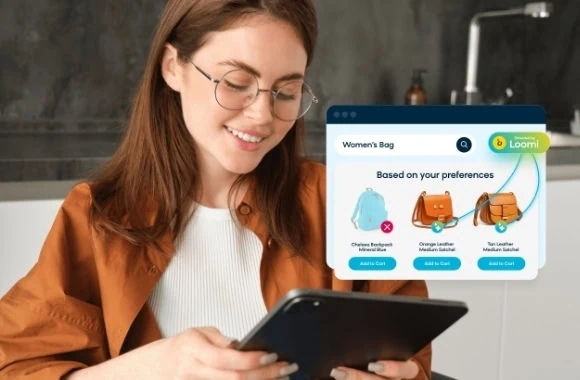

Omnichannel commerce gets discussed as if it’s an end state, something a brand either achieves or hasn’t yet. The reality is more useful: omnichannel is a capability, not a destination, and according to Manhattan Associates’ latest benchmark, only 7% of specialty retailers have reached full maturity.
The original promise (meet customers wherever they are, with a consistent experience) hasn’t changed since the term gained traction in the early 2010s. What has changed is the technology available to actually deliver on it, the customer expectations surrounding it, and the cost of getting it wrong.
This guide breaks down what omnichannel ecommerce means in practice, how it differs from multichannel, the measurable benefits it delivers, the challenges that trip up most brands, and how to build a strategy that holds together across channels.
What Is Omnichannel Commerce?
Omnichannel commerce is a multi-faceted approach to sales focused on providing seamless customer experiences across multiple channels. The goal is to create a consistent experience at every touchpoint, whether the customer is shopping online from a mobile device, on a laptop, or in a brick-and-mortar store.
The data makes the case clearly: research from Grocery Doppio, Incisiv, and FMI found that omnichannel shoppers spend 1.5x more than single-channel buyers ($1,043 vs. $659-669 per month in a study of 5,100+ grocery shoppers), and they’re 3x more loyal, tolerating 4.2 bad experiences before churning compared to just 1.3 for digital-only customers.
The takeaway: customers who interact with your brand across multiple channels are more valuable, more forgiving, and more likely to come back. A good omnichannel strategy focuses on the entire customer experience, not the customer’s individual experiences on different channels.
Omnichannel vs. Multichannel vs. Single-Channel
There are important differences between omnichannel and multichannel commerce. Here’s how to think about each:
- Single-channel commerce means selling through one channel only. This could be a brick-and-mortar store, a webshop, or a marketplace like eBay. It can work perfectly well, but limits how customers can engage with your brand.
- Multichannel commerce means selling on multiple channels, both online and offline. You interact with customers via social media, by phone, and in your physical store. Your online presence is solid and your customers know where to find you. Multichannel is a strong foundation for brand engagement.
-
Omnichannel commerce also operates across multiple channels, which is where the confusion comes in. The key difference: omnichannel connects all channels so customers have a consistent experience across every platform. Without multichannel, there’s no omnichannel. But omnichannel adds the connective tissue that makes the whole greater than the sum of its parts.

Now, let’s see what omnichannel commerce can do for your business.
Benefits of Omnichannel Commerce
Omnichannel commerce integrates multiple platforms to create a cohesive customer journey across online and offline channels. The result: increased sales opportunities, stronger loyalty, and better operational efficiency.
Here are the five core benefits of a high-performing omnichannel commerce strategy.
Better Customer Experience
What do customers expect above all else? Consistency. Salesforce’s “State of the Connected Customer” report found that 70% of customers expect every company representative to have the same information about them, regardless of channel. When a customer contacts support after browsing your site, they expect that context to carry over.
As the number of touchpoints increases, so does the need for seamless integration between them, whether it’s a social ad, an email newsletter, a mobile push notification, a conversation with your chatbot, or a face-to-face chat with store staff.
By connecting channels rather than siloing them, you empower customers to interact with your brand in a way that feels natural. That’s the foundation of a genuinely customer-centric approach and a better ecommerce customer experience overall.
Higher Sales and Revenue
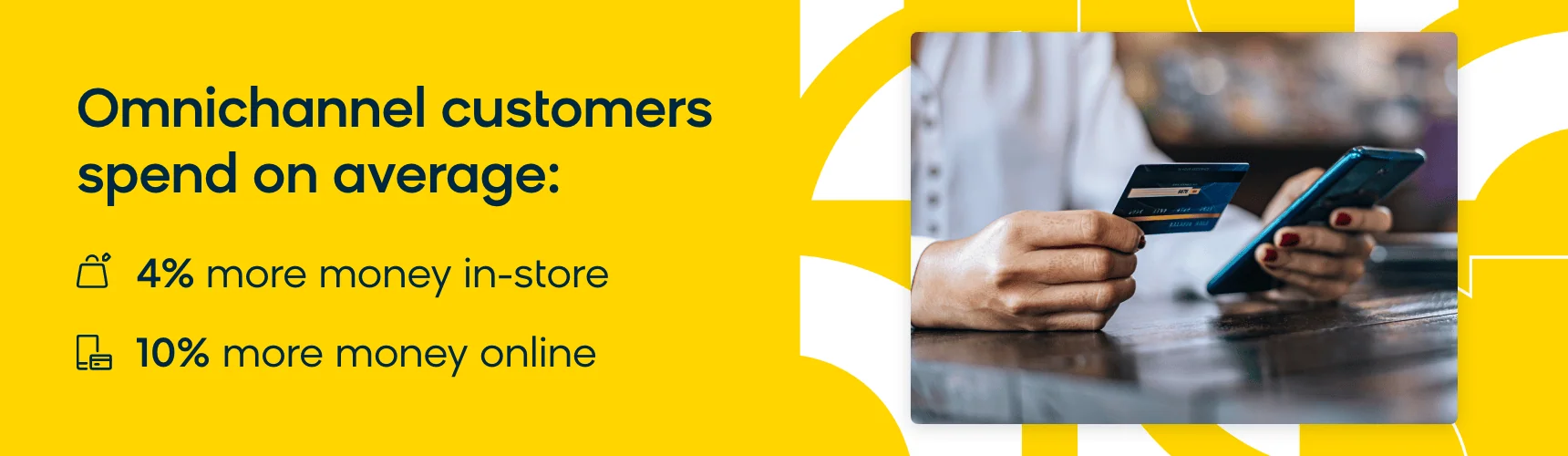
Omnichannel customers spend more. Research from Grocery Doppio and Incisiv found that omnichannel shoppers spend $1,043 per month compared to $659-669 for single-channel buyers. And with every additional channel they used, shoppers spent more.
[DESIGN TEAM: Replace omnichannel-spending.png — current graphic shows old HBR data. New graphic should reflect Grocery Doppio/Incisiv figures: $1,043 vs. $659-669 monthly spend, omnichannel vs. single-channel buyers.]
The pattern extends beyond individual spend. Manhattan Associates’ 2026 Unified Commerce Benchmark found that retailers with mature omnichannel capabilities achieve nearly 2x higher growth rates than those still operating with basic, disconnected systems. More connected touchpoints create more opportunities to convert and retain, and the compounding effect is significant.
This is where a unified intelligence platform makes a practical difference. When data flows between email, web, app, and in-store, every channel becomes smarter. We call this compound value: the measurable lift one channel brings to another when they share the same customer context. It’s the core principle behind Loomi AI, Bloomreach’s intelligence platform, which connects customer data, AI decisioning, and channel orchestration in a single system.
Stronger Customer Loyalty
Omnichannel customers spend more and stick around. The same Grocery Doppio/Incisiv study found that omnichannel buyers are 3x more loyal than digital-only customers, tolerating more friction before switching to a competitor.
They were also more likely to recommend the brand to family and friends than those who used a single channel. With a consistent, connected brand experience, you can build loyalty that doesn’t depend on discount coupons or mid-sale campaigns.
Building omnichannel loyalty programs that recognize customers across touchpoints is one of the most effective ways to reinforce this behavior. When a customer’s in-store purchase triggers a personalized follow-up email, or their browsing history informs their app experience, that continuity builds trust.
Better Data and Personalization
Tracking customer behavior across channels gives you a complete picture of preferences, intent, and purchase patterns. That unified view is what makes real omnichannel personalization possible.
With a single customer view, you can create content and offers that match where a customer actually is in their journey, not where you assume they are based on one channel’s data. This turns generic campaigns into relevant, timely interactions.
We power this with Bloomreach Data Engine, which unifies customer data across every touchpoint and makes it actionable for omnichannel orchestration and personalization at scale. The result: customers find what they need faster, conversion rates improve, and you stop guessing what works.
Streamlined Operations and Inventory
A mature omnichannel approach doesn’t just improve the customer side; it tightens operations. Retailers that achieve high maturity in unified commerce report 27% lower fulfillment costs and 18% reduced cart abandonment, according to Manhattan Associates.
Integrated inventory systems give you better stock visibility across all channels, leading to more accurate demand forecasting. That means fewer stockouts, less overstock, and a supply chain that adapts to actual demand rather than lagging behind it.
The operational gains extend to cost optimization across the business. When channels share infrastructure, you eliminate redundancies in fulfillment, customer service, and marketing operations.
Common Omnichannel Challenges
The case for omnichannel is clear, but most brands hit the same friction points before they see results. Understanding these challenges upfront helps you build a strategy that addresses them rather than discovering them mid-implementation.
Data Silos Across Channels
This is the number one barrier. A DATAVERSITY survey found that 68% of organizations cite data silos as a top concern, a significant increase from prior years. When your email platform, website analytics, in-store POS, and customer service tools each hold separate fragments of customer data, you can’t deliver a connected experience.
The fix starts with a customer data platform that consolidates behavioral, transactional, and profile data into a single, real-time view. Without that foundation, omnichannel personalization remains aspirational.
Inventory Synchronization
Selling across online, in-store, and marketplace channels means inventory has to be accurate everywhere, in real time. A customer who sees “in stock” online but arrives to an empty shelf doesn’t come back.
Unified inventory management requires systems that update stock counts across channels within seconds of a transaction, not hours. This is where the operational and customer experience sides of omnichannel converge.
Measuring Cross-Channel Attribution
When a customer sees an Instagram ad, browses on mobile, gets an email reminder, and purchases in-store, which channel gets credit? Traditional last-click attribution breaks down in an omnichannel world.
Brands need attribution models that account for the full journey. Cross-channel marketing platforms that track unified customer profiles across touchpoints make this measurable rather than theoretical.
Technology Stack Complexity
Most retailers are still juggling disconnected systems that were never designed to work together. As we explore in the 2026 trends section below, Manhattan Associates found that only 7% of specialty retailers achieve true unified commerce maturity. The rest are stuck managing fragmented stacks.
The path forward is a platform approach rather than point solutions. When your marketing automation, product discovery, and customer data share the same intelligence layer, integration becomes a solved problem rather than an ongoing project.
Personalization in Omnichannel Commerce
Your customers expect a personalized experience at every channel and touchpoint. Today’s consumers want quality products fast, with easy access to the information they need to buy. They want to search products easily, compare prices, and see recommendations that actually reflect their preferences.
Among the volume of content and offers competing for attention, personalized experiences cut through. Generic content gets ignored. Relevant content earns engagement.
Personalization is no longer a nice-to-have. It’s a baseline expectation. Yves Rocher saw an 11x better conversion rate by implementing real-time personalized recommendations, a concrete example of what’s possible when personalization is backed by the right data infrastructure.
We power personalization with Bloomreach Data Engine and Loomi AI, which unify your customer and product data, then activate it across every channel in real time (from data ingestion to activation in 5ms-2s). The result: personalization that drives growth rather than guesswork.
The outcome: customers find what they need faster, satisfaction increases, and businesses see measurable lifts in conversion rate across every connected channel.
How AI Is Transforming Omnichannel Commerce
AI has moved from a theoretical advantage to practical infrastructure for omnichannel commerce, and Loomi AI is built specifically to bridge the gap between offline and online channels. Where legacy systems rely on rule-based automation, Loomi AI learns, adapts, and acts autonomously across every touchpoint.
Unified customer intelligence. Rather than running separate models for email engagement, site behavior, and purchase history, Loomi AI connects these signals into a single real-time view of each customer, then acts on it across channels simultaneously.
Conversational shopping. AI-powered conversational commerce is reshaping how customers discover and buy products. Our conversational shopping agent uses customer context and product data to guide shoppers through natural-language interactions, answering questions and making recommendations based on their actual preferences and history.
Predictive orchestration. Rather than relying on static rules to determine when and how to engage customers, AI predicts the optimal channel, timing, and message for each individual. This is where omnichannel messaging and personalization at scale moves from theory to practice.
Inventory and operations. AI algorithms predict demand trends across channels, helping you plan ahead and ensure customers find what they need whether they’re shopping online or in-store. This connects directly to the fulfillment cost reductions that mature unified commerce delivers.
Brands achieving the highest omnichannel ROI are those treating AI as the connective layer between channels, not as a feature bolted onto individual touchpoints. For a deeper look at practical applications, see our guide to AI in omnichannel marketing.
Building Your Omnichannel Commerce Plan
Shifting from single-channel or multichannel to a fully connected omnichannel experience takes investment, but the returns justify it. The challenges above (data silos, inventory sync, attribution complexity, and stack fragmentation) are all addressable with the right approach. Here’s a practical framework:
Get to know your customer. Don’t make assumptions. Research your target audience’s interests, behavior, and needs. Ask them questions, invite feedback, and use social listening tools to understand what they actually want, not what you think they want.
Map the customer journey. Identify every touchpoint where customers interact with your brand, from first discovery through post-purchase. Plan where they should be going and what they should encounter at each stage. Build a comprehensive omnichannel engagement strategy around this map.
Select the right channels. Not every channel matters equally for your audience. Find out where your customers spend their time and focus your resources there. A strong presence on three well-connected channels beats a fragmented presence on eight.
Define a purpose for each channel. Each channel should have a clear role: one for interaction, another for news, another for post-purchase support. When channels have distinct purposes but share customer context, the experience feels intentional.
Connect all channels. This is the hard part, and it only works with the right technology. You need a platform that follows your customer across touchpoints, from reading reviews on your website to seeing social ads to purchasing in-store. Marketing automation powered by a unified intelligence layer makes this coordination possible without manual orchestration.
Maintain and iterate. Keep testing and improving your strategy. Document touchpoints, measure performance, and optimize where channels underperform. A successful omnichannel customer engagement strategy is never finished; it evolves with your customers.
Track performance and optimize. Some channels will outperform expectations, others won’t. Track cross-channel attribution to understand where your strategy delivers and where it falls short. Use that data to reallocate resources and refine your approach over time.
Building Your Omnichannel Commerce Plan
Shifting from single-channel or multichannel to a fully connected omnichannel experience takes investment, but the returns justify it. The challenges above (data silos, inventory sync, attribution complexity, and stack fragmentation) are all addressable with the right approach. Here’s a practical framework:
Get to know your customer. Don’t make assumptions. Research your target audience’s interests, behavior, and needs. Ask them questions, invite feedback, and use social listening tools to understand what they actually want, not what you think they want.
Map the customer journey. Identify every touchpoint where customers interact with your brand, from first discovery through post-purchase. Plan where they should be going and what they should encounter at each stage. Build a comprehensive omnichannel engagement strategy around this map.
Select the right channels. Not every channel matters equally for your audience. Find out where your customers spend their time and focus your resources there. A strong presence on three well-connected channels beats a fragmented presence on eight.
Define a purpose for each channel. Each channel should have a clear role: one for interaction, another for news, another for post-purchase support. When channels have distinct purposes but share customer context, the experience feels intentional.
Connect all channels. This is the hard part, and it only works with the right technology. You need a platform that follows your customer across touchpoints, from reading reviews on your website to seeing social ads to purchasing in-store. Marketing automation powered by a unified intelligence layer makes this coordination possible without manual orchestration.
Maintain and iterate. Keep testing and improving your strategy. Document touchpoints, measure performance, and optimize where channels underperform. A successful omnichannel customer engagement strategy is never finished; it evolves with your customers.
Track performance and optimize. Some channels will outperform expectations, others won’t. Track cross-channel attribution to understand where your strategy delivers and where it falls short. Use that data to reallocate resources and refine your approach over time.
Omnichannel Commerce Trends in 2026
The omnichannel landscape is shifting in several directions at once. Here are the trends reshaping how brands connect with customers this year.
Conversational Commerce Goes Mainstream
AI-powered shopping assistants are moving from novelty to expectation. The U.S. conversational commerce market is projected to grow from $3.2 billion in 2025 to $12 billion by 2035, at a 14.1% CAGR. Customers increasingly expect to ask questions, get recommendations, and complete purchases through natural-language interactions rather than traditional search and browse.
Unified Commerce Replaces Omnichannel Buzzwords
The industry is moving from talking about omnichannel to actually measuring it. Manhattan Associates’ 2026 Global Unified Commerce Benchmark assessed 400+ specialty retailers across 330 capabilities. The finding: only 7% qualify as “leaders.” The gap between ambition and execution is still enormous, which means brands that close it have a meaningful competitive advantage. Bloomreach’s platform approach (unifying customer data, AI decisioning, and channel orchestration in a single intelligence layer) is designed to close exactly this gap.
Social Commerce Matures
Social commerce is projected to grow from $2 trillion in 2025 to $8.5 trillion by 2030, according to a SellersCommerce analysis of Statista and eMarketer data. Platforms like TikTok Shop, Instagram Shopping, and YouTube Shopping are becoming full purchase channels, well beyond discovery. Integrating social commerce into your omnichannel strategy means treating these platforms as full sales channels with customer data flowing back to your core systems. A unified data platform like Bloomreach Data Engine ensures social interactions inform every other touchpoint.
Composable Architecture Enables Flexibility
Brands are increasingly moving away from monolithic commerce platforms toward composable commerce architectures. This approach lets you swap individual components (search, personalization, content management) without rebuilding the entire stack. The advantage for omnichannel: composable systems make it easier to integrate AI across every touchpoint and add new channels without starting from scratch.
Omnichannel Commerce Success Stories
Yves Rocher
Challenge: Yves Rocher, a worldwide cosmetics and beauty brand focused on sustainability, wanted to provide better personalized product recommendations to both returning customers and first-time visitors.
Solution: Yves Rocher implemented our marketing automation platform for its real-time personalized recommendations. While most companies can’t do much for first-time visitors due to a lack of data history, our algorithms created personalized recommendations as soon as a visitor interacted with a product on the site, within a fraction of a second.
Result: Yves Rocher saw an 11x better conversion rate compared to generic “top-selling products” recommendations.
Benefit Cosmetics
Challenge: Benefit Cosmetics, the No. 1 Prestige Makeup Brand in the UK and No. 1 Brow Brand Worldwide, wanted to create an omnichannel campaign that met customers where they were in their journey with the brand.
Solution: Benefit used our marketing automation platform to deploy its “Blush Launch” omnichannel campaign, combining email, lead generation, and weblayers. The campaign was structured in three phases (pre-launch, launch, and post-launch), each with different objectives. Email marketing moved customers forward after acquisition through other channels.
Result: The Blush Launch campaign achieved a 50% higher click-through rate compared to other Benefit campaigns in the same year.
Notino
Challenge: Notino, Europe’s largest online beauty retailer (operating in 27 countries with 100,000+ products), needed to expand beyond email into a true omnichannel engagement strategy that connected digital and physical touchpoints.
Solution: Notino adopted Bloomreach’s marketing automation platform to orchestrate campaigns across email, SMS, mobile push, and remarketing ads, creating unified customer journeys that worked across channels and markets.
Result: Notino achieved a 63% increase in total conversions from remarketing campaigns, while SMS became a major revenue driver: 11% of Black Friday orders came through the SMS channel, and 58% of in-store discount code redemptions were driven by SMS messages during a perfume launch event.
Ready to Build a Better Omnichannel Experience?
The shift from disconnected channels to a unified omnichannel strategy is worth the investment. Customers who experience your brand consistently across touchpoints spend more, stay longer, and advocate for you.
A quick recap of the differences:
- Single-channel commerce sells through one channel, such as a store-only or web-only business
- Multichannel commerce operates on multiple channels, both online and offline
- Omnichannel commerce connects all channels, offering customers a seamless experience across every platform
See how Bloomreach powers personalization across every touchpoint, from email and web to mobile app and in-store, with Loomi AI orchestrating the intelligence behind every interaction. Explore Bloomreach →
Frequently Asked Questions
What is omnichannel commerce?
Omnichannel commerce is an approach to selling that connects every customer-facing channel (website, app, physical store, social, email) into a single, seamless experience. Unlike multichannel, where each channel operates independently, omnichannel ensures that customer data, inventory, and messaging stay synchronized across all touchpoints.
What is an example of an omnichannel business?
A cosmetics brand like Yves Rocher uses omnichannel commerce by connecting its website, physical stores, and marketing channels through a unified platform. A customer browsing products online receives personalized recommendations in real time, and that same personalization carries over to email follow-ups and in-store experiences. The result: 11x better conversion rates compared to generic recommendations.
What is the difference between omnichannel and multichannel?
Multichannel means selling on multiple platforms (website, store, marketplace). Omnichannel goes further by connecting those channels so customer data, inventory, and messaging are shared. In a multichannel setup, a customer’s cart on your website doesn’t follow them to your app. In an omnichannel setup, it does.
What are the 4 Cs of omnichannel?
One useful framework breaks omnichannel down into four principles: Consistency (same brand experience across channels), Continuity (customer journey picks up where it left off), Context (each touchpoint knows the customer’s history), and Convenience (customers choose how they engage). Together, these guide how brands design connected cross-channel experiences.