
There’s a big AI elephant in the room — a critical question that I think every software company leader needs to answer honestly: Are we the product that agents replace, or the infrastructure that agents depend on?
That question sits at the heart of everything Bloomreach is building right now. And the answer we’ve arrived at is what led us to Loomi Connect.
But to understand why this matters, it’s important to first understand the broader AI disruptions that are happening right now and what they mean for SaaS businesses.
Disruption 1: AI Agents Replace SaaS UI
At its core, many SaaS companies exist because most people don’t know how to write SQL queries.
That statement is a little reductive, but it’s largely true — many products essentially present a graphical interface that translates human intent into a database query. The UI is the product, and the business logic is a static, predefined translation layer.
And here’s the problem for SaaS companies: If there’s one thing AI agents are good at, it’s writing SQL queries (along with other snippets of code).
So, when you can simply tell an agent what you want — “Who handles marketing at this company?” or “Show me all orders over $500 from the last 30 days” — and it finds the answer for you on the fly, the static UI sitting on top of a database starts to look like an expensive, unnecessary middleman.
This is a very real concern for a lot of SaaS companies on the market today, and it’s the disruption that gets talked about more. However, there’s another disruption worth digging into.
Disruption 2: Your Customer’s IT Team Becomes Your Competitor
The second level of AI disruption is subtler and, in some ways, a bigger threat.
SaaS companies usually operate by building a generic platform that appeals to the lowest common denominator across their target audience. And while almost all of them will offer some level of customization, it will never be as perfectly tailored as a bespoke solution created specifically for one company.
In the past, the time and resource investment for a company’s IT team to build that bespoke solution simply wasn’t worth it, and so they would opt for a slightly less customized SaaS platform instead.
However, AI has significantly lowered the friction of building software, and suddenly, the math is changing. With AI-assisted development, a capable internal team can now build a bespoke solution that caters to their company’s needs and use cases — faster and cheaper than ever. The companies that don’t reckon with this will get caught flat-footed within the next couple of years.
How We Approach Disruption
In light of these AI disruptions, what you shouldn’t do is pretend your moat is deeper than it is, build higher walls around your existing product, and hope the disruption doesn’t reach you.
The right approach is to ask: What part of what we’ve built can’t be commoditized? And are we doubling down on it?
That’s the approach we’ve always taken — we haven’t operated like a SaaS company in a long time. That means our defensibility now against AI disruption isn’t in the UI (though our UI has always been strong). Instead, our software infrastructure is (and has been) our differentiator, with an underlying stack comprising over a decade of first-party data and commerce-specific data schemas, a real-time decisioning engine, AI models trained on billions of interactions, and an orchestration platform that reliably executes millions of engagements a day.
Critically, we don’t think of our platform as a destination — a product people simply log in to and click through. That would put us in the same realm as the SaaS UI that agents route around.
Because we’ve always focused on our software infrastructure, it’s easier for us to become the execution layer that AI agents depend on. Instead of being a destination, we become the road. This is where Loomi Connect comes in.
Where Loomi Connect Fits
Loomi Connect is our MCP (Model Context Protocol) layer. It’s a set of interfaces through which external agents, AI systems, and partner applications can tap into Loomi AI and its first-party context, commerce insights, marketing execution, and analytics capabilities.
Loomi Connect can be broken down into three key pillars:
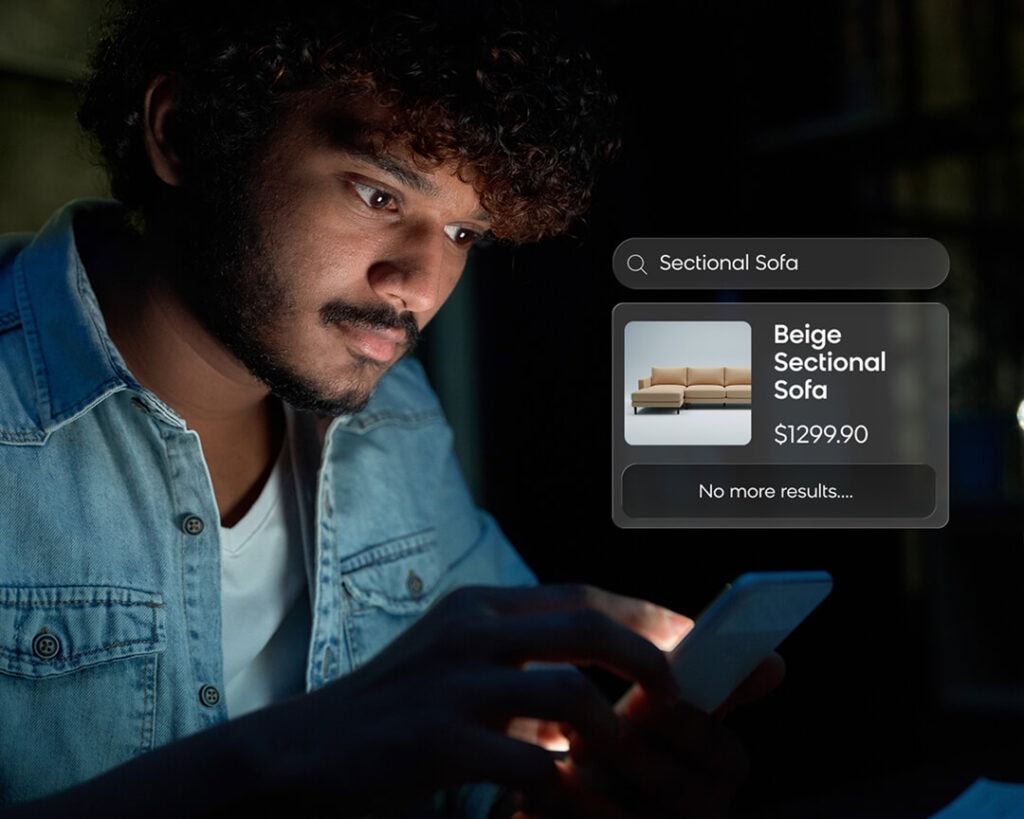
- Shopper MCP enables conversational commerce experiences, so when a customer interacts with an AI shopping assistant (including in platforms like ChatGPT), our product intelligence and personalization powers the discovery and recommendations underneath.
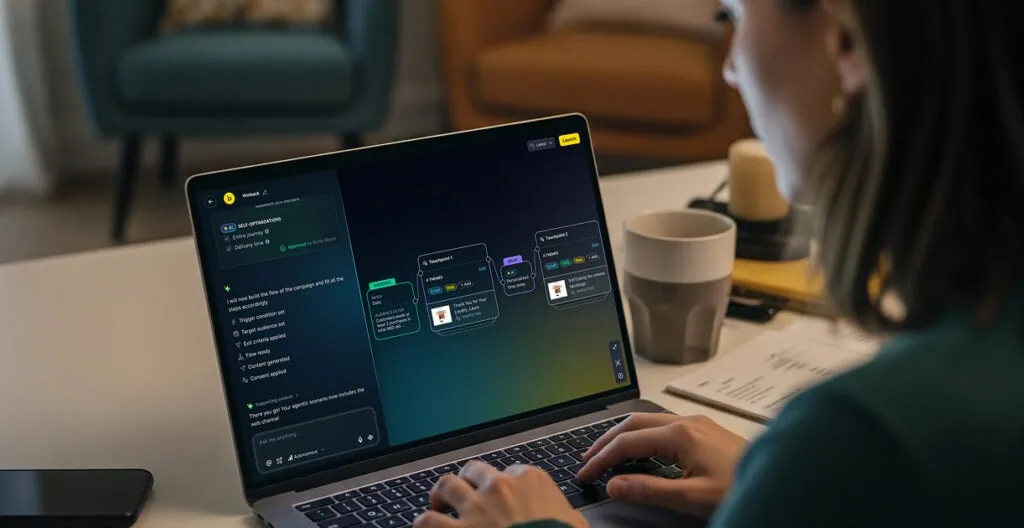
- Workflow MCP opens our marketing automation to external agents. Instead of a marketer sitting inside our UI building a campaign, an AI agent — whether built by us, a partner, or the customer’s own team — can orchestrate full workflows through Loomi AI’s capabilities.
- Analytics MCP makes our intelligence queryable. An agent working across a customer’s data stack can pull from Loomi AI’s analytics and customer insights just as naturally as it queries a data warehouse.

We’re also building an ISV and partner ecosystem that allows them to build agents that consume Bloomreach capabilities through Loomi Connect. And, we’re moving toward a framework where customers and partners can build entirely new agents on top of the platform.
That last part is intentional. We know the future of marketing is agentic, and we want to be the platform those agents are built on.
How Loomi Connect Answers Both Levels of Disruption
So the question is: How exactly does Loomi Connect address these two levels of AI disruption?
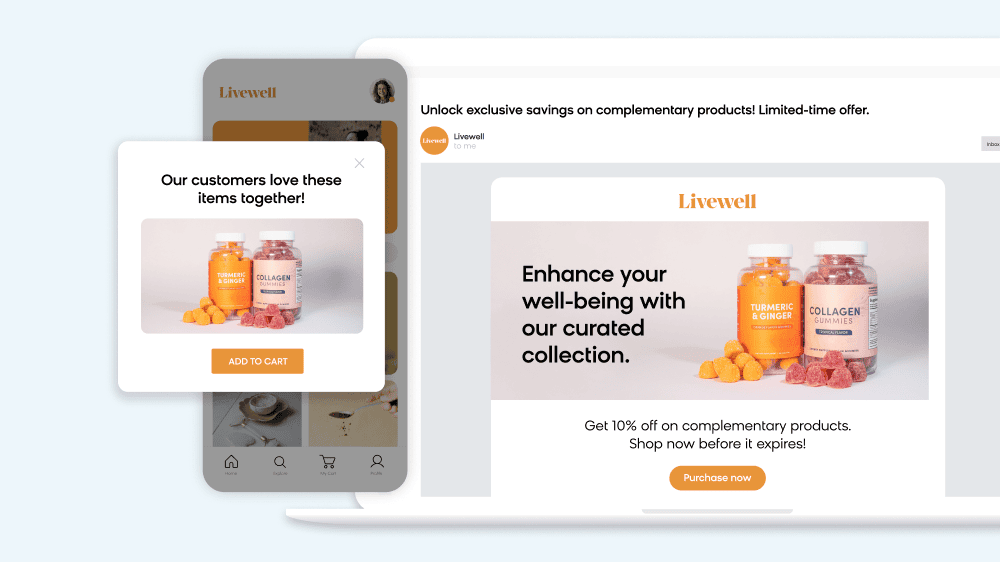
Against the first level, Loomi Connect isn’t here to defend a UI, but to enable agents. The more the world moves toward agentic interfaces, the more central our infrastructure becomes, because agents need to do something when they understand what a customer wants. Whether an agent is trying to deliver a personalized email, trigger a loyalty offer, or update a product ranking in real time, that execution happens on our stack.
For the second level of disruption, Loomi Connect gives IT teams something better to work with. A sophisticated enterprise with strong internal developers can build its own custom orchestration on top of our platform to build new value/functionality rather than trying to rebuild the platform itself. This is important because, with our early focus on infrastructure, we’ve built and refined a system that can easily handle peak season traffic without faltering. That’s a level of reliability and scale that big businesses can’t attempt to recreate without significant investments in resources, time, and money.
Thus, with Loomi Connect, enterprise teams get the bespoke experience they want, while we provide the commerce intelligence and execution infrastructure they can’t realistically replicate. It becomes a partnership instead of a threat.
Ultimately, I don’t think the winners will be the companies with the best AI-powered UI, but rather the companies whose capabilities are so deeply embedded in the agentic workflow that working without them becomes unthinkable. We’re building Loomi Connect to make that infrastructure accessible to whatever form the future takes, whether it’s a marketer working inside our platform, an AI agent orchestrating a campaign autonomously, or a partner building a new kind of commerce experience we haven’t imagined yet.
The key takeaway? The SaaS reckoning is real, but if you’re the tooling infrastructure, it’s no longer a reckoning — it’s an opportunity.