
Everyone is talking about AI agents, but almost no one has the infrastructure to make them genuinely different from everyone else’s.
If your business is unique, your agents should be too. That means agents that understand your customers, your products, your channels, and your business logic, not just a clever prompt on top of a generic model.
Across the industry, the biggest platforms are already shifting in this direction. They’re exposing their stacks as APIs, streaming real-time events into MCP-style interfaces, and inviting agents to sit on top of their data and workflows rather than hiding behind a UI. The message is clear: the future isn’t “yet another dashboard” — it’s infrastructure that agents can depend on.
Loomi Connect is that infrastructure for commerce and personalization. It’s our agentic layer (MCP, UCP, ACP): a set of interfaces that lets agents tap into Loomi AI’s customer context, product data, content, marketing execution, and analytics in real time.
In this post, I’ll dig into what this unlocks, how you can build better agents (faster) with Loomi Connect, and how different audiences (i.e., brands, agencies, and ISV/tech partners) can use it to ship differentiated agents that actually move revenue.
Why Generic Agents Won’t Win
Most of today’s “AI agents” look the same:
- They sit on top of a single system of record
- They rely on shallow context — a few fields from a CRM, a product feed, maybe a reporting API
- They answer questions or trigger a workflow or two, but they don’t truly adapt to your business
That’s fine for demos, but it breaks down in real commerce:
- Personalization isn’t just about prompts: It’s models trained on your data, your customers, and your business logic, running continuously across every touchpoint
- Journeys aren’t linear: Your customers move across web, app, email, ads, support, and new conversational surfaces in a single day
- Margins are under pressure: Margins are getting tighter across the board due to rising acquisition costs, changing regulations, and higher expectations around loyalty and relevance
If your agents don’t understand all of that, they become another thin layer the business has to work around, instead of the execution engine everything runs through.
Build Better Agents Faster With Loomi Connect
Loomi Connect exists so you don’t have to rebuild a personalization and orchestration platform just to participate in the agent era.
At a high level:
- Loomi Connect is the agentic (MCP, UCP, ACP) layer for Loomi AI. It exposes commerce intelligence, customer profiles, product discovery, marketing automation, and analytics as composable tools that any compliant agent can call
- Agents stop guessing and start acting on real context. Instead of scraping UIs or stitching together brittle APIs, agents can reliably:
- Fetch rich customer and product context
- Make real-time decisions (offers, rankings, journeys)
- Execute across channels (email, SMS, push, web, ads, search, conversational)
- You bring the business logic, we bring the infrastructure. The models, decisioning, and guardrails are already tuned for commerce, so your differentiation shows up in the agents you design — not in months of plumbing
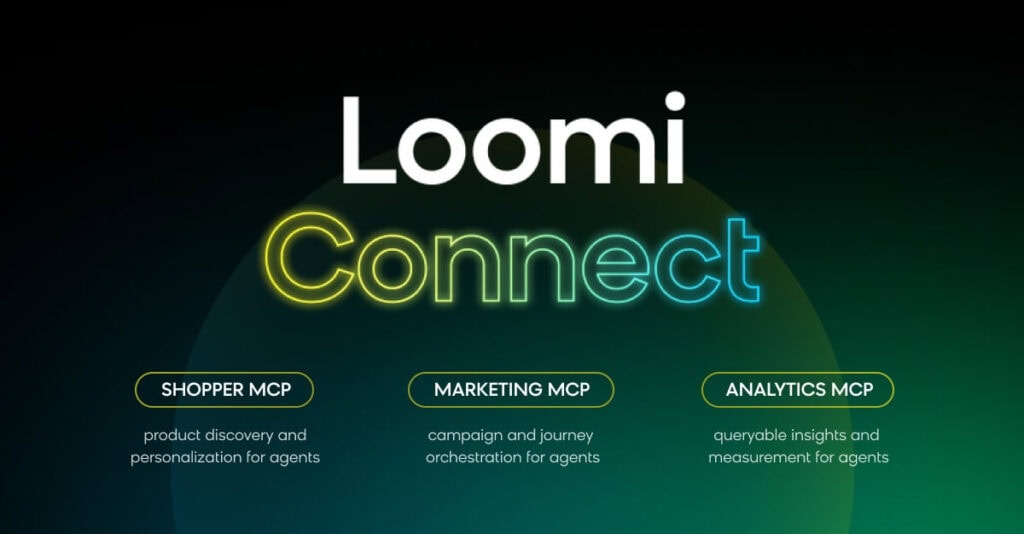
Under the hood, Loomi Connect is organized around three major pillars you can build against:
- Shopper MCP — product discovery and personalization for agents
- Marketing MCP — campaign and journey orchestration for agents
- Analytics MCP — queryable insights and measurement for agents
Everything else in this post is what you can build when those three pillars are available to any agent, anywhere.
Who Loomi Connect Is For (And Why)
For Customers (Brands and Retailers)
Loomi Connect exists to:
- Turn your existing commerce and marketing data into an agent-ready infrastructure layer, not a dead-end UI
- Let you build better agents — agents that know your catalog, your lifecycle, your promotions, and your customers’ history by default
Instead of a generic AI assistant, you get agents that are as differentiated as your business model.
For Agencies
For every $1 spent on software, there’s historically been around $6 spent on services. That service number is getting squeezed.
Loomi Connect gives agencies a way to move up the value chain:
- Package commerce and personalization agent starter kits, accelerators, and vertical agents as IP you can reuse across clients
- Build agents that plug directly into Loomi AI’s personalization infrastructure, so you spend your time on strategy and domain logic rather than wiring up another brittle integration
- Deliver results faster and with higher margins
For ISVs and Tech Partners
Your customers’ businesses are unique, and they increasingly expect their tools to talk to the rest of their stack through agents, not point-to-point APIs.
Loomi Connect enables partners to:
- Let customers move across stacks seamlessly with their own agents, instead of being locked into a single UI or automation engine
- Tap into MCP as the protocol for orchestrating cross-stack workflows with the right guardrails, respecting consent, rate limits, and channel policies by design
In short: You can ship agent experiences inside your own product that immediately understand the commerce context without rebuilding that layer yourself.
What You Can Build on Loomi Connect
There are many ways to slice the catalog of agent use cases on Loomi Connect. Below is a practical way to group them, based on who benefits and which MCP pillar they lean on.
Agents for Customer Experience and Merchandising Teams
These agents sit closest to your shoppers and product catalog, primarily powered by Shopper MCP.
Conversational knowledge agents:
- Guide employees assisting customers through complex decisions (“help me find a gift under $50 that ships this week and matches my previous orders”)
- Translate natural language into product discovery (search queries, filters, bundles) across web, app, and emerging LLM surfaces
- Learn from real-time behavior to adjust recommendations, rankings, and content moments later, not weeks later
Launch and campaign merchandising agents:
- Spin up hundreds of personalized PDP and category experiences for a launch, based on audiences, channels, and intent signals
- Coordinate which products to feature across search, recommendations, email hero slots, and paid media, so every shopper sees the launch through a relevant lens rather than a one-size-fits-all banner
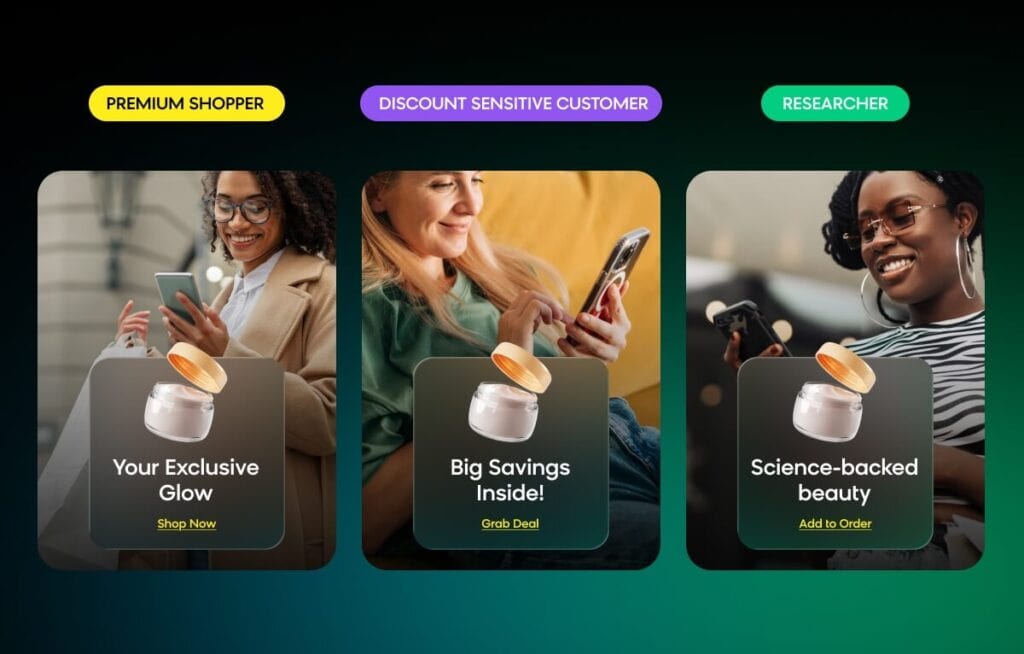
Recovery and reactivation agents:
- Detect churn signals in-session and over time — not just “hasn’t purchased in X days,” but patterns across visits, losses, preferences, and engagement
- Trigger the right nudge or offer on the right channel, under strict guardrails, to reengage the customers who actually need an incentive while suppressing those who’d return anyway
Agents for Lifecycle and Growth Teams
These agents are primarily powered by Marketing MCP, orchestrating journeys across channels.
Autonomous campaign agents:
- Generate, test, and optimize personalized email and mobile campaigns with dynamic content variants (subject lines, product blocks, incentives) without having to manually juggle calendars
- Move customers between flows based on behavior (opens, clicks, purchases, channel engagement), rather than waiting for weekly analysis
Multi-system workflow integration agents:
- Connect ecommerce, CRM, support, and ad platforms into a single agentic workflow — for example, if a high-value customer has an issue logged with support, the agent pauses outbound promos, triggers a retention offer, and alerts the account owner with full context
- Keep messaging and offers in sync when any part of the stack changes (inventory spikes, pricing updates, new consent signals)
Omnichannel journey agents:
- Orchestrate journeys that move fluidly across email, SMS, web, push, and conversational surfaces
- Decide which channel, which moment, and which message in real time, based on fresh signals and predicted response, not static rules
Agents for Operations and Analytics
These lean on Analytics MCP, turning measurement into a tool any agent can use.
Agentic analytics and benchmarking:
- Give agents a queryable view into performance (e.g., revenue per visitor, CLV, cohort retention, journey drop-offs) so they can answer “what happened” and “what should we try next” in the same workflow
- Benchmark experiments and variants automatically, then push winners back into campaigns, search ranking, and content

Cross-channel dashboards as agents:
Instead of building yet another dashboard, build an agent that:
- Pulls from email, SMS, ads, search, and on-site behavior into a unified view of performance
- Surfaces anomalies (“this segment’s open rate just spiked”) and opportunities (“these products are over-performing search impressions but under-performing conversion”)
- Proactively recommends next actions, then executes them through Workflow MCP if you approve
Starter Kits and Vertical Agents for Partners
For agencies and partners, Loomi Connect is a factory for reusable IP.
You can build:
- Vertical-specific starter kits, such as agents tuned for regulated industries, subscription businesses, or high-consideration purchases, each with domain-specific playbooks and guardrails
- Acceleration packs, or bundles of prebuilt agents (launch, lifecycle, support, analytics) that you customize per client instead of reinventing from scratch
- Embedded co-pilots inside your own products — these are powered by Loomi Connect behind the scenes but surfaced in your UI where your users already work
This is how services revenue turns into productized offerings, leading to a higher margin for you and faster time-to-value for your customers.
Industry Momentum Is on Your Side
If this all feels like a big shift, it is. But you’re not alone in making it.
Across marketing clouds, CRMs, and experience platforms, industry giants are:
- Repositioning their core platforms as headless, API-first infrastructure with agent access baked in
- Shipping MCP-like servers that let agents read from and act on journeys, campaigns, and analytics wherever users are — Slack, web, mobile, or voice
- Talking explicitly about agent-first roadmaps instead of UI-first roadmaps
Loomi Connect is how we bring that same level of agentic capability to commerce personalization. You don’t need to start from a blank slate — instead, you can use a solution that’s grounded in 15+ years of shopping and engagement data.
Ultimately, your differentiation won’t come from whether you use agents. It’ll come from how uniquely those agents reflect your business.
To see firsthand what these agents can do for your business, be sure to sign up for our Loomi Connect Hackathon, a global sprint focused on agents that push the boundaries of personalization and commerce.