
The most dangerous phrase in modern marketing isn’t “we don’t have the data.” It’s “we don’t have the bandwidth.”
For years, the promise of personalization has outpaced the reality of it. Marketers sat on rich behavioral data, loyalty tiers, product catalogs, and purchase histories — all of it structured, accessible, and theoretically actionable. The bottleneck was never the data; it was the human effort required to turn it into something.
When broken out into individual tasks, it all feels manageable: build the segment, write the triggers, configure the recommendation logic, etc. But when you need to manage these tasks across hundreds of campaigns, each with different target audience segments, then it becomes an impossible undertaking.
This is what AI agents are now fundamentally changing.
Why AI Agents Are Different From Everything That Came Before
In marketing, the AI conversation has moved through several phases. First came predictive analytics: smarter data, better signals. Then came generative AI: faster content, lower production costs. Both were meaningful, but neither solved the fundamental problem of execution.
The thing is, marketers know what good looks like. They can describe, in a single sentence, the exact campaign logic that would drive a loyal customer toward their next tier or reengage a lapsed buyer at precisely the right moment. The gap has always been the distance between that sentence and a production-ready campaign.
An AI agent isn’t a tool that helps you do the work faster. It’s a system that does the work on your behalf — reasoning, deciding, building, and adapting based on a goal you define. And when agents are purpose-built for a specific domain, trained on a decade of industry patterns, and wired directly into the data infrastructure of a business, the results are categorically different from anything a general-purpose AI layer can produce.
This is what’s happening in commerce and marketing right now. Not AI-assisted campaigns, but autonomous ones.
The Shift From Building Campaigns to Directing Them
Think about what a senior marketing strategist actually does when they’re at their best. They don’t spend their days in a campaign builder dragging segments into flows. They think about customer lifecycle stages, revenue opportunities, and behavioral patterns. They have ideas — good ones — that never make it off the whiteboard because the production cost is too high to justify.
But with agentic AI, a natural-language brief can be converted into a fully built campaign — complete with audience logic, personalization dimensions, timing configuration, and email content. As a result, the marketer’s role becomes more directorial. You define the objective, you review and shape the output, and you decide what ships.
A two-person team can operate the campaign program that used to require a full department. Not because they’re working harder, but because the work that consumed their hours has been redistributed to agents that operate in parallel, around the clock, without fatigue or context-switching costs.
This is the true impact of increased campaign velocity. It’s not speed for speed’s sake. It’s the ability to test ideas that never would have been prioritized before, to clear a backlog of campaigns your team always believed in but never had the time to build, and to turn those experiments into compounding revenue.
Unlock Autonomous Marketing With Loomi Marketing Agent
Meet Loomi Marketing Agent — the autonomous way to use Loomi AI to power your marketing automation. Tell it your goal, and it builds full campaigns tailored to each customer — delivering the kind of deep personalization that used to take your team hours in a fraction of the time.
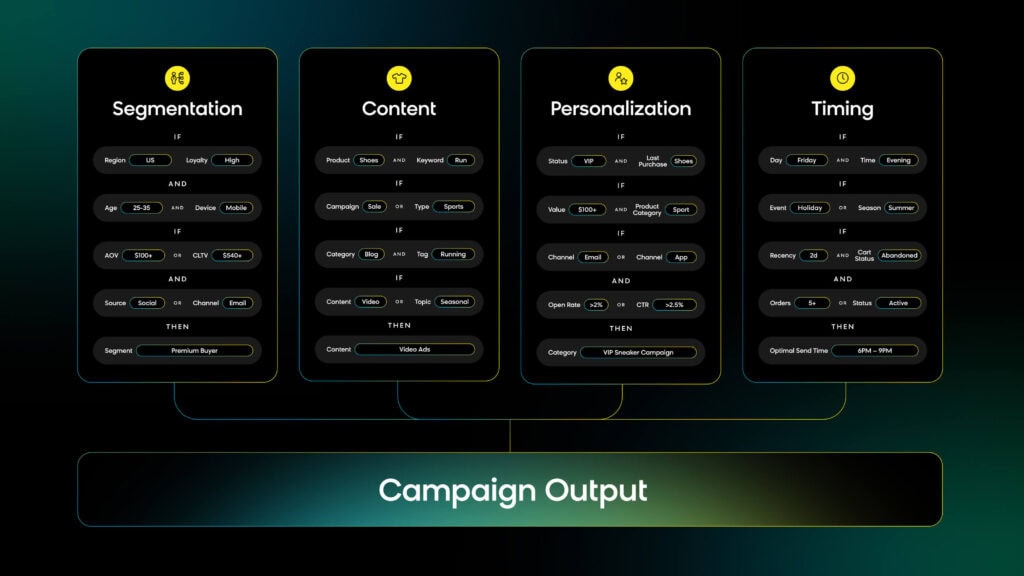
It starts with a conversation — not a form, not a template. Marketers describe their goal, and Loomi Marketing Agent responds with proven strategies and use cases tailored to that objective. Once a direction is set, Loomi Marketing Agent divides the work in parallel: building the audience segment, drafting on-brand content, writing the personalization logic, and optimizing send timing.
What makes this architecture different from a generic AI layer is where it operates. Our marketing agent exists natively inside Loomi AI, reasoning directly from unified customer profiles, real-time behavioral data, product catalogs, and loyalty tiers. It doesn’t approximate what customers want — it works inside the data itself, which means every segment, every recommendation block, and every conditional rule reflects the actual depth of what a brand knows about its customers.
This empowers Loomi Marketing Agent to translate your business intelligence into the right decision for every campaign: how to define a win-back window, when to suppress a recent buyer, or which product attributes drive cross-sell. The result is a personalized campaign that a senior marketer would build by hand, produced at an unprecedented speed and scale.
A human team might configure five or ten rules for a single campaign and call it well-personalized. Loomi Marketing Agent can construct hundreds of layered rules across dozens of variants, transforming personalization from a feature you technically have into a capability you actually deploy.
The Top Autonomous Marketing Use Cases of 2026
The best way to understand what’s possible with autonomous marketing is through specific use cases. Here are some of the campaigns that used to be too complex to build — and are now being built from a single prompt.
Individualized Replenishment Triggers Based on Purchase Cadence
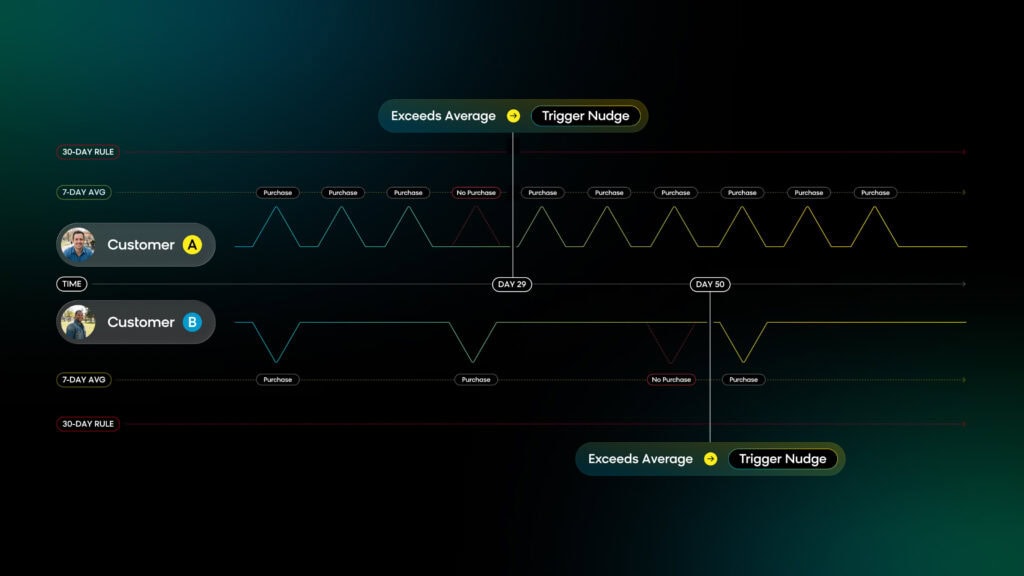
Static reengagement rules — “hasn’t purchased in 30 days” — treat a weekly buyer and a monthly buyer identically. Loomi Marketing Agent calculates each customer’s personal purchase rhythm from their own transaction history, then triggers a reengagement flow the moment that individual exceeds their own average. A customer who buys every two weeks gets a nudge at day 15. A customer who buys every six weeks gets one at day 43. Neither gets a message at an arbitrary threshold that has nothing to do with their actual behavior.
Children’s Apparel Size Progression Campaigns
Let’s say a parent purchased a 3T six months ago, but they haven’t bought in that category since. Loomi Marketing Agent identifies the elapsed time, understands the brand’s sizing hierarchy, and sends a “time to size up” message recommending a size 4. No hard-coded rules for every size bracket, and no manual maintenance as the catalog evolves. The agent synthesizes purchase history, product catalog structure, and timing into a single automated flow — the kind of campaign a marketer can describe in one sentence and, without agent support, would take days to build.
Loyalty Tier Win-Back With Real-Time Points Calculation
Loomi Marketing Agent makes managing loyalty programs much easier. If a member is almost at their next tier but hasn’t purchased recently, the campaign agent calculates, per individual, exactly how many points they need, the deadline to hit it, and which products in their preferred categories would close the gap. The math is done at the customer level, not approximated with a segment average. The email doesn’t say, “You’re close.” It says, “You need 200 points by May 31st, and here’s exactly how to get there.”
Loyalty math like this has always been technically feasible; it’s just never been operationally practical without developer support. Loomi Marketing Agent removes that dependency entirely.
Intent Scoring Without a Data Team
Previously, if a marketer wanted to route shoppers into high and low-intent segments based on specific behavioral signals (e.g., product views, sessions, add-to-cart actions, time on site, etc.), they’d need to rely on a data science team.
Now, the marketer can define the metrics and the relative weights, and then Loomi Marketing Agent computes a composite score per customer and routes them into the appropriate segment automatically. What previously required a data science team, an engineering pipeline, and a sync back into the marketing platform now happens inside a single prompt.
Abandoned Browse With Intelligent Product Substitution
When a shopper views a product page three times without adding to cart, Loomi Marketing Agent triggers a reengagement email. However, instead of recycling what the shopper already viewed, the recommendation block automatically substitutes duplicates with contextually relevant alternatives from the same category. Seasonal exclusion rules filter out out-of-stock SKUs and irrelevant product lines without a single line of custom code.
What makes this powerful isn’t any one layer of logic. It’s all of them operating together: browse history, catalog availability, seasonal relevance, and deduplication, stacked and running automatically.
Ad-Aware Abandoned Cart Messaging
Let’s say a customer arrived on site by clicking an ad about a jacket’s waterproof performance, but they didn’t complete their purchase. The abandoned cart email they receive doesn’t just show them the jacket — it leads with waterproof performance, because that’s the angle that already captured their attention, and the referring URL is treated as contextual data.
Loomi Marketing Agent reads it, interprets the intent, and generates a variant that continues the conversation the ad already started. Every abandoned cart email becomes a signal-driven response, not a generic recovery play.
Deep Newsletter Personalization With Behavioral Exclusions
A bestseller newsletter sounds simple, but making it individually personalized is not. For customers with purchase history, Loomi Marketing Agent creates a newsletter that surfaces bestsellers only within categories they frequently buy from — and excludes anything they’ve already purchased. For browsers without purchase history, it calculates which category they spent the most time in and surfaces bestsellers from that category, excluding products they’ve already viewed.
Loomi Marketing Agent uses layered logic: catalog intelligence, behavioral history, and per-recipient exclusion rules, all assembled from a single prompt.
Category-Aware Replenishment for First-Time Buyers
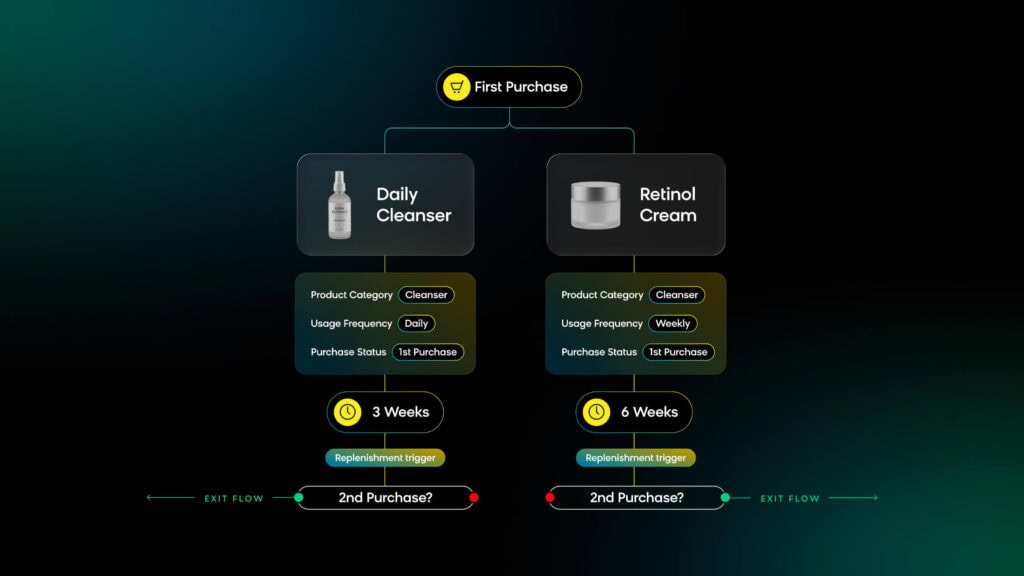
A first-time buyer of a daily cleanser and a first-time buyer of a nighttime-only retinol should not receive the same replenishment email on the same schedule. Loomi Marketing Agent segments post-purchase timing by product category, applying realistic usage timelines that reflect how customers actually interact with what they bought. The cleanser customer gets a reminder in three weeks, while the retinol customer gets one in six. Exit criteria remove both from the flow the moment a second purchase is recorded.
What the Best Campaigns of 2026 Have in Common
Each of these use cases shares a structural characteristic: they were always possible, but they were never practical. The data existed and the strategy was sound, but the execution cost and time were prohibitive.
Loomi Marketing Agent removes that cost, not by cutting corners on personalization depth, but by removing the human hours required to configure it. The result isn’t a shortcut to a mediocre campaign. It’s the full version of the campaign — the one with the loyalty math done right, the timing calibrated to individual behavior, the recommendation block that actually reflects what each customer needs — shipped at a fraction of the previous effort.
Marketers aren’t passive approvers in this process — they’re directors. Campaign strategy and personalization logic can be edited conversationally at any point. The marketer’s role isn’t a gatekeeper — it’s an air traffic controller. The marketer is actively shaping every campaign’s direction while Loomi Marketing Agent handles the construction. The result is a significant increase in campaign velocity without a proportional increase in headcount, and a backlog of untested ideas that finally has a path to production.
For marketing leaders, this has a huge impact on strategy. The backlog of campaigns your team has always believed in but never had the capacity to build is no longer a ceiling — it’s a pipeline.
The teams that move into this model earliest will have a greater advantage: more experiments run, more campaigns proven to work, more revenue generated from the same strategic intelligence they already had.
Request a demo today to learn how Loomi Marketing Agent can scale your campaign velocity and help your team launch campaigns in minutes.