
Campaign agents represent the future of autonomous marketing, and now I’d like to pull back the curtain and dive deeper into the tech.
In particular, I want to look at the introduction of a self-optimizing agent into campaign agents and how that will provide the spark to truly help marketers reach their business goals.
An Overview of Campaign Agents
First, I want to highlight what campaign agents are and what they’re capable of. At its core, campaign agents use AI agents to autonomously build sophisticated marketing campaigns. You simply need to tell the campaign agent what you want to build using natural language, and then it’ll build the campaign for you. Beyond that, it will continue to learn and optimize even after it’s live. This empowers marketers to optimize toward their business goals at a scale that was previously impossible.
We’ve accomplished this by building campaign agents with a multi-agent architecture. These agents do all the thinking — natural language processing, data analysis, scenario creation, orchestration, etc. — on behalf of the marketer. All of the agents work in tandem to take the initial goal set by the marketer and develop the best approach.
But what really sets campaign agents apart is one particular agent: the self-optimizing agent.
A Closer Look at the Self-Optimizing Agent
With the introduction of a self-optimizing agent, we’re using reinforcement learning to empower campaign agents to discover the final optimal parameters for a scenario that matches the intended business result (e.g., conversion rate).
To understand how reinforcement learning works, we can look at how it’s been applied to chess. While older chess engines like Deep Blue relied on input from chess masters and computer scientists to develop their strategies, this approach eventually hit a wall in its effectiveness.
Now, modern chess engines like Leela Chess Zero use reinforcement learning to train itself — essentially, the AI constantly plays against itself, developing its own internal logic instead of relying on human experts.
That’s because there’s a limitation to how much (and how effectively) humans can teach AI. By using reinforcement learning, chess engines can train themselves at a much faster and more efficient rate to find optimal strategies.
So, how does this translate to marketing automation? Let’s look at an example of how the self-optimizing agent works within our campaign agents:
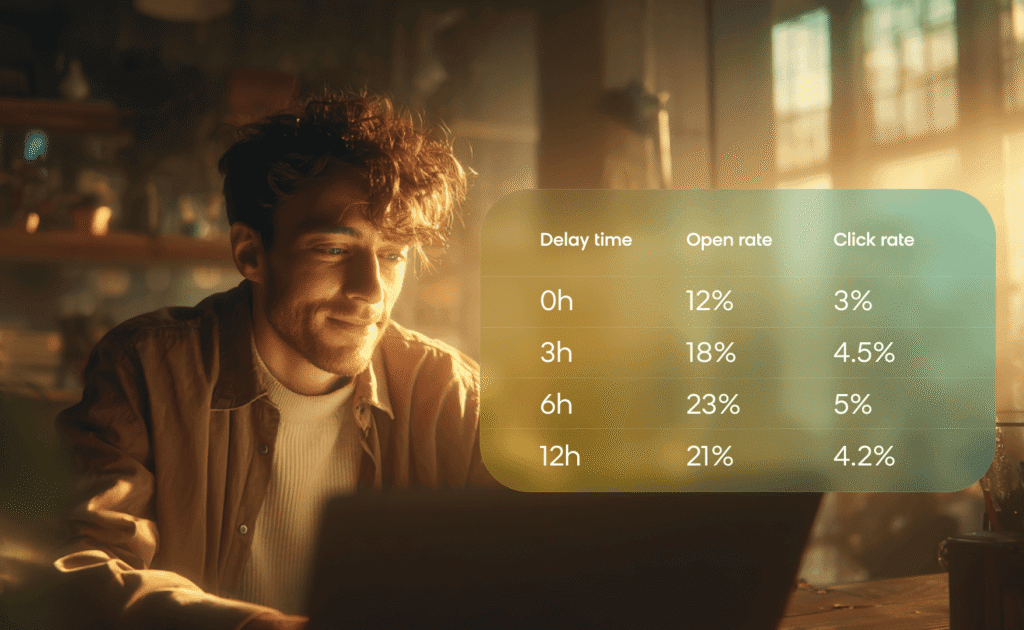
- The self-optimizing agent first starts with a quantifiable parameter — for example, “what is the best delay time to send a reactivation email to improve conversion rates?”
- To start testing, the agent will take its best guess on an initial approach based on annotated data sets trained by humans (benchmark data and other provided data)
- Once it gets baseline results from this test, it’ll continue testing different strategies to measure the impact of different delay times on conversion rates with real-time data from the end users
- The self-optimizing agent will continue testing until it finds the best strategy for this particular parameter (i.e., how long to wait before sending a reengagement email to drive the greatest conversion rates)
What sets this apart from other methods is how effective it is. Supervised learning often doesn’t work as well as we want because the AI is trained on homogeneous or static data that requires an initial randomization period. Reinforcement learning, on the other hand, uses contextual bandits to solve for these issues.
The result is that the self-optimizing agent can turn the campaign agents into a superhuman marketer, capable of testing at a scale and breadth that humans simply can’t achieve.
Supercharging Marketing With Campaign Agents
Campaign agents represent the next evolution of marketing automation. Thanks to the self-optimizing agent and reinforcement learning, marketers can focus their energy and effort on crafting high-impact strategies, then let the campaign agents take care of the rest.
Our customers are already seeing greater revenue and increased efficiency with campaign agents. Learn more about campaign agents and how you can greatly improve your marketing processes and results.