As generative AI continues to mold commerce and marketing, a significant development in this space is the emergence of AI-powered personal shopping services.
Personal shopping services, as the name suggests, are services that aim to provide a tailored shopping experience online for each customer. AI-powered personal shopping services are used by ecommerce companies to replace the need for humans to lead shoppers every step of the way. Instead, these services use generative AI to help.
Traditionally, personal shopping services were exclusively offered by high-end department stores to their elite clientele at brick-and-mortar stores. Personal shoppers would curate items based on their clients’ tastes, needs, and budget. However, with the rise of AI-powered technology and digital commerce, these services have become democratized and widely accessible, completely transforming the concept.
AI-powered personal shopping services leverage advanced algorithms and machine learning to understand a customer’s preferences, style, and budget. They can sort through thousands of products in seconds, curating a selection that matches the customer’s unique needs. Not only does this save time, but it also makes shopping online a hassle-free and enjoyable experience.
Generative AI is revolutionizing the way these personal shopping services operate, bringing a new level of ecommerce personalization and internal operational efficiency to the table. These AI-powered systems become more accurate as they gather more data, constantly refining and improving their recommendations. This means that the more you use these services, the better they get at understanding your style and preferences.
So, what does this mean for the future of shopping? The rise of AI-powered personal shopping services signifies a move towards more personalized, efficient, and customer-centric retail experiences. As these technologies continue to evolve, they promise to reshape the shopping landscape in ways we can only begin to imagine.
That begs the next question: what does that mean for brands who want to offer their customers the most cutting-edge online shopping experiences? It means that adopting agentic AI, generative AI, conversational AI, and conversational commerce use cases will be essential in how they carve out their position in the modern ecommerce marketplace.
How Can AI Be Used in Online Shopping?
AI has the potential to have a transformative impact on online shopping.
It’s clear that this technology is reshaping the ecommerce landscape in profound ways. Consider the stakes: according to McKinsey research, 71% of consumers expect personalized interactions when they shop online, and 76% get frustrated when those expectations go unmet. AI’s integration into online shopping platforms is the most practical path to meeting that bar — delivering personalized, efficient, and secure experiences at scale.
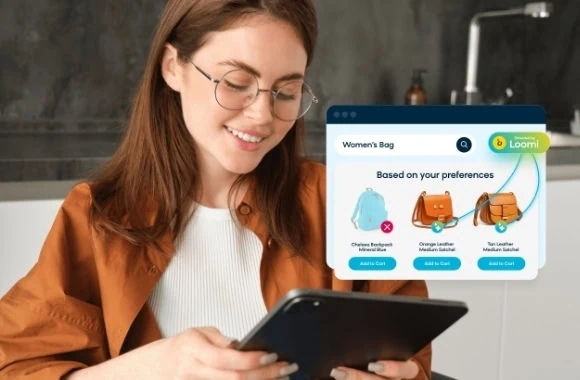
One of the most impactful uses of AI in online shopping is the ability to deliver personalized product recommendations. By analyzing customer data, AI algorithms can predict and suggest items that align with individual preferences and shopping habits. This not only enhances the shopping experience by making it more relevant to the consumer but also boosts sales for retailers by increasing the likelihood of conversion.
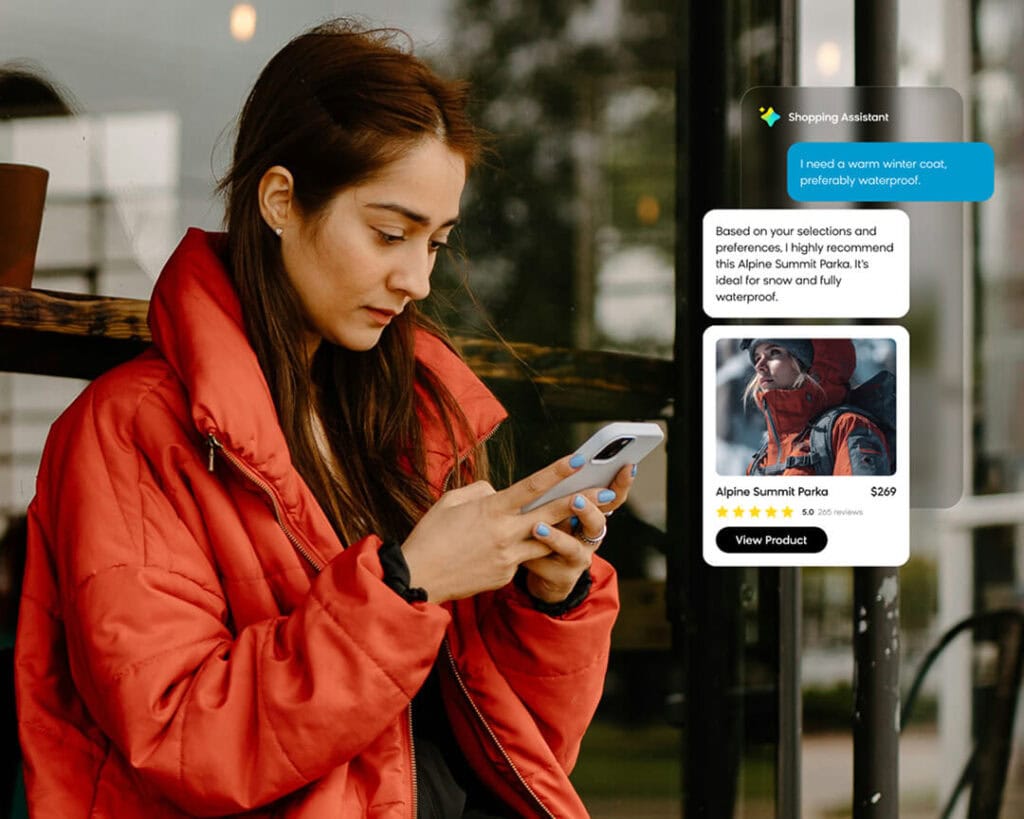
AI-powered chatbots and virtual assistants are revolutionizing customer service in ecommerce. These tools provide instant responses to customer inquiries, assist with purchase decisions, and even handle returns. By offering 24/7 support, they enhance customer satisfaction and loyalty without the need for extensive human resources.
Together, these (and many other) AI innovations are not just transforming the online shopping experience; they are setting the stage for a more interactive, personalized, and efficient future in ecommerce. As AI continues to evolve, its impact on online shopping will undoubtedly deepen, offering even greater benefits to consumers and retailers alike.
Understanding AI-Powered Personal Shopping Services
AI-powered personal shopping services are essentially a bespoke solution to your retail needs.
Picture a friend or family member who knows your style inside out and can pick out items that you’ll love: that’s what these services aim to replicate. They’re your own personal stylist, your shopping guide, and your time-saver, all rolled into one.
With the rise of more accessible AI, these services are now able to offer a level of personalization and efficiency that was unthinkable in the past. With the combination of powerful algorithms and machine learning, AI-powered personal shopping services can effectively understand a customer’s preferences and provide a highly tailored shopping experience.
In essence, the evolution of personal shopping services reflects the broader shifts in the retail landscape — a move towards more personalized, customer-centric experiences. As technology continues to advance, we can only expect these services to become more sophisticated, offering an even higher level of personalization and convenience.
How AI Is Powering Personalized Shopping
With its advanced capabilities, AI is revolutionizing the way these services operate and bringing a new level of personalization to the retail industry. It’s not just about making shopping easier or more efficient — it’s about creating a personalized shopping experience that feels truly tailored to each individual customer.
There are several types of AI being utilized in personal shopping services, each with its unique features and benefits.
Generative AI can create new product recommendations from scratch, based on a deep understanding of a customer’s style and preferences. Conversational AI can interact with customers in real time, answering queries and providing product suggestions in a conversational manner.
These AI-powered systems offer a myriad of benefits to both businesses and consumers. For businesses, AI can process vast amounts of data quickly and efficiently, providing valuable insights into customer behavior and trends. This allows businesses to tailor their offerings more precisely, leading to increased sales and improved customer satisfaction. It also reduces the need for manual input, saving time and resources.
For consumers, the benefits are equally compelling. AI-powered personal shopping services provide a highly customized shopping experience, with product recommendations that align closely with their individual tastes and needs. These services make shopping more efficient and enjoyable, saving customers time and reducing the risk of making unsatisfactory purchases.
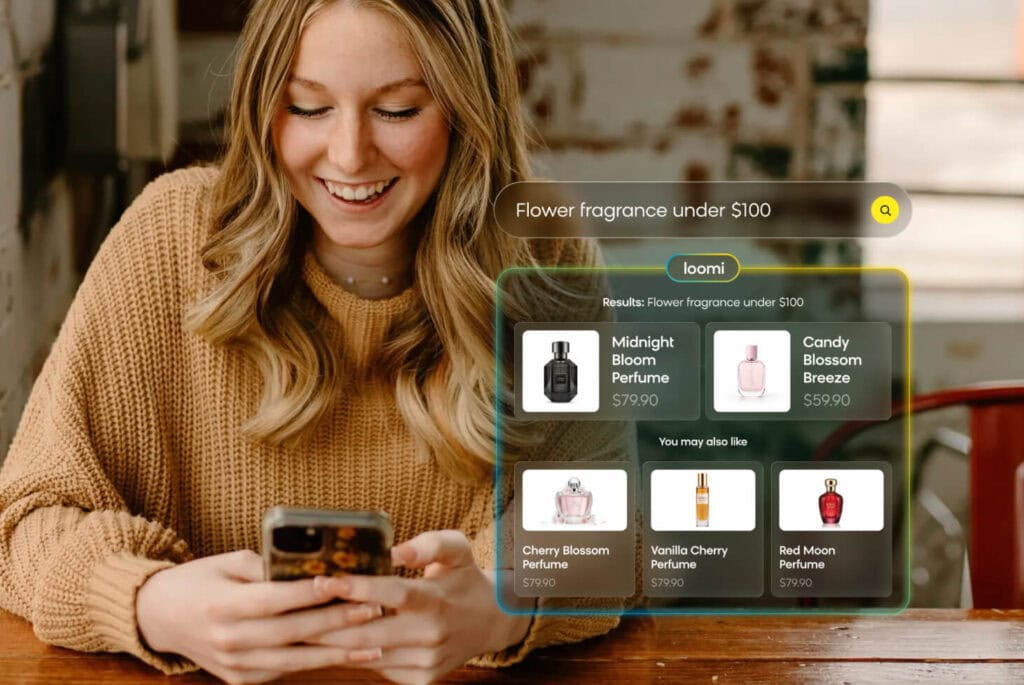
Agentic AI and Personal Shopping Services
Agentic AI refers to artificial intelligence systems designed to autonomously make decisions aligned with specific objectives.
Unlike traditional AI tools that rely on explicit prompts to deliver results, agentic AI utilizes machine learning, natural language processing, and large language models to assess situations, devise solutions, and take action without human intervention.
In essence, agentic AI goes beyond merely responding to user inputs — it actively works toward achieving goals, leveraging context and adapting to new information to make well-informed decisions.
This advanced autonomy is made possible by AI agents and powers agentic personalization. Operating within agentic AI systems, these agents independently manage tasks, analyze data, and make real-time adjustments to optimize outcomes.
AI agents can revolutionize personal shopping assistance for online shoppers by providing tailored, efficient, and engaging experiences. They can do this by offering:
- Personalized Recommendations: AI agents analyze user preferences, browsing history, and purchase behavior to suggest products that align with individual tastes and needs. For example, they can recommend clothing styles, gadgets, or home decor based on past purchases or saved items.
- Virtual Styling and Advice: By leveraging natural language processing, AI agents can act as virtual stylists or consultants, answering questions like, “What shoes go with this dress?” or “Which laptop is best for graphic design?”
- Seamless Checkout Experiences: By guiding users through the checkout process, AI agents can ensure a smooth and hassle-free transaction, even offering payment or shipping suggestions based on past behavior.
By combining data-driven insights with real-time adaptability, AI agents can create a highly personalized and efficient shopping experience, fostering customer loyalty and boosting sales for online retailers.
Generative AI and Personal Shopping Services
Generative AI’s remarkable ability to create original content from scratch powers personal shopping services online that we couldn’t even imagine just a few years ago. It’s like having a virtual creative genius at your service, generating personalized recommendations that cater to your unique preferences and style.
Generative AI is transforming the face of retail by revolutionizing the way we discover and shop for products. Instead of relying solely on past purchases or browsing history, generative AI takes a holistic approach. It learns from your behavior, preferences, and even external trends, combining them to provide you with a highly tailored shopping experience.
One of the most incredible impacts of generative AI is that it is constantly evolving and improving. As it learns more about the preferences and style of your customers, it becomes better at understanding their needs and desires. This means that over time, the recommendations provided by personal shopping services powered by generative AI become even more accurate and tailored to your specific tastes.
As we move forward, the possibilities for generative AI-powered personal shopping services are endless. From virtual stylists that curate outfits based on your preferences to AI-driven chatbots that provide real-time assistance, the future of personal shopping is exciting and full of potential.
Bloomreach’s Conversational Shopping Agent: AI-Powered Personal Shopping at Scale
As brands compete to offer the most personalized online experiences possible, we’ve built the ideal combination of customer data, product intelligence, and generative AI to make that a reality.
Our conversational shopping agent is purpose-built to transform the way customers engage with your brand. Powered by Loomi AI, our intelligence platform, it goes beyond a standard chat widget — acting as an always-on sales associate that guides shoppers across your entire site, from product pages to checkout, in real time.
With access to real-time customer data combined with intelligence curated from over 13 years of shopping and searching patterns, our conversational shopping agent helps every shopper find exactly what they need — even before they know they need it. It understands your brand’s unique voice and enables authentic, personalized conversations that resonate with shoppers, no matter which channel they choose to engage with you.
The results speak for themselves. When TFG, one of South Africa’s largest fashion and retail groups, deployed our conversational shopping agent during Black Friday, the impact was immediate: a 35.2% increase in online conversion rates and a 39.8% rise in revenue per visit among customers who engaged with the agent — alongside a 28.1% reduction in exit rates.
Conversational AI: A New Era of Shopping
Conversational AI is a type of artificial intelligence that can specifically simulate human conversation. It offers an interactive dialogue and dynamic exchange with users, or in this use case, your customers at your e-shop.
While chatbots were the original channels to use a form of conversational AI, the rise of generative AI has made these human conversations much more realistic thanks to natural language processing capabilities. Conversational AI can now revolutionize personal shopping services and pave the way for a new era of customer engagement online.
Understanding Conversational AI and Its Role in Personal Shopping Services
As conversational AI bridges the gap between humans and machines, shoppers can now engage with virtual assistants, chatbots, and voice-enabled devices effortlessly, unlocking a world of personalized and meaningful conversations.
At the heart of personal shopping services, conversational AI assumes the role of a trusted shopping advisor that guides customers through their purchase journey. With its ability to understand and respond to user queries in real time, this technology empowers shoppers to make informed decisions. Whether it’s seeking product recommendations, inquiring about availability, or exploring alternative options, conversational AI acts as a knowledgeable companion that can cater to individual preferences and needs.
This transformative technology not only enhances convenience but also adds a personal touch to the shopping experience. By offering tailored interactions and understanding customer intent, conversational AI establishes a genuine connection that builds trust and loyalty. With its friendly and relatable approach, shoppers are more likely to feel valued and understood, fostering a strong bond between brands and their customers.
In this new era where AI-powered personal shopping services will become increasingly popular online, conversational AI has become an indispensable tool, providing confident, friendly, and smart assistance to customers.
By seamlessly integrating with various channels and platforms, this technology ensures consistency in communication, delivering clear, concise, and authoritative responses across all touchpoints. As brands strive to engage and delight their audience, harnessing the power of conversational AI becomes imperative for leaving a lasting impression and forging stronger connections in today’s dynamic retail landscape.
Amazon’s AI Shopping Innovation: Rufus
Numerous personal shopping services have embraced conversational AI with exceptional results.
One of the most prominent examples is Amazon’s Rufus, a generative AI-powered shopping assistant embedded directly in the Amazon Shopping app. Unlike a traditional voice assistant, Rufus is built specifically for shopping — it answers complex product questions, compares items, tracks price history, and proactively recommends alternatives based on what each customer has previously browsed and purchased.
The scale of Rufus’s adoption reflects the appetite for this kind of experience. In just one year, more than 250 million customers used Rufus, with monthly active users up 149% and total interactions up 210%. Amazon continues to expand Rufus’s capabilities, including agentic features that can automatically add items to a customer’s cart and set price alerts that trigger purchases autonomously when a target price is met.
The takeaway for brands: customers are already comfortable talking to an AI about what they want. The brands that meet them there with equally capable, equally personalized experiences will have a significant advantage.
The Role of Conversational AI in Online Shopping
Conversational AI is emerging as a pivotal element in transforming online retail experiences. This technology, encompassing chatbots and virtual assistants, plays a crucial role in enhancing customer service, streamlining shopping processes, and significantly improving user engagement.
24/7 Customer Support
Conversational AI offers a new level of customer service by providing instant, around-the-clock support. Unlike traditional customer service channels that may be limited by human resources and operating hours, AI-powered chatbots are available 24/7 to answer queries, provide product information, and assist with order tracking. This constant availability ensures that customers receive timely assistance, leading to higher satisfaction and loyalty.
Simplified Shopping Process
By using conversational AI, the shopping journey becomes more efficient and seamless. These intelligent systems can guide customers through their shopping experiences by offering personalized product recommendations based on past behaviors and preferences. Additionally, chatbots can handle various tasks such as processing orders, managing returns, and even providing post-purchase support, thereby reducing friction in the shopping process and freeing up human resources for more complex queries.
Personalized Customer Interactions
For retailers, conversational AI offers an efficient way to manage personalized customer interactions without the need for extensive human intervention. This leads to cost savings and the ability to scale support services quickly during peak shopping seasons. For consumers, the benefits are clear: quicker resolution of issues, a more personalized shopping experience, and the convenience of accessing support whenever needed.
Conversational Commerce and Personal Shopping Services
Similar to conversational AI, conversational commerce has seen a recent spike in popularity with the boom of generative AI.
Conversational commerce is slowly carving out its role in the ecommerce customer experience. By definition, it is the process of using automated conversations and technologies — powered by AI and machine learning — to create more engaging customer experiences when shopping online.
The marriage between conversational AI and conversational commerce has paved the way for a revolutionary transformation in personal shopping services. The seamless synergy between these two powerful technologies has given rise to a new era of customer engagement, where personalized shopping experiences are at the forefront.
By leveraging advanced algorithms and machine learning capabilities, AI-powered shopping assistants offer tailored recommendations that consider individual shopping behavior and preferences. This level of personalization makes brands even more attractive to customers, as customers now receive curated suggestions that align with their unique tastes and needs.
The impact of conversational commerce on personal shopping services cannot be understated. It aims to revolutionize the shopping experience by providing a personalized, convenient, and efficient service. With AI-powered virtual assistants and chatbots, customers can engage in meaningful conversations to seek advice, ask questions, and receive real-time assistance. This not only streamlines the shopping process but also enhances the overall customer satisfaction by creating a more interactive and engaging environment.
AI-Powered Personal Shopping Services: A Long-Lasting Impact
The impact that AI-powered personal shopping services can have on your brand has the potential to be far-reaching and long-lasting.
AI-powered personal shopping services have opened up new opportunities for smaller retailers and independent brands. By leveraging the power of generative AI, these businesses can compete with larger players in the industry and reach a wider audience. This democratization of personal shopping services has leveled the playing field and created a more diverse and inclusive retail landscape.
With AI algorithms analyzing vast amounts of data, customers now receive personalized product recommendations that truly align with their preferences and needs. This level of customization has not only improved the overall shopping experience but has also increased customer satisfaction and loyalty.
AI-powered personal shopping services have revolutionized the way businesses operate. By utilizing advanced technologies like machine learning and natural language processing, these services provide businesses with valuable insights into consumer behavior, allowing them to make data-driven decisions. This has resulted in improved operational efficiency, more cost savings, and enhanced customer engagement, ultimately driving business growth.
The Impact on Customers
AI-powered personal shopping services have revolutionized the way consumers shop, providing them with personalized recommendations, convenience, and better shopping experiences.
Here are some of the key ways this technology has impacted consumers:
- Personalized Recommendations: AI algorithms can analyze vast amounts of data, including shopping history, preferences, and trends, to offer personalized product recommendations. This saves consumers time and effort in searching for products that match their preferences.
- Enhanced Shopping Experiences: AI-powered chatbots and virtual assistants provide real-time support and guidance to consumers throughout their shopping journey. These services can answer queries, provide styling tips, and offer personalized suggestions, replicating the experience of having a personal shopper.
- Time and Convenience: AI-powered personal shopping services enable consumers to quickly find products that meet their specific needs without extensive research. Features like voice search, visual search, and recommendation systems simplify the shopping process, making it more efficient and convenient.
The Impact on Brands
The adoption of AI-powered personal shopping services has brought significant benefits to businesses, helping them streamline operations, improve customer satisfaction, and increase sales.
The business case is backed by data. McKinsey research shows that tailoring customer experiences typically drives a 10–15% revenue uplift, with some companies seeing gains as high as 25% depending on their industry and personalization maturity. Ecommerce brands that adopt AI-powered personal shopping tools can expect to see:
- Data-Driven Insights: AI algorithms gather and analyze vast amounts of customer data, providing businesses with valuable insights into consumer behavior, preferences, and buying patterns. This information helps businesses make informed decisions about product assortment, pricing, and marketing strategies.
- Improved Customer Engagement: By utilizing AI-powered chatbots and virtual assistants, businesses can engage with customers in real time, addressing their concerns, providing personalized recommendations, and improving overall customer satisfaction. This leads to increased customer loyalty and repeat business.
- Efficiency and Cost Savings: AI-powered personal shopping services automate various tasks, such as product recommendations, inventory management, and customer support, reducing the need for manual intervention. This results in improved operational efficiency and cost savings for businesses.
The Impact on the Online Retail Industry
The integration of AI-powered personal shopping services has had a profound impact on the online retail industry as a whole, reshaping traditional shopping experiences and driving innovation.
Three more key benefits to consider:
- Ecommerce Transformation: AI-powered personal shopping services have accelerated the growth of ecommerce by providing personalized experiences that rival in-store shopping. Consumers can explore products, receive recommendations, and make purchases seamlessly, leading to increased online sales.
- Shift in Retail Roles: The introduction of AI-powered personal shopping services has led to a shift in the roles of retail employees. With automation handling routine tasks like product recommendations and inventory management, employees can focus on providing more specialized services, such as styling advice or in-depth product knowledge.
- Technological Advancement: The adoption of AI-powered personal shopping services has pushed retailers to invest in advanced technologies such as machine learning, natural language processing, and computer vision. This has led to new innovations in areas like visual search, voice-activated shopping, and augmented reality, enhancing the overall customer experience.
Brands that have adopted these AI-powered personal shopping services have transformed the way they do business and the ways in which their customers interact with them.
Turn AI-Powered Personal Shopping Into Real Revenue With Bloomreach
The future of personal shopping services lies in the hands of AI-powered technologies as they continue to transform the retail landscape.
By leveraging conversational AI and embracing conversational commerce, brands can deliver exceptional experiences that cater to individual needs and preferences. As the world becomes increasingly digital, the rise of AI-powered personal shopping services will undoubtedly shape the future of retail, providing convenience, personalization, and efficiency like never before.
Where should your brand start? With Bloomreach, the agentic platform for personalization. Powered by Loomi AI, our conversational shopping agent works as an always-on expert sales associate — guiding every shopper to the right product at the right time and turning browsers into buyers autonomously.
Ready to see it in action? Learn more about our conversational shopping agent.
Frequently Asked Questions About AI-Powered Personal Shopping
What can an AI shopping assistant do?
An AI shopping assistant can handle a wide range of tasks across the customer journey. At the product discovery stage, it interprets natural language queries to surface relevant products — for example, understanding “casual shoes for wide feet under $80” and returning accurate results without the shopper needing perfect search keywords. It can compare products, summarize reviews, answer questions about sizing or materials, and flag alternatives when an item is out of stock. At checkout, AI shopping assistants can address last-minute hesitations, explain return policies, and help shoppers feel confident before completing a purchase. After the sale, they can track orders, handle return requests, and provide ongoing support — all without human intervention. The most effective AI shopping assistants, like our conversational shopping agent, also embed across multiple site touchpoints rather than sitting in a single chat window, engaging shoppers in the moments that matter most.
How do AI-powered personal shopping services work?
AI-powered personal shopping services combine several technologies to understand each shopper and deliver relevant experiences in real time. Natural language processing (NLP) interprets what a customer is asking, even when the phrasing is casual or ambiguous. Machine learning models analyze behavioral data — browsing history, past purchases, time spent on products — to build a picture of each customer’s preferences. Generative AI then synthesizes that understanding to produce personalized responses, recommendations, and guidance. The best implementations also integrate real-time inventory and product catalog data, so the assistant is always working with accurate, up-to-date information rather than producing suggestions that turn out to be out of stock. Over time, these systems improve: every interaction adds data that makes future recommendations more accurate.
What is the difference between a chatbot and an AI shopping assistant?
Traditional chatbots follow rule-based scripts: if a customer asks X, the bot responds with Y. They’re useful for answering a fixed set of FAQs but break down when customers ask anything outside the script. AI shopping assistants are fundamentally different. They use large language models and machine learning to understand intent, handle ambiguous or complex queries, and generate contextual responses. They can learn from previous interactions, adapt to individual preferences, and proactively guide shoppers rather than waiting to be prompted. Where a chatbot can confirm an order status, an AI shopping assistant can guide a first-time customer through your entire catalog, help them compare products, and build purchase confidence — all in a single conversation.
How can brands measure the ROI of AI-powered personal shopping services?
The most direct metrics to track are conversion rate, revenue per visit, and average order value among customers who engage with the AI shopping service compared to those who don’t. Cart abandonment rate and exit rate are also valuable: if the assistant is working, you should see fewer shoppers leaving without purchasing. Longer-term indicators include repeat purchase rate and customer satisfaction scores (CSAT or NPS). Operational metrics like support ticket volume and resolution time can also quantify cost savings from AI automation. Running A/B tests — comparing the shopping experience with and without the AI assistant active — gives you the clearest picture of incremental impact. For reference, TFG measured a 35.2% higher conversion rate and 39.8% higher revenue per visit by doing exactly this analysis during Black Friday.